Used Kawasaki Ninja 400 Buying Guide: Checklist & What to Inspect
The Kawasaki Ninja 400 remains a strong used sportbike choice in the United States in 2026. Its manageable weight, low running costs and highway-capable performance appeal to both newer and experienced riders. For claimed vs tested specs, top speed, and model-year context, see our Kawasaki Ninja 400 Specs & Performance Guide. Kawasaki discontinued the model after 2023 and replaced it with the Ninja 500, so condition, equipment and total purchase cost now matter more than showroom availability. A well-maintained used Ninja 400 may cost less overall than a newer motorcycle with higher fees.
Kawasaki Ninja 400 Specifications and Costs
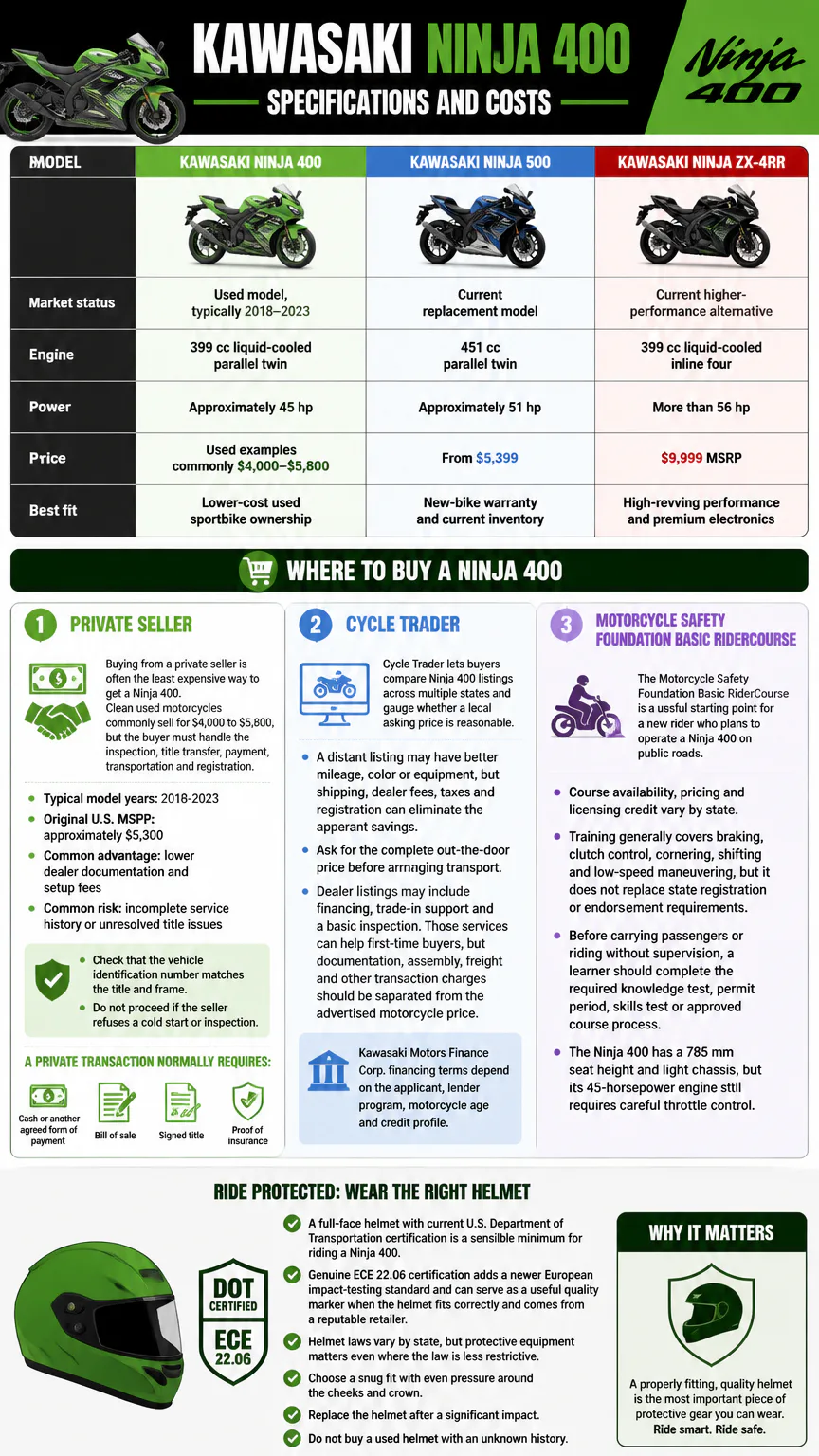
| Attribute | Kawasaki Ninja 400 | Kawasaki Ninja 500 | Kawasaki Ninja ZX-4RR |
|---|---|---|---|
| Market status | Used model, typically 2018–2023 | Current replacement model | Current higher-performance alternative |
| Engine | 399 cc liquid-cooled parallel twin | 451 cc parallel twin | 399 cc liquid-cooled inline four |
| Power | Approximately 45 hp | Approximately 51 hp | More than 56 hp |
| Price | Used examples commonly $4,000–$5,800 | From $5,399 | $9,999 MSRP |
| Best fit | Lower-cost used sportbike ownership | New-bike warranty and current inventory | High-revving performance and premium electronics |
Private seller
Buying from a private seller is often the least expensive way to get a Ninja 400. Clean used motorcycles commonly sell for $4,000 to $5,800, but the buyer must handle the inspection, title transfer, payment, transportation and registration. A private sale makes the most sense when you can assess the motorcycle yourself or pay for an independent inspection before handing over the money.
- Typical model years: 2018-2023
- Original U.S. MSRP: approximately $5,300
- Common advantage: lower dealer documentation and setup fees
- Common risk: incomplete service history or unresolved title issues
Check that the vehicle identification number matches the title and frame. Do not proceed if the seller refuses a cold start or inspection. A private transaction normally requires cash or another agreed form of payment, a bill of sale, a signed title and proof of insurance.
Cycle Trader
Cycle Trader lets buyers compare Ninja 400 listings across multiple states and gauge whether a local asking price is reasonable. A distant listing may have better mileage, color or equipment, but shipping, dealer fees, taxes and registration can eliminate the apparent savings. Ask for the complete out-the-door price before arranging transport.
Dealer listings may include financing, trade-in support and a basic inspection. Those services can help first-time buyers, but documentation, assembly, freight and other transaction charges should be separated from the advertised motorcycle price. Kawasaki Motors Finance Corp. financing terms depend on the applicant, lender program, motorcycle age and credit profile.
Motorcycle Safety Foundation Basic RiderCourse
The Motorcycle Safety Foundation Basic RiderCourse is a useful starting point for a new rider who plans to operate a Ninja 400 on public roads. Course availability, pricing and licensing credit vary by state. Training generally covers braking, clutch control, cornering, shifting and low-speed maneuvering, but it does not replace state registration or endorsement requirements.
Before carrying passengers or riding without supervision, a learner should complete the required knowledge test, permit period, skills test or approved course process. The Ninja 400 has a 785 mm seat height and light chassis, but its 45-horsepower engine still requires careful throttle control.
DOT and ECE 22.06 helmet
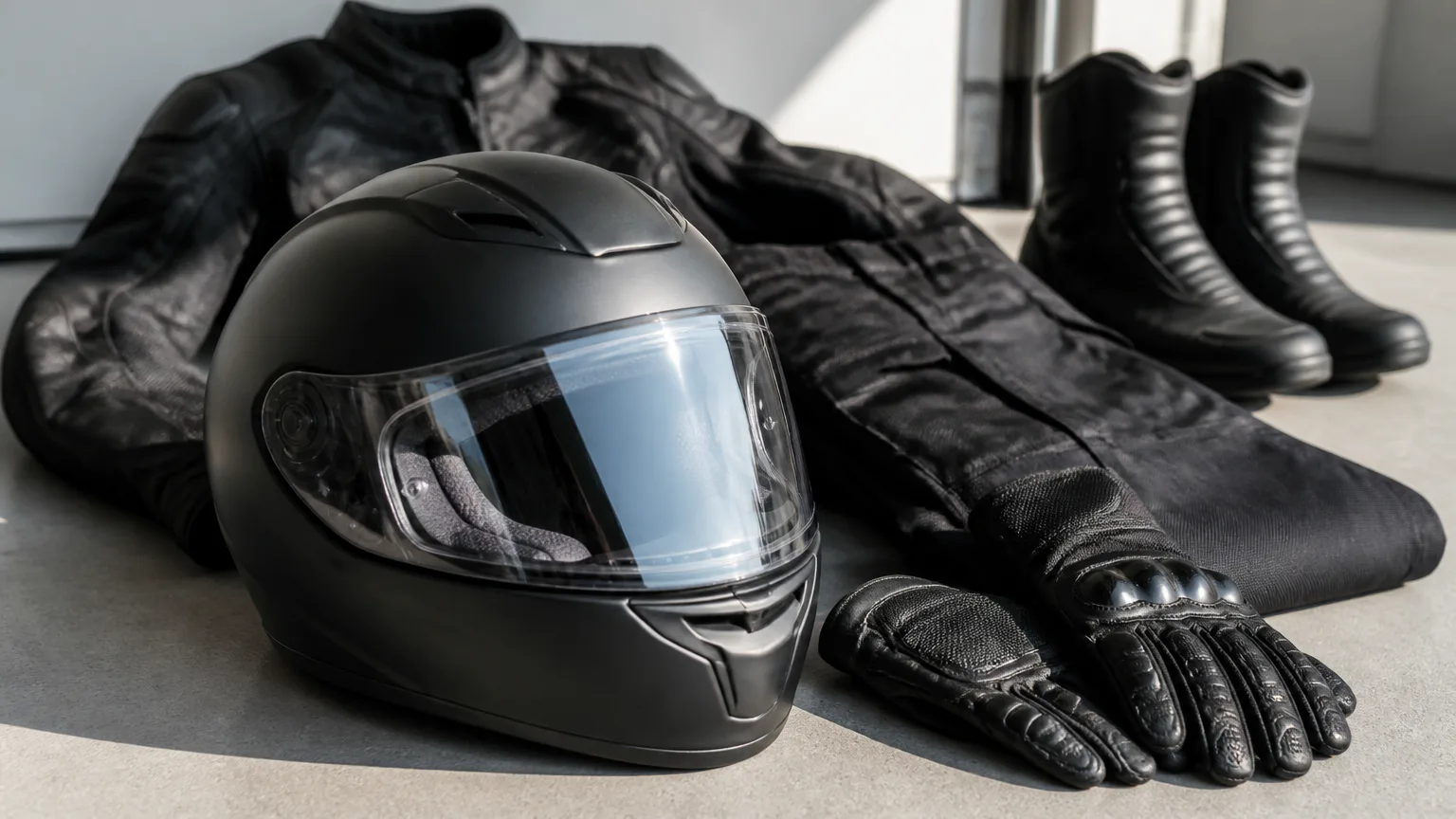
A full-face helmet with current U.S. Department of Transportation certification is a sensible minimum for riding a Ninja 400. Genuine ECE 22.06 certification adds a newer European impact-testing standard and can serve as a useful quality marker when the helmet fits correctly and comes from a reputable retailer. Helmet laws vary by state, but protective equipment matters even where the law is less restrictive.
- Choose a snug fit with even pressure around the cheeks and crown.
- Replace the helmet after a significant impact.
- Do not buy a used helmet with an unknown history.
- Match the helmet to your riding position, noise tolerance and climate.
Protective gloves, a motorcycle jacket, riding pants and over-the-ankle boots complete the basic equipment package. Include those costs in the purchase budget even though they are separate from the motorcycle’s sale price.
Requirements and context
The Ninja 400 is no longer Kawasaki’s current U.S. lightweight sportbike. The Kawasaki Ninja 500 replaced it with a 451 cc parallel-twin engine, approximately 51 horsepower and base pricing of $5,399. The Ninja 500 ABS is listed at $5,799, while the Ninja 500 SE ABS is listed at $6,499 before destination, setup, tax and documentation charges.
The Kawasaki Ninja ZX-4RR serves a different purpose. Its 399 cc liquid-cooled inline-four produces more than 56 horsepower and revs beyond 16,000 rpm. It also includes equipment such as a Showa SFF-BP fork, BFRC lite rear shock, quick shifter, traction control, power modes and a color TFT display. Its $9,999 MSRP puts it well above a used Ninja 400.
A Kawasaki Ninja 400 ABS is worth choosing when the price difference is reasonable. ABS can reduce the chance of wheel lock during hard braking or on wet pavement. Before buying, confirm the model-specific equipment and check the dashboard or wheel-speed hardware. A Kawasaki dealer can identify model-year equipment, inspect a trade-in, arrange financing and process registration, but dealer fees increase the final cost.
What the Ninja 400 is like to ride
The Ninja 400 uses a 399 cc liquid-cooled parallel-twin engine that produces approximately 45 horsepower at 10,000 rpm and about 28 lb-ft of torque. Power delivery remains predictable at low rpm and becomes more energetic as the engine builds revs. That gives newer riders room to develop their skills without making the motorcycle feel weak on ordinary highways.
Performance estimates put top speed near 115 mph and 0-60 mph acceleration near 4.1 seconds. Rider weight, wind, elevation, tires, gearing and motorcycle condition all affect those figures, so treat them as reference points rather than guarantees.
The steel trellis frame, 41 mm conventional telescopic fork and preload-adjustable linkage rear shock give the Ninja 400 neutral handling for commuting and back-road riding. A 310 mm semi-floating front disc with Nissin equipment provides strong braking feel. The assist and slipper clutch reduces lever effort and helps control rear-wheel hop during aggressive downshifts.
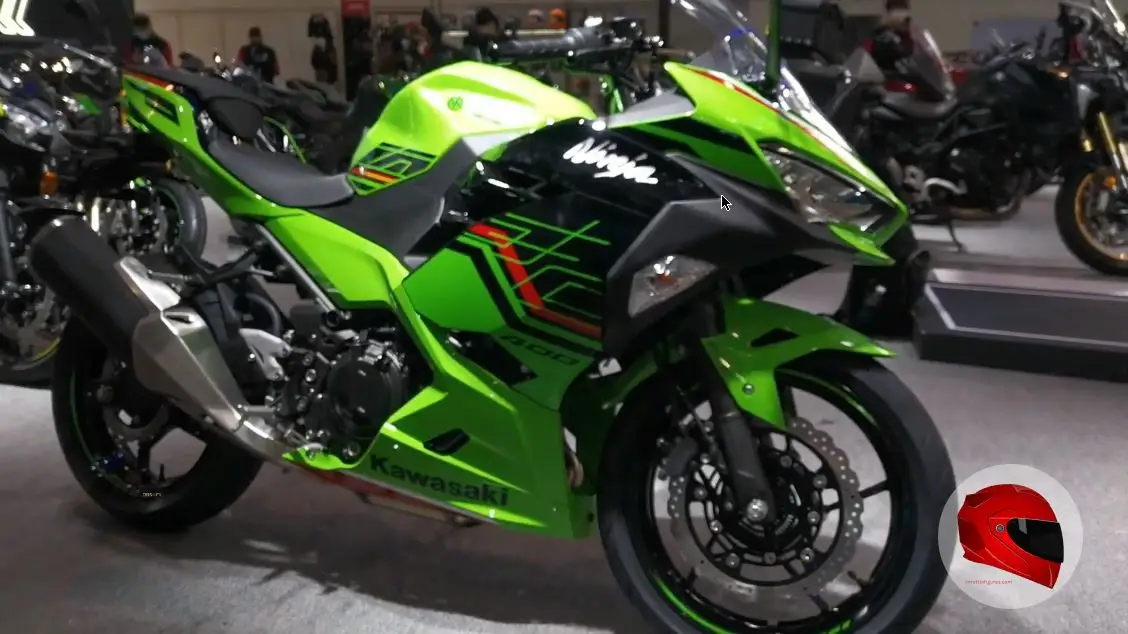
At 368 pounds wet and with a 30.9-inch (785 mm) seat height, the Ninja 400 is easy to move around a parking lot and less intimidating than heavier middleweight motorcycles. The riding position is sportier than a standard motorcycle but remains usable for commuting. Full LED lighting, a 14-liter fuel tank and typical fuel economy of 50 to 60 mpg support everyday riding.
The Kawasaki Ninja 400 feels lively because its modest peak horsepower is paired with a relatively light curb weight. That balance makes it responsive through corners and during everyday acceleration without feeling as intimidating as a larger bike. Comparing motorcycle power-to-weight ratios helps put its performance alongside heavier middleweights and high-output sportbikes.
Is the Ninja 400 still worth buying?
Yes, if the used price matches the motorcycle’s age and condition. The Ninja 400 suits riders who want a lightweight twin-cylinder sportbike, affordable consumables, accessible ergonomics and a large supply of replacement parts. It becomes less appealing when a nearly new Ninja 500 is available locally for only a small difference after fees.
- Buy it for: commuting, first-bike ownership, weekend riding, training and low-cost sportbike performance.
- Check carefully: crash damage, neglected chain maintenance, worn tires, missing service records and non-factory electrical modifications.
- Prefer ABS: especially for wet-weather commuting, emergency braking or a newer rider.
- Compare the Ninja 500: when you want a new warranty, current inventory or dealer financing.
- Consider the ZX-4RR: when high-revving performance and premium chassis electronics justify the larger budget.
Annual ownership costs commonly reach $1,000 to $1,500 before fuel, financing and major damage. Experienced riders may pay approximately $300 to $700 per year for insurance, while new riders, younger riders and riders in high-cost states can pay substantially more.
How to buy a used Ninja 400
Calculate the total cost instead of focusing only on the advertised motorcycle price. A used bike may require tax, title and registration charges, insurance, transportation, protective gear, immediate maintenance and possibly a battery or tires before the first ride.
- Set a complete budget that includes purchase fees, gear, insurance and initial service.
- Compare local private listings with Cycle Trader inventory and dealer offers.
- Request the VIN, title status, mileage, service records and details of any crash or track use.
- Inspect the motorcycle cold, or pay a qualified technician for a pre-purchase inspection.
- Get the final price, financing rate, dealer fees, shipping charge and delivery terms in writing.
- Arrange insurance before riding and complete the title, registration and endorsement requirements.
Cash is usually simplest for a private transaction. Dealer financing can suit buyers who need a structured payment plan or trade-in, although some lenders offer less favorable terms for an older discontinued motorcycle than for current dealer inventory.
A low asking price does not automatically make a Ninja 400 a good deal. Service history, cold-start behavior, tire age, chain condition and clean paperwork can have a major effect on the final cost. Inspect each bike in the same order so you can compare private sellers with dealers without missing expensive maintenance issues. A used motorcycle buying checklist can help you keep track of these details during the viewing and test ride.
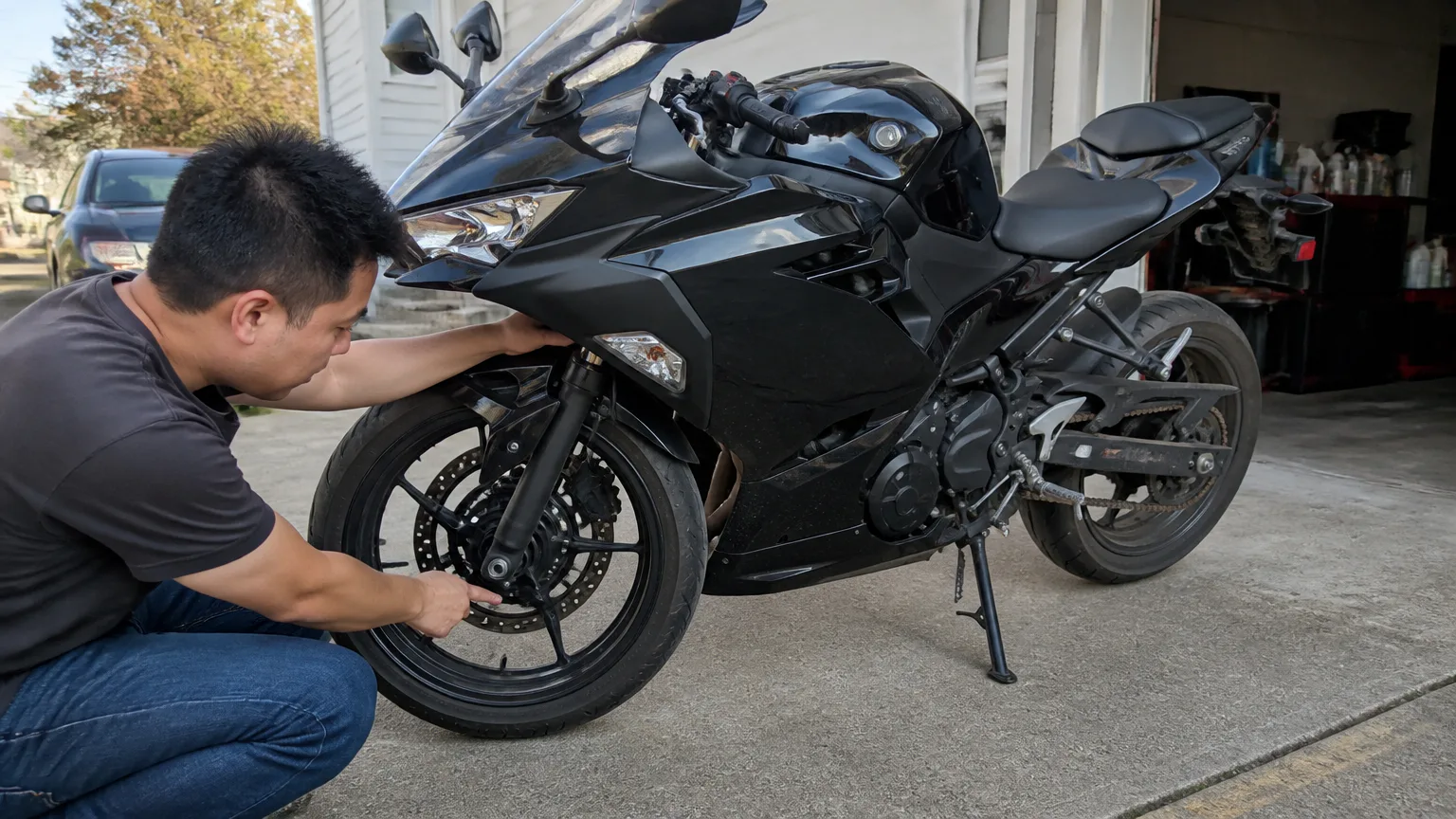
Used Ninja 400 inspection checklist
A clean appearance does not prove that a motorcycle is mechanically sound. Inspect the Ninja 400 in daylight, ask for a cold start and compare the VIN on the steering head, frame and title.
- Confirm a clear title, matching VIN, current registration status and seller identity.
- Check for bent levers, scraped engine covers, mismatched body panels and damaged bar ends.
- Look for fork-tube leaks, steering-head play, swingarm play and rear-shock damage.
- Inspect chain slack, sprocket teeth, brake-pad thickness and disc surface condition.
- Check tire date codes, tread depth, cracks and uneven wear. Tire life is commonly 5,000 to 8,000 miles, and replacement costs approximately $300 to $400 installed.
- Start the engine cold and listen for abnormal noise, an unstable idle, smoke or warning lights.
- Test the clutch, gearbox, brakes, lighting, instrument cluster, cooling fan and charging system.
- Ask for evidence of oil changes and the major valve-clearance inspection.
The engine holds approximately 2.2 quarts of 10W-40 oil. Basic annual maintenance can stay under $150, but the valve-clearance inspection is due at approximately 15,000 miles and may cost more than routine oil service. The first scheduled service commonly costs $150 to $250.
FAQs
Is the Kawasaki Ninja 400 discontinued?
Yes. Kawasaki replaced the Ninja 400 with the Ninja 500 in the U.S. lineup. Model years 2018-2023 remain common on the used market, although some remaining dealer stock may still exist.
How much horsepower does the Ninja 400 have?
The Ninja 400 produces approximately 45 horsepower at 10,000 rpm. Output varies slightly by market, testing method, fuel and drivetrain losses.
What is the Ninja 400 top speed?
Top speed is approximately 115 mph under favorable conditions. Rider weight, wind, elevation, gearing, tires and mechanical condition affect the result.
Is the Ninja 400 good for beginners?
Yes. Its manageable weight, moderate seat height, predictable parallel-twin engine and light clutch make it approachable. New riders still need formal training, protective gear and gradual practice before riding in difficult traffic.
The Ninja 400 suits new riders because its moderate weight, predictable power delivery and manageable dimensions leave room to build confidence and technique. The right first bike still depends on your inseam, riding environment, low-speed confidence and ability to handle the motorcycle comfortably at a stop. Consider those tradeoffs in a first motorcycle guide before choosing a bike with a sport-oriented riding position.
How much does a used Ninja 400 cost?
Used prices commonly fall between $4,000 and $5,800 in the United States. Mileage, ABS, model year, service history, modifications, regional demand and crash damage can move the price outside that range.
Conclusion
The Kawasaki Ninja 400 remains a sensible used sportbike when you find a well-documented, undamaged example at the right price. Compare its total cost with a new Ninja 500, prioritize ABS and inspection quality, and set aside money for tires, scheduled maintenance, insurance, registration and proper riding gear.