How to Store a Motorcycle for the Winter
Winter storage protects a motorcycle from corrosion, stale fuel, battery failure, tire damage and pests during months of inactivity. The routine depends on the fuel system, battery access, storage temperature and whether electricity is available. Clean the motorcycle, treat the fuel, change the necessary fluids, maintain the tires and battery, and use a breathable cover before putting the bike away.
Motorcycle Winter Storage Steps
- Check the owner’s manual for model-specific storage instructions, fluid capacities, battery procedures and fuel-system requirements.
- Wash the motorcycle thoroughly to remove road grime and salt. Dry the brake discs and hidden areas completely, then wax painted and chrome surfaces.
- Add the recommended amount of fuel stabilizer, such as STA-BIL or Sea Foam, to a nearly empty tank. Fill the tank with fresh gasoline and run the engine for 5-10 minutes.
- Drain the old motor oil, replace the oil filter, refill with clean engine oil and run the engine briefly to circulate it.
- Check the coolant level, inspect for leaks and confirm freeze protection. Inspect the brake fluid and replace DOT 4 fluid when its service interval requires it.
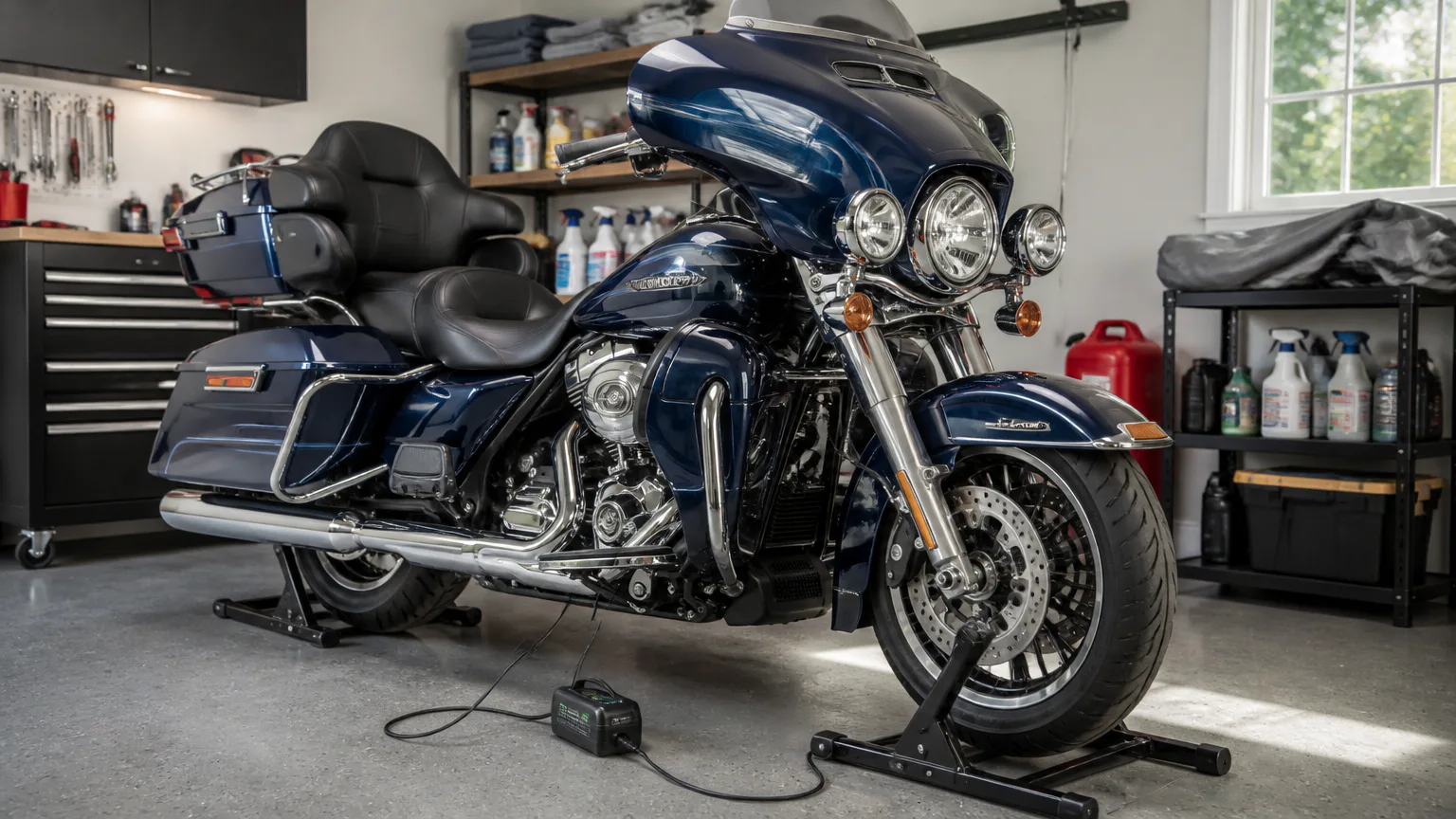
- Disconnect or remove the battery, then connect a smart maintainer such as Battery Tender or NOCO Genius throughout storage.
- Inflate the front and rear tires to the manufacturer’s recommended pressures. Place the motorcycle on stands when available.
- Clean and lubricate the chain, inspect the belt drive for damage and tension, and protect suitable unpainted metal from corrosion.
- Block the exhaust outlets and air intakes, place the motorcycle on a moisture barrier, cover it with a breathable motorcycle cover and store it in a dry, secure location.
Clean and Dry the Motorcycle
Wash away road salt, brake dust, bugs, mud and oily grime before the motorcycle sits unused. These contaminants hold moisture against paint, chrome, fasteners and aluminum surfaces, allowing corrosion to continue under the cover. Clean the underside, wheels, swingarm and frame as well as the visible bodywork.
- Rinse loose dirt away before wiping painted surfaces.
- Clean the wheels, chain area, engine cases, brake components and underside.
- Dry the motorcycle with a clean towel or low-pressure air.
- Dry the brake discs, rotors, seams, controls and recessed areas completely.
- Wax painted surfaces and apply rust inhibitor or silicone spray to suitable unpainted metal.
Keep rust inhibitor, silicone spray, grease and wax away from brake rotors, brake pads, tires and other friction surfaces. A final short ride before storage can evaporate trapped water, but let hot components cool before covering the motorcycle.
Change Oil and Check Coolant
Old engine oil may contain fuel dilution, moisture, acids and combustion byproducts that remain against internal parts during storage. Changing the oil and filter before parking leaves cleaner lubricant in the engine. Follow the motorcycle’s specified oil grade and capacity rather than treating one viscosity as universal.
- Engine oil: Change it before storage when it contains contaminants or the motorcycle has accumulated significant seasonal mileage.
- Oil filter: Replace the filter during the oil change, then run the engine briefly so fresh oil circulates.
- Coolant: Check the level, inspect for leaks and confirm freeze protection before temperatures drop below freezing.
- DOT 4 brake fluid: Replace it according to the service interval because it absorbs water. A two-year interval is common.
Temperatures below 32°F generally do not damage a properly winterized engine when the coolant and battery receive the correct care. Avoid starting the motorcycle repeatedly for a few minutes during storage. Short runs can create condensation without bringing the entire engine and exhaust system to operating temperature.
Stabilize Fuel Before Storage
Gasoline deteriorates during prolonged inactivity and can leave residue that clogs carburetor passages, injectors, filters and other fuel-system components. A full tank also reduces the air space where condensation can form, helping limit internal tank corrosion. Use a stabilizer formulated for the motorcycle’s fuel system and follow the label dosage.
- Add STA-BIL or Sea Foam immediately before the final fill-up.
- Fill the fuel tank with fresh gasoline to reduce condensation and corrosion.
- Run the engine for 5-10 minutes so treated fuel reaches the fuel lines, carburetors or injectors.
- Shut the engine down normally and let the exhaust system cool before covering the motorcycle.
Draining the fuel system may suit museum-like storage or periods longer than approximately six months when the motorcycle’s design and manual support that procedure. Do not drain the system automatically. Some tanks and fuel systems benefit from being full, while some carbureted motorcycles require specific draining steps.
Maintain the Motorcycle Battery
A motorcycle battery gradually discharges while the bike is parked, and cold conditions reduce available cranking power. Disconnecting or removing the battery limits parasitic drain. A smart battery maintainer is safer for long-term use than an uncontrolled charger because it regulates charging and maintenance modes automatically.
- Turn the ignition off and identify the positive and negative battery terminals.
- Disconnect or remove the battery according to the owner’s manual.
- Store a removed battery in a dry, temperature-stable location away from extreme heat and freezing conditions.
- Connect a Battery Tender or NOCO Genius to the battery terminals, or charge the disconnected battery indoors.
- Inspect the charger connection periodically for damage, heat or loose terminals.
When electricity is unavailable, check the battery and recharge it approximately monthly with a suitable motorcycle charger. Keep charging equipment dry, select the correct battery mode and keep the charger away from fuel vapors and water.
Protect Tires, Chain, and Belt
Correct tire pressure reduces the risk of deformation during storage. Inflate both tires to the motorcycle manufacturer’s recommended pressure with an accurate gauge, then check them again after the motorcycle has been parked for a day. Front and rear stands provide the most effective protection against long-term contact stress and flat spots.
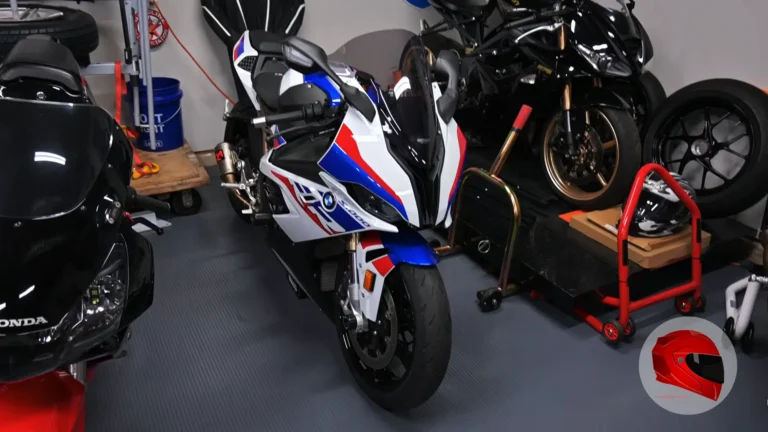
- Use front and rear stands when they are compatible with the motorcycle and available.
- Move the motorcycle periodically to change the tire contact patch when stands cannot be used.
- Clean the chain with an O-ring-safe degreaser and lubricate it before storage.
- Inspect a belt drive for chips, cuts, fraying, missing teeth and incorrect tension.
- Place plywood, carpet or a rubber mat under the tires and metal components on damp concrete.
Do not rely on an inaccurate pressure gauge or allow the tires to sit underinflated for months. Keep chain lubricant, silicone and rust inhibitor off the tire tread, brake rotors and brake pads.
Block Pests and Cover the Bike
Rodents and insects can enter through exhaust outlets, air intakes and other openings while a motorcycle is parked. Block or plug those openings after the engine and exhaust have cooled. Use barriers that are easy to see and remove, since every plug must be removed before the first ride.
- Cover or plug each exhaust outlet.
- Block accessible air-intake openings without restricting parts that must remain ventilated.
- Remove every plug before reconnecting the battery or starting the engine.
- Use a breathable motorcycle cover that allows moisture to escape.
- Avoid plastic covers and tarps that trap condensation and promote rust, corrosion and mold.
Keep food, oil-soaked rags and nesting material away from the storage area. A cover protects against dust and incidental moisture, but it cannot correct a damp location or replace pest inspections.
Compare Winter Storage Locations
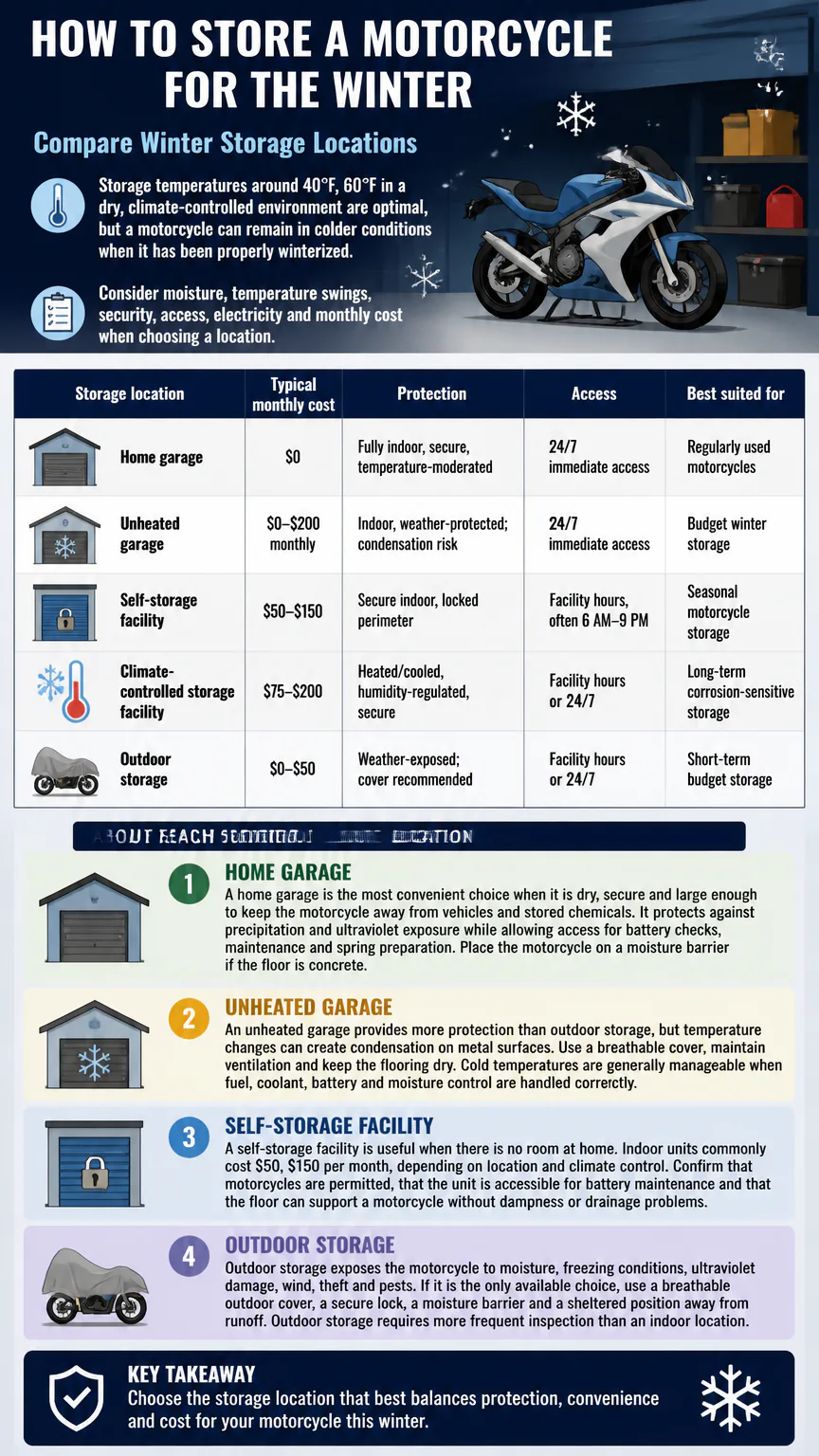
Storage temperatures around 40°F, 60°F in a dry, climate-controlled environment are optimal, but a motorcycle can remain in colder conditions when it has been properly winterized. Consider moisture, temperature swings, security, access, electricity and monthly cost when choosing a location.
| Storage location | Typical monthly cost | Protection | Access | Best suited for |
|---|---|---|---|---|
| Home garage | $0 | Fully indoor, secure, temperature-moderated | 24/7 immediate access | Regularly used motorcycles |
| Unheated garage | $0–$200 monthly | Indoor, weather-protected; condensation risk | 24/7 immediate access | Budget winter storage |
| Self-storage facility | $50–$150 | Secure indoor, locked perimeter | Facility hours, often 6 AM–9 PM | Seasonal motorcycle storage |
| Climate-controlled storage facility | $75–$200 | Heated/cooled, humidity-regulated, secure | Facility hours or 24/7 | Long-term corrosion-sensitive storage |
| Outdoor storage | $0–$50 | Weather-exposed; cover recommended | Facility hours or 24/7 | Short-term budget storage |
Home garage
A home garage is the most convenient choice when it is dry, secure and large enough to keep the motorcycle away from vehicles and stored chemicals. It protects against precipitation and ultraviolet exposure while allowing access for battery checks, maintenance and spring preparation. Place the motorcycle on a moisture barrier if the floor is concrete.
Unheated garage
An unheated garage provides more protection than outdoor storage, but temperature changes can create condensation on metal surfaces. Use a breathable cover, maintain ventilation and keep the flooring dry. Cold temperatures are generally manageable when fuel, coolant, battery and moisture control are handled correctly.
Self-storage facility
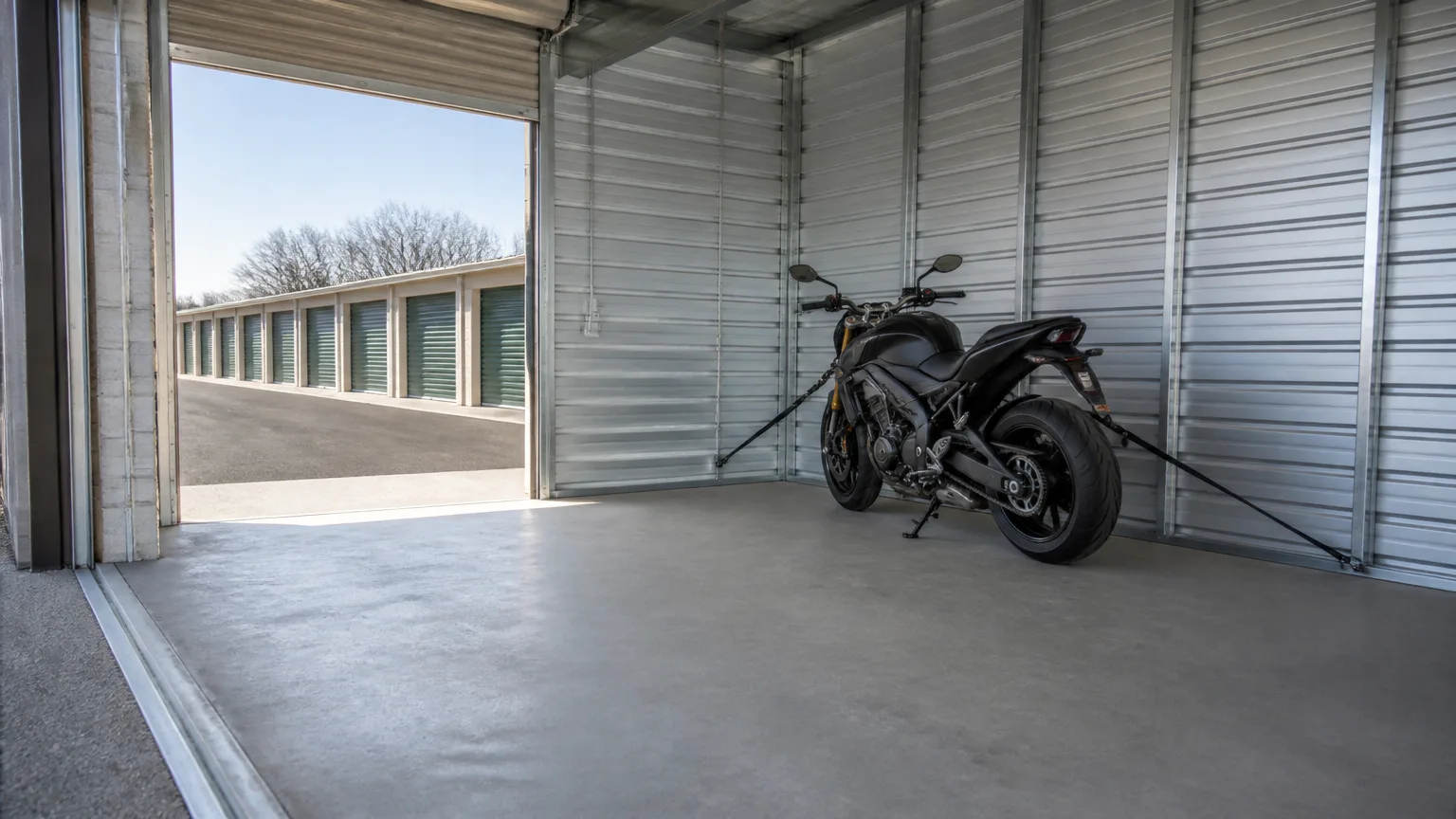
A self-storage facility is useful when there is no room at home. Indoor units commonly cost $50, $150 per month, depending on location and climate control. Confirm that motorcycles are permitted, that the unit is accessible for battery maintenance and that the floor can support a motorcycle without dampness or drainage problems.
Outdoor storage
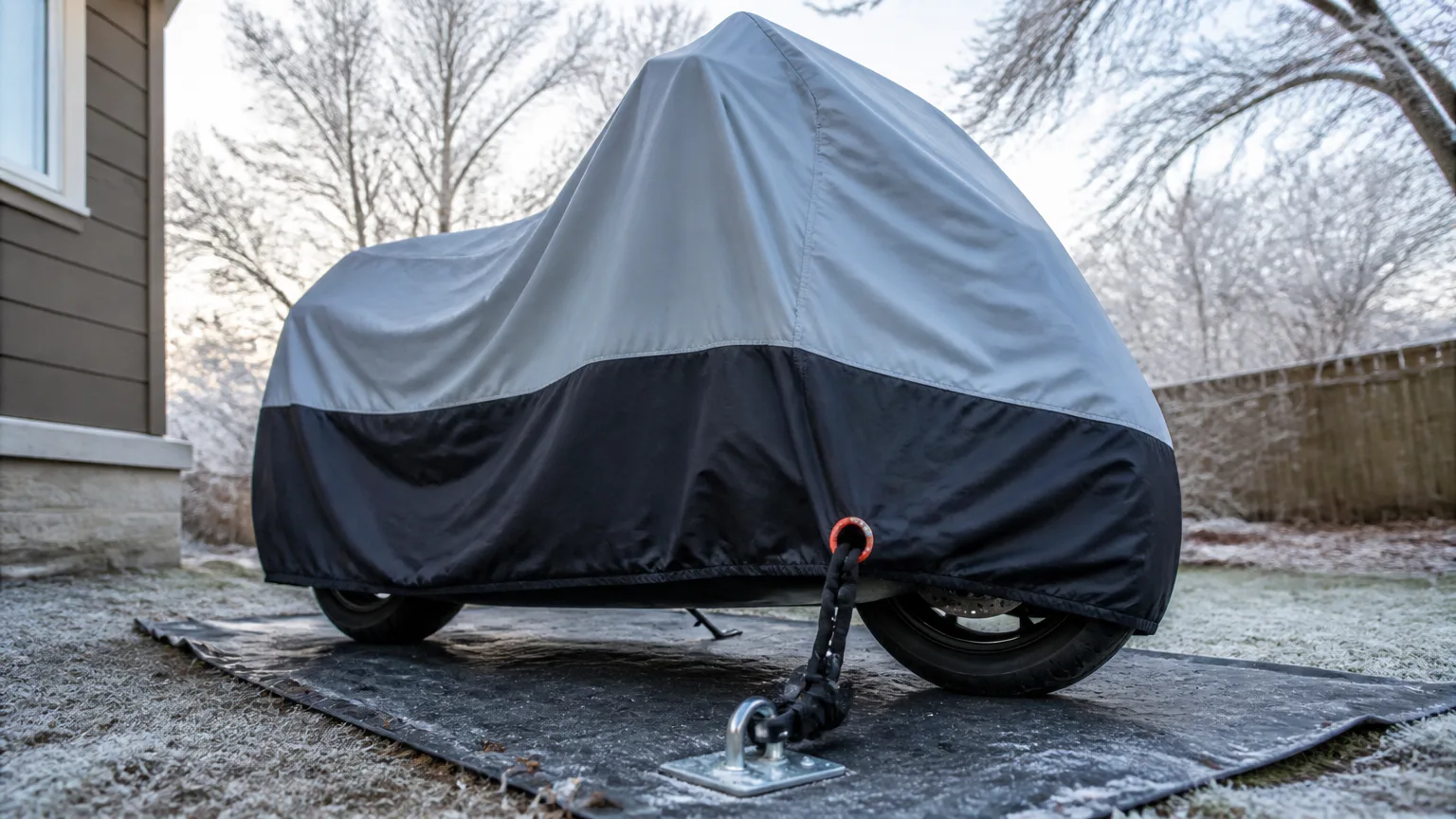
Outdoor storage exposes the motorcycle to moisture, freezing conditions, ultraviolet damage, wind, theft and pests. If it is the only available choice, use a breathable outdoor cover, a secure lock, a moisture barrier and a sheltered position away from runoff. Outdoor storage requires more frequent inspection than an indoor location.
Avoid Common Winter Storage Mistakes
Storage problems usually begin with contaminants, moisture, untreated fuel or a weak battery left unattended. Other shortcuts can create hazards when the motorcycle returns to service. Complete this check before closing the storage area:
- Do not park the motorcycle with untreated gasoline in the fuel system.
- Do not cover a wet motorcycle or use a plastic cover that traps moisture.
- Do not leave the tires underinflated for the entire storage period.
- Do not put rust inhibitor, chain lubricant or silicone on brake rotors or tire tread.
- Do not leave the battery connected without a charging plan.
- Do not perform repeated short cold starts during storage.
- Do not forget to remove exhaust and intake plugs before riding.
Take photographs of battery connections, plug locations and disconnected hoses if the procedure is unfamiliar. Keep the owner’s manual with the motorcycle so spring reassembly follows the correct model-specific sequence.
Check the Motorcycle Each Month
Monthly checks can reveal moisture, pests, battery problems and tire-pressure loss before they lead to expensive repairs. The motorcycle does not need to be started during each inspection. If a maintainer is connected, inspect the equipment rather than repeatedly running the engine.
- Check the cover for trapped moisture, tears and contact with wet surfaces.
- Inspect the floor, exhaust, airbox area and nearby storage space for rodent activity.
- Confirm that the battery maintainer is connected correctly and remains dry.
- Measure tire pressure and inspect for cracking, damage or a developing flat spot.
- Look for oil, coolant, brake-fluid or fuel leaks.
- Move the motorcycle periodically when stands are unavailable.
Keep the inspection brief and avoid opening the fuel system unnecessarily. If the storage area becomes damp, improve ventilation or move the motorcycle before corrosion develops.
Prepare for the First Spring Ride
Spring preparation is a safety inspection, not simply a battery reconnection. Return the motorcycle to service gradually, especially if it spent several months in an unheated or outdoor location.
- Remove all exhaust and air-intake plugs, covers and storage materials.
- Reconnect or reinstall the fully charged battery and confirm terminal security.
- Check the engine oil, coolant, brake fluid and fuel. Inspect visible hoses for correct levels and leaks.
- Measure tire pressure and inspect both tires for cracking, damage and flat spots.
- Inspect the chain or belt, controls, cables, lights, mirrors and fasteners.
- Apply the front and rear brakes while stationary to confirm normal lever and pedal feel.
- Start the motorcycle in a ventilated area and check for warning lights, leaks, unusual noises and a stable idle.
- Test the brakes, steering, clutch, throttle and lights at low speed before entering traffic.
Remove any old fuel if it smells stale or shows contamination, and follow the motorcycle’s manual for fuel-system service. Delay the first longer ride until the motorcycle operates normally and all safety controls respond correctly.
FAQs
What is the 12-second rule on a motorcycle?
The 12-second rule is a riding-awareness practice: scan at least 12 seconds ahead for traffic, road hazards and escape paths. It applies to riding technique rather than winter storage, but it is useful during the cautious first rides after seasonal storage.
How long can a motorcycle sit unused?
A motorcycle can sit unused for several months when its fuel, oil, battery, tires, drivetrain and storage environment are prepared correctly. For storage longer than approximately six months, review the model-specific fuel procedure and pay closer attention to the battery, tires and moisture control.
What temperature is too cold for a motorcycle?
There is no single temperature at which every motorcycle becomes unsafe to store. Temperatures below 32°F generally do not damage a properly winterized motorcycle when the coolant has adequate freeze protection and the battery is cared for. Repeated temperature swings increase condensation risk.
Is it safe to store a motorcycle outside in winter?
Outdoor storage provides less protection because the motorcycle faces moisture, freezing conditions, UV exposure, wind, theft and pests. It can be done with a breathable outdoor cover, secure anchoring, a moisture barrier, fuel and battery preparation, and regular inspections, but an indoor location is safer for long storage.
Conclusion
Prepare the motorcycle before the final storage day: clean and dry it, stabilize the fuel, change contaminated fluids, maintain the battery, protect the tires and drivetrain, and keep moisture and pests out. A dry home garage is usually the simplest choice. Riders without reliable indoor space can use a self-storage facility costing $50, $150 monthly or a climate-controlled storage facility costing $75, $200.