Kawasaki Ninja H2R: Specs, Performance, Price & Track-only Ownership
Disclaimer: Performance figures may vary depending on factors such as rider, road and weather conditions, vehicle condition, and testing methods. Figures are provided for informational purposes only.
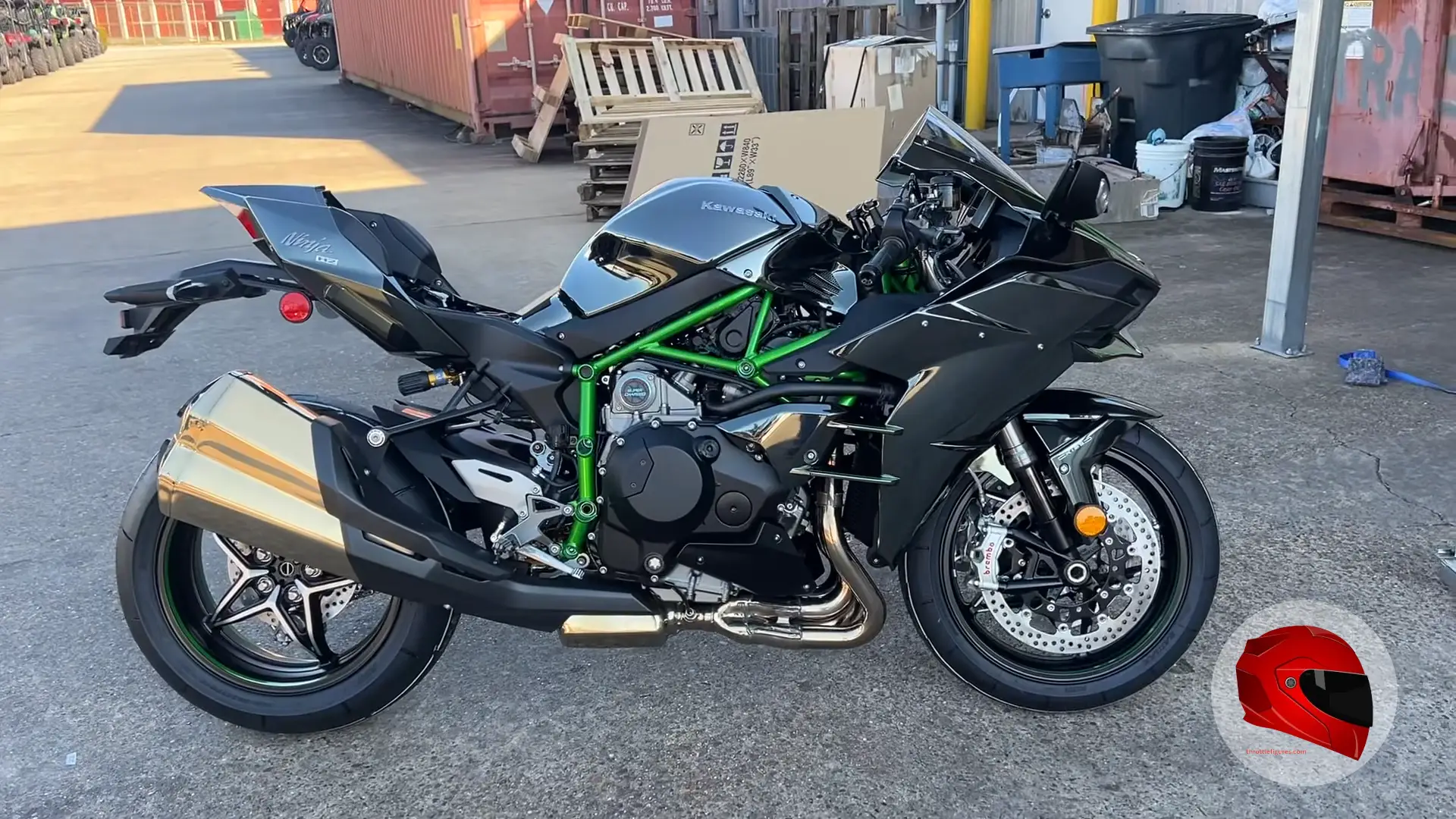
The 2026 Kawasaki Ninja H2R is a limited-production hypersport motorcycle built for closed-course use. Its base MSRP is $62,100 before destination, tax, setup and other transaction costs. Buying one also requires track access, transport, racing tires, support equipment and enough experience to handle a 322-hp machine responsibly.
Kawasaki Ninja H2R Specifications and Price
| Specification | 2026 Ninja H2R ABS |
|---|---|
| Manufacturer | Kawasaki Motors |
| Parent company | Kawasaki Heavy Industries |
| Production | 2015–present |
| Vehicle class | Track-only closed-course hypersport |
| Base MSRP | $62,100 |
| Destination charge | $840 |
| Total MSRP | $62,940 |
| Color | Mirror Coated Matte Spark Black |
| Engine | 998cc liquid-cooled 4-stroke inline-four |
| Valve train | DOHC, 16 valves |
| Bore x stroke | 76.0 × 55.0 mm |
| Compression ratio | 8.3:1 |
| Supercharger | Kawasaki centrifugal type; up to 2.4× atmospheric pressure |
| Fuel system | DFI, four 50mm throttle bodies, dual injection |
| Maximum horsepower | 322 hp at 14,000 rpm |
| Maximum torque | 121.5 lb-ft at 12,500 rpm |
| Top speed | Approximately 249 mph |
| Transmission | 6-speed return shift, dog-ring |
| Clutch | Wet multi-disc; hydraulic assist and slipper |
| Final drive | Sealed chain |
| Curb weight | 476.3 lb |
| Estimated dry weight | 432.2 lb |
| Fuel capacity | 4.5 gal |
| Wheelbase | 57.1 in |
| Seat height | 32.7 in |
| Ground clearance | 5.1 in |
| Overall length | 81.5 in |
| Overall width | 33.5 in |
| Overall height | 45.7 in |
| Rake and trail | 25.1°; 4.3 in |
| Frame type | High-tensile steel trellis |
| Front suspension | 43mm Kayaba AOS-II inverted fork; adjustable damping and preload |
| Rear suspension | Öhlins TTX36 gas-charged shock; remote preload adjuster |
| Front tire | 120/60-17 V01F racing slick |
| Rear tire | 190/65-17 V01R racing slick |
| Front brakes | Dual 330mm discs; Brembo M50 Monobloc calipers |
| Rear brakes | Single 250mm disc |
| Electronics | 6-axis IMU, KTRC, KLCM, KEBC, KIBS, quick shift |
| Operating status | Closed-course use only |
What Makes the H2R So Fast
The H2R uses a 998cc inline-four and a centrifugal supercharger instead of relying on engine displacement alone. The supercharger compresses intake air as engine speed rises, producing 322 hp at 14,000 rpm and 121.5 lb-ft of torque at 12,500 rpm. Its 8.3:1 compression ratio accommodates the forced-induction system.
A dog-ring transmission, sealed chain drive and electronic controls support the engine’s output. The electronics manage traction, launch behavior, engine braking and quick shifting. Aerodynamic winglets and a race-focused riding position help keep the motorcycle stable as speed increases. Top speed is approximately 205 mph, while 0-60 mph times depend on rider technique, launch settings, surface grip and tire temperature.
The chassis is set up for controlled track conditions. The 43mm Kayaba AOS-II fork has adjustable damping and preload, while the Öhlins TTX36 rear shock includes adjustable damping and a remote preload adjuster. Dual 330mm front discs with radial Brembo M50 Monobloc calipers provide the braking hardware needed for repeated high-speed deceleration.
Ninja H2R versus Ninja H2
| Model | Primary use | Legal status | Power focus | Road equipment |
|---|---|---|---|---|
| Ninja H2R | Closed-course performance | Track only | 322 hp | Not road equipped |
| Ninja H2 | Street and track riding | Street legal | Road-legal supercharged performance | Road equipment included |
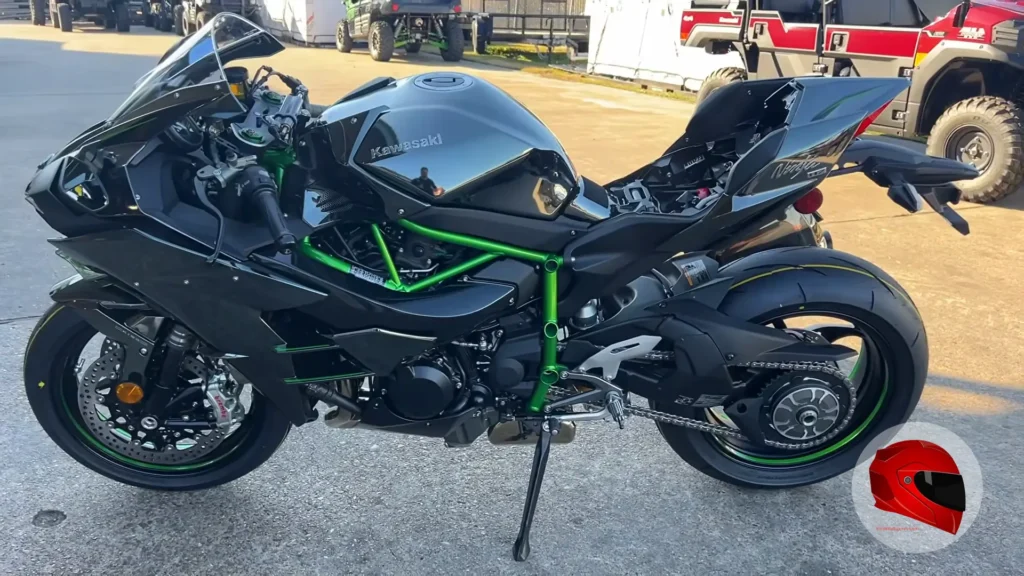
The Kawasaki Ninja H2 is the better choice for riders who want supercharged performance on public roads as well as at the track. It has the equipment and compliance required for registration and street use. The H2R is built around circuit performance, racing slicks and dedicated aerodynamic bodywork, so its operating environment is much narrower.
The Kawasaki Ninja H2 SX takes the same supercharged family in a different direction. It is a street-legal sport-touring motorcycle with a more comfortable riding position, touring equipment and electronic cruise control. It suits long-distance road riding but does not replace the H2R’s track-focused chassis and race tires.
With race-focused aerodynamics, slick tires and unrestricted performance, the H2R is a very different machine from the road-legal H2, despite their shared supercharged engine platform. The choice comes down to whether lap-time potential matters more than registration, road equipment and everyday usability. A detailed H2 versus H2R comparison can help clarify which model fits those priorities.
Why the Ninja H2R Is Track-Only
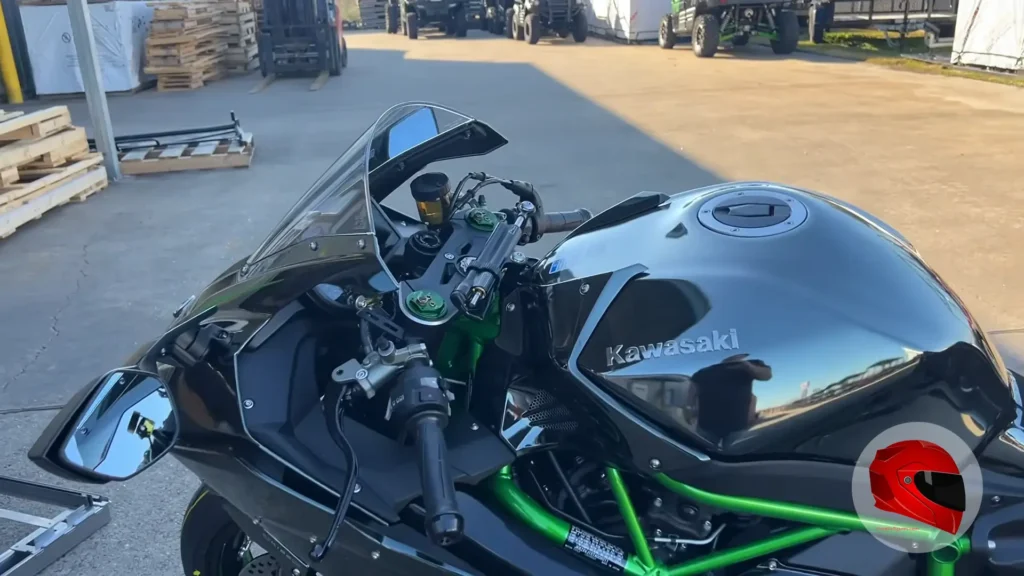
The H2R cannot be registered for normal public-road use in the United States. Kawasaki sells it as a closed-course motorcycle without the complete road equipment and highway compliance required of a street motorcycle. Obtaining a state title or registration does not turn it into a conventional road-legal bike.
- Use the motorcycle only at closed-course race tracks.
- Transport it to the circuit with a trailer, enclosed vehicle or professional motorcycle shipper.
- Do not ride it on public streets, even for a short distance between facilities.
- Choose a track that permits racing slicks and accommodates high-performance motorcycles such as the H2R.
- Carry the purchase documents and vehicle identification information required by the track, insurer, transporter or storage facility.
Track rules still apply after purchase. Noise limits, rider-group requirements, technical inspections and tire regulations vary by venue, so the track must be equipped to handle a closed-course superbike.
What You Need to Run an H2R
The motorcycle is only one part of an H2R track setup. It arrives with racing slicks and requires preparation before a session, along with transport and safety equipment that many street-bike owners do not already have.
- Closed-course race-track access
- Race trailer or enclosed motorcycle transport
- Motorcycle stands and tie-down equipment
- Tire warmers for bringing the racing slicks to operating temperature
- Track-approved fuel and a safe fueling container
- Full leather racing suit, back protector, gloves, boots and approved helmet
- Basic tools, spare levers, fluids and paddock supplies
- Qualified track support for suspension setup and tire-pressure adjustments
Racing slicks do not provide their intended grip when cold and are not suitable for public roads. Riders also need enough high-performance experience to manage the H2R’s acceleration, braking loads and electronic settings before attempting its highest speeds.
How to Buy a Kawasaki Ninja H2R
New allocations are limited, while used motorcycles appear through dealers, marketplaces and collector auctions. Treat the purchase as a specialized powersports transaction and budget for more than the advertised motorcycle price.
- Contact Authorized Kawasaki dealers about allocation availability and factory-order windows.
- Compare the $62,100 MSRP and $840 destination charge with setup fees, taxes, shipping and any dealer markup.
- Search Cycle Trader for dealer-listed new and used H2R motorcycles across the country.
- Use MotoHunt to locate current dealership inventory and pre-owned listings by region.
- Check Bring a Trailer for low-mileage and collector-owned H2R motorcycles offered through auctions.
- Request the VIN, ownership documents, maintenance records, storage history and crash history before committing to a used bike.
- Inspect the supercharger system, bodywork, winglets, wheels, brake components, suspension and slick tires.
- Arrange enclosed transport to your home, workshop or chosen circuit.
Very low mileage does not automatically make a used H2R a low-risk purchase. Long storage periods, aged tires, battery condition, fluid degradation and incomplete track preparation can all create immediate service costs.
H2R Ownership Costs and Risks
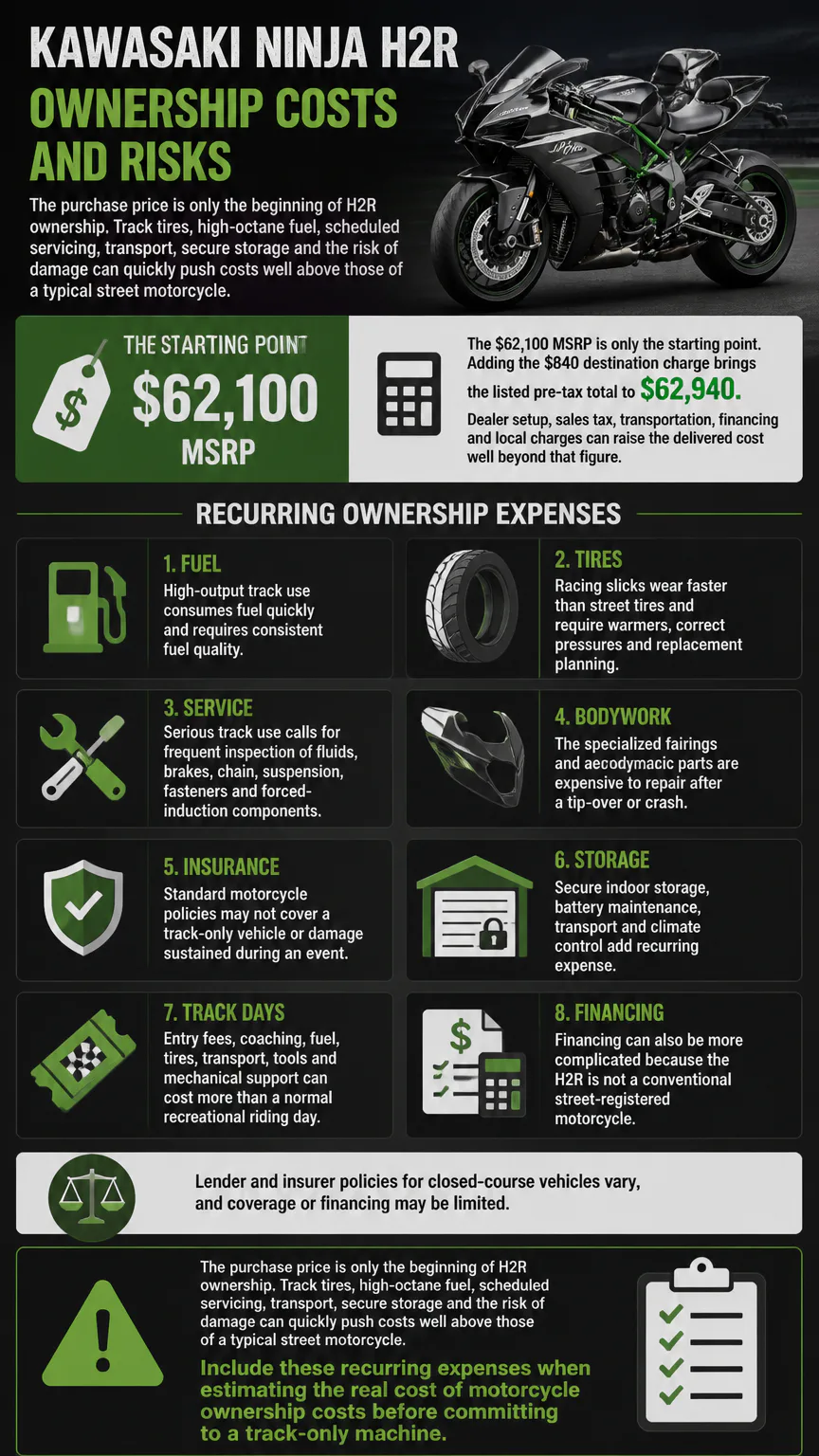
The $62,100 MSRP is only the starting point. Adding the $840 destination charge brings the listed pre-tax total to $62,940. Dealer setup, sales tax, transportation, financing and local charges can raise the delivered cost well beyond that figure.
- Fuel: High-output track use consumes fuel quickly and requires consistent fuel quality.
- Tires: Racing slicks wear faster than street tires and require warmers, correct pressures and replacement planning.
- Service: Serious track use calls for frequent inspection of fluids, brakes, chain, suspension, fasteners and forced-induction components.
- Bodywork: The specialized fairings and aerodynamic parts are expensive to repair after a tip-over or crash.
- Insurance: Standard motorcycle policies may not cover a track-only vehicle or damage sustained during an event.
- Storage: Secure indoor storage, battery maintenance, transport and climate control add recurring expense.
- Track days: Entry fees, coaching, fuel, tires, transport, tools and mechanical support can cost more than a normal recreational riding day.
Financing can also be more complicated because the H2R is not a conventional street-registered motorcycle. Lender and insurer policies for closed-course vehicles vary, and coverage or financing may be limited.
The purchase price is only the beginning of H2R ownership. Track tires, high-octane fuel, scheduled servicing, transport, secure storage and the risk of damage can quickly push costs well above those of a typical street motorcycle. Include these recurring expenses when estimating the real cost of motorcycle ownership costs before committing to a track-only machine.
Kawasaki Ninja H2R Pros and Cons
The H2R’s strengths matter most on a suitable circuit, where its supercharged engine, aerodynamic bodywork, racing tires and premium suspension can be used as intended. Its drawbacks matter more to buyers who want occasional recreational riding or simple ownership instead of a dedicated track program.
- Pros: 322 hp, approximately 205-mph top speed, centrifugal supercharger, premium Öhlins and Kayaba suspension, Brembo M50 front brakes, advanced chassis electronics and strong collector appeal. These features suit experienced riders who value outright performance and collectors looking for a distinctive Kawasaki flagship.
- Cons: No public-road use, racing slicks, specialized transport, high purchase price, expensive bodywork, demanding setup, limited track compatibility and substantial operating costs. Owners also need tire warmers, suitable safety gear, track access and enough experience to use the available performance responsibly.
The H2R is a poor fit for someone expecting one motorcycle to handle commuting, touring and occasional track days. It makes more sense for an experienced track rider or collector who accepts that preparation, maintenance and logistics are part of ownership.
Who Should Buy the Ninja H2R
The H2R suits an experienced track rider, collector or owner with regular access to a suitable closed-course facility. It is not a sensible first performance motorcycle because its power, tire requirements, braking capability and operating restrictions leave little room for casual use.
Choose the Ninja H2 if public-road access matters. Choose the Ninja H2 SX if touring comfort and cruise control matter more than race-track hardware. The H2R makes sense when its track-only status is the reason for buying it, not a restriction to work around.
The H2R suits experienced track riders who can handle its power, keep up with its running demands and access a suitable circuit regularly. Riders who want a highly capable liter-class superbike with wider parts support, more familiar handling and road registration may prefer a conventional alternative. The Kawasaki Ninja 10R guide offers a useful benchmark when comparing that option with the H2R’s specialized design.
FAQs
What is the price of H2R in Pakistan?
The 2026 U.S. base MSRP is $62,100, with an $840 destination charge before taxes and dealer costs. Pakistan does not have one equivalent factory price because shipping, import duties, taxes, compliance requirements, dealer margin and currency conversion affect the landed total.
Is the Kawasaki Ninja H2R a 2,000cc motorcycle?
No. The Ninja H2R uses a 998cc supercharged inline-four engine. Supercharging increases power output without increasing engine displacement to 2,000cc.
Is there a Kawasaki Ninja H2R toy?
Licensed and unlicensed toy replicas can appear in model and collectible markets, but availability and specifications vary by seller. They are unrelated to the operating requirements and performance of the full-size track motorcycle.
Conclusion
The Kawasaki Ninja H2R is a specialized track machine, not a street motorcycle with its road equipment removed. Buy it only if you have the experience, circuit access, transport, budget and support system to use its supercharged performance properly. Otherwise, the Ninja H2 or Ninja H2 SX is the more practical Kawasaki choice.