Yamaha R15: Specs, Performance, Generations, and U.S. Alternatives
Disclaimer: Performance figures may vary depending on factors such as rider, road and weather conditions, vehicle condition, and testing methods. Figures are provided for informational purposes only.
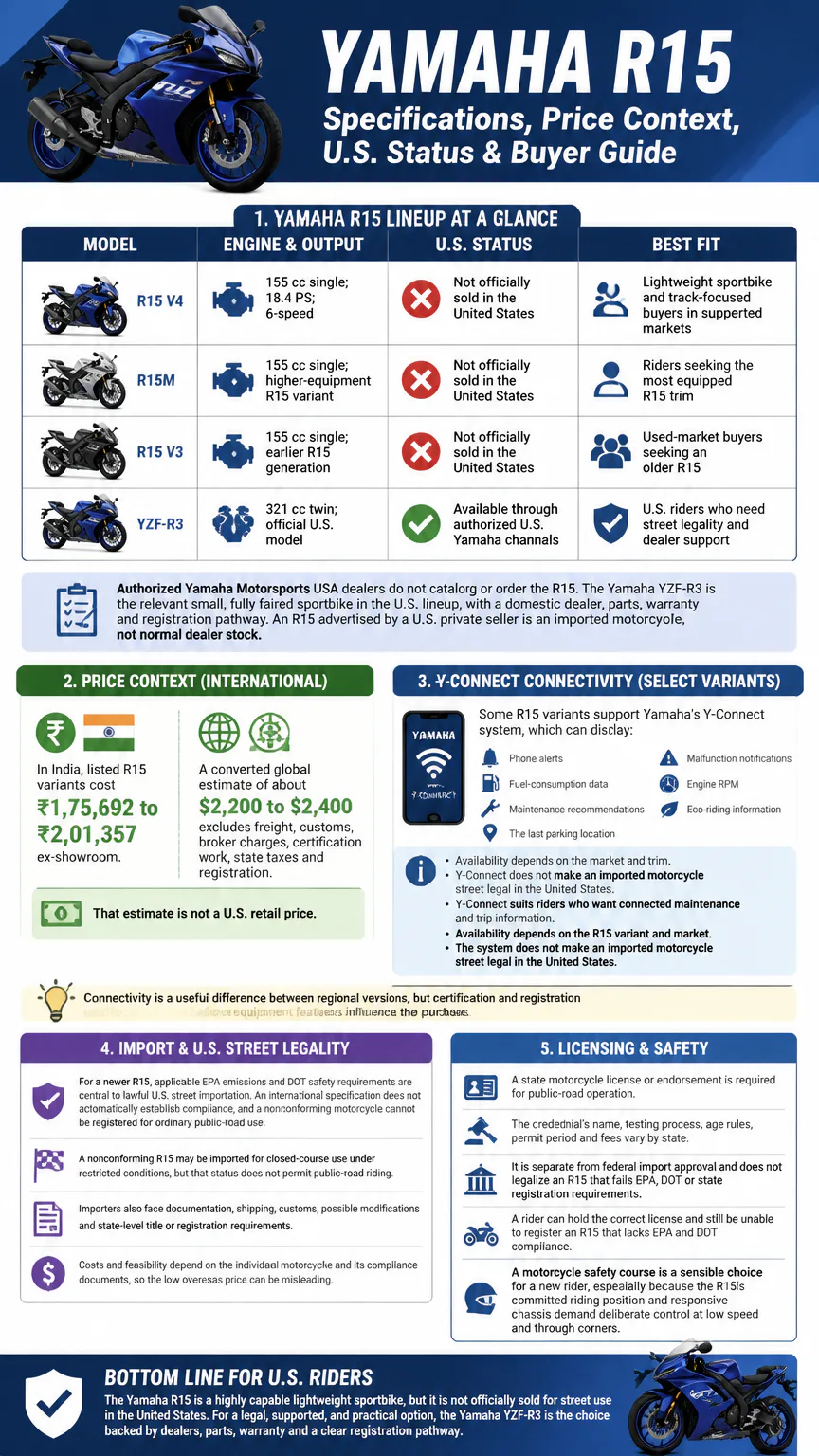
For U.S. riders, buying a Yamaha R15 involves more than choosing a lightweight sportbike. Its 155 cc VVA engine, compact chassis and sportbike equipment make it appealing for learning cornering technique and track riding. In 2026, however, street availability, import age, certification, licensing and the cost of a legal alternative determine whether an R15 is practical in the United States.
Yamaha R15 Specifications and Price Context
| Motorcycle | Engine and output | U.S. status | Best fit |
|---|---|---|---|
| Yamaha R15 V4 | 155 cc single; 18.4 PS; 6-speed | Not officially sold in the United States | Lightweight sportbike and track-focused buyers in supported markets |
| Yamaha R15M | 155 cc single; higher-equipment R15 variant | Not officially sold in the United States | Riders seeking the most equipped R15 trim |
| Yamaha R15 V3 | 155 cc single; earlier R15 generation | Not officially sold in the United States | Used-market buyers seeking an older R15 |
| Yamaha YZF-R3 | 321 cc twin; official U.S. model | Available through authorized U.S. Yamaha channels | U.S. riders who need street legality and dealer support |
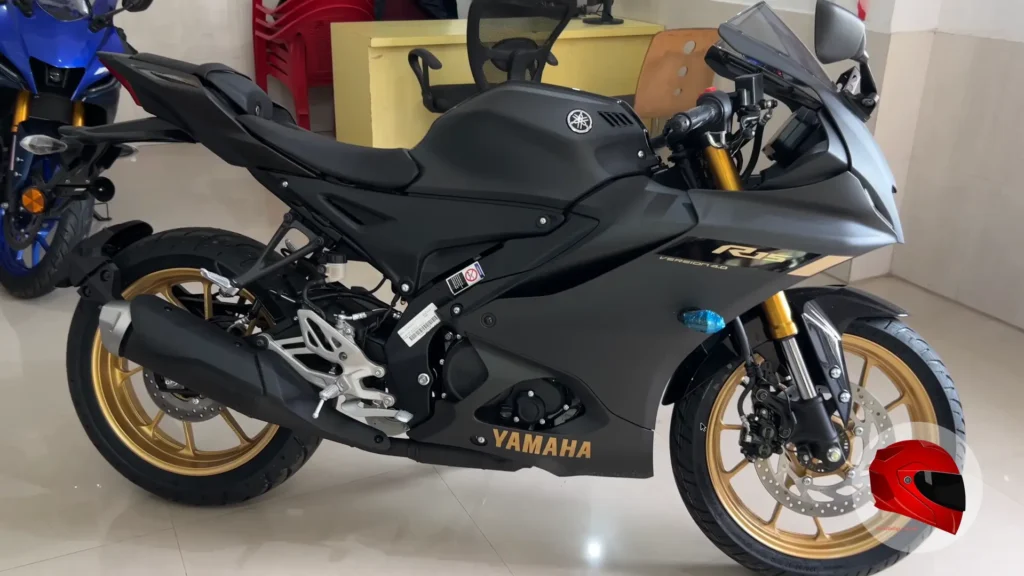 Authorized Yamaha Motorsports USA dealers do not catalog or order the R15. The Yamaha YZF-R3 is the relevant small, fully faired sportbike in the U.S. lineup, with a domestic dealer, parts, warranty and registration pathway. An R15 advertised by a U.S. private seller is an imported motorcycle, not normal dealer stock.
International pricing helps explain the model’s appeal. In India, listed R15 variants cost ₹1,75,692 to ₹2,01,357 ex-showroom. A converted global estimate of about $2,200 to $2,400 excludes freight, customs, broker charges, certification work, state taxes and registration. That estimate is not a U.S. retail price.
Some R15 variants support Yamaha’s Y-Connect system, which can display phone alerts, fuel-consumption data, maintenance recommendations, the last parking location, malfunction notifications, engine RPM and eco-riding information. Availability depends on the market and trim. Y-Connect does not make an imported motorcycle street legal in the United States.
- Y-Connect suits riders who want connected maintenance and trip information.
- Availability depends on the R15 variant and market.
- The system does not make an imported motorcycle street legal in the United States.
Connectivity is a useful difference between regional versions, but certification and registration need to be resolved before equipment features influence the purchase.
For a newer R15, applicable EPA emissions and DOT safety requirements are central to lawful U.S. street importation. An international specification does not automatically establish compliance, and a nonconforming motorcycle cannot be registered for ordinary public-road use.
A nonconforming R15 may be imported for closed-course use under restricted conditions, but that status does not permit public-road riding. Importers also face documentation, shipping, customs, possible modifications and state-level title or registration requirements. Costs and feasibility depend on the individual motorcycle and its compliance documents, so the low overseas price can be misleading.
A state motorcycle license or endorsement is required for public-road operation. The credential’s name, testing process, age rules, permit period and fees vary by state. It is separate from federal import approval and does not legalize an R15 that fails EPA, DOT or state registration requirements.
A rider can hold the correct license and still be unable to register an R15 that lacks EPA and DOT compliance. A motorcycle safety course is a sensible choice for a new rider, especially because the R15’s committed riding position and responsive chassis demand deliberate control at low speed and through corners.
Requirements and context
The R15 name covers several generations and trims, and specifications vary by market. The original model used a 149.8 cc engine. The current platform uses a 155 cc liquid-cooled single with Variable Valve Actuation. The R15 V3 is an earlier generation, while the R15 V4 adds newer electronics, styling and equipment. The R15M is the higher-equipment trim in the modern family.
The Yamaha YZF-R3 provides the clearest U.S. comparison. It is a larger, officially supported Yamaha sportbike with a 321 cc twin-cylinder engine and established dealer, parts, registration and warranty support. Riders comparing displacement, performance and ownership costs should view the R3 as the authorized U.S. alternative, not as another R15 generation.
- R15 V4: Current 155 cc VVA platform with updated styling, traction control, connectivity and market-dependent quickshifter equipment.
- R15M: Higher-spec trim with additional finish and equipment differences that depend on the country and variant.
- R15 V3: Earlier 155 cc generation with older styling and electronics.
- Yamaha YZF-R3: U.S.-market alternative with substantially greater displacement and official support.
What makes the R15 V4 different
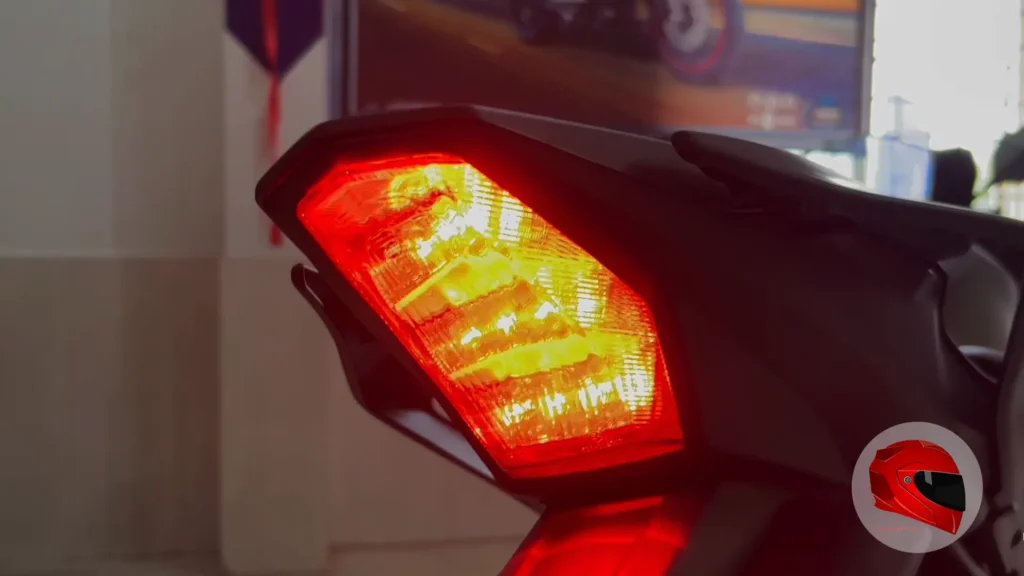
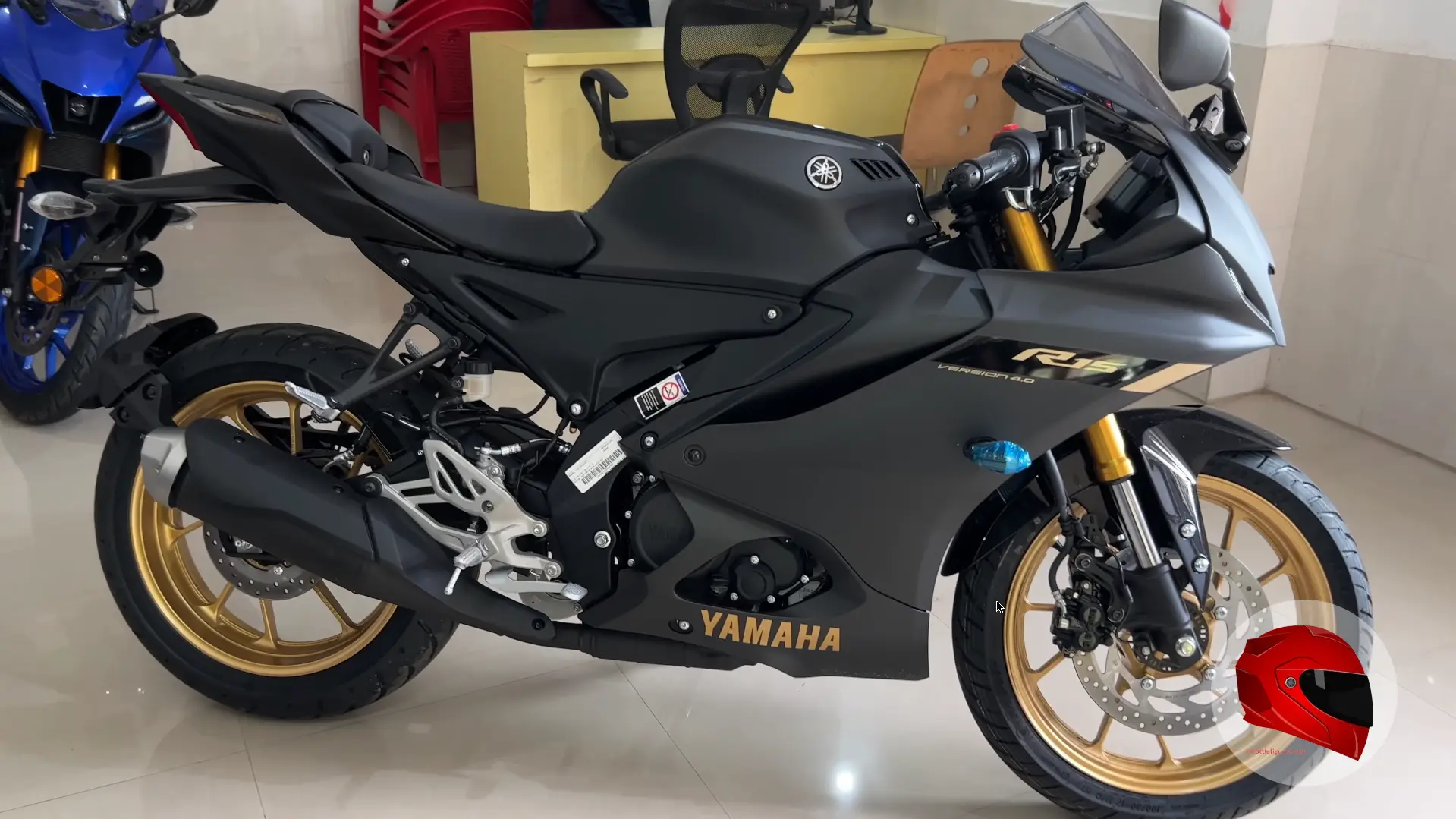
The R15 V4 uses a steel twin-spar Deltabox frame, an aluminum swingarm, a 37 mm upside-down front fork and a linked rear monoshock. Its 282 mm front disc and 220 mm rear disc work with dual-channel ABS. The 140 mm rear radial tire completes the bike’s sharp, fully faired sportbike profile.
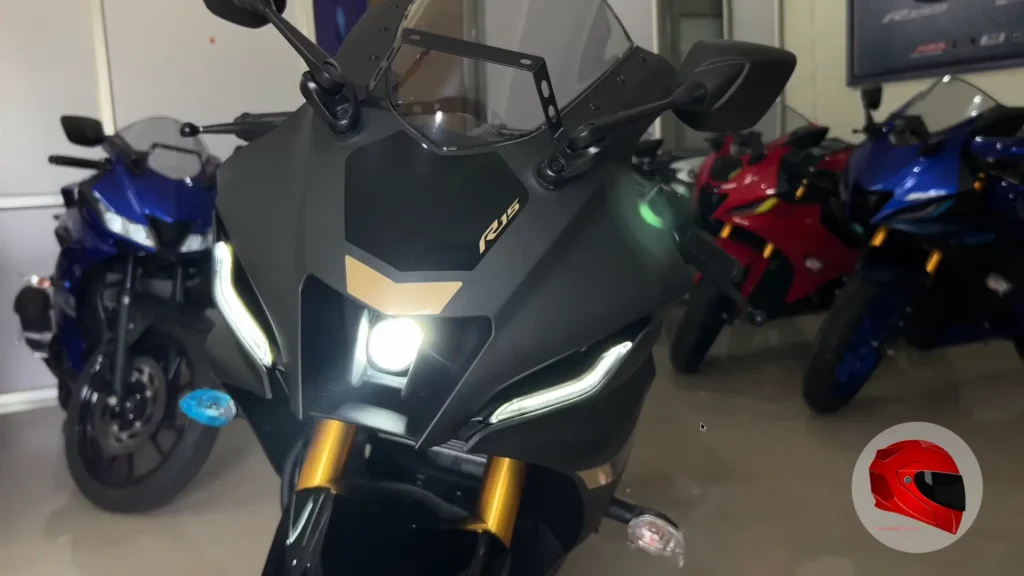
Equipment can include traction control, an assist-and-slipper clutch, a class-D bi-functional LED headlight and an upshift quickshifter. The quickshifter is available on selected variants or as an accessory, so it is not fitted to every R15 sold in every country.
The V4’s electronic package is substantial for a compact motorcycle. Y-Connect-supported versions can report phone alerts, maintenance recommendations, fuel consumption, parking location, malfunctions, engine RPM and eco-riding information. These features add convenience but do not change the motorcycle’s legal classification or federal import requirements.
Engine performance and fuel economy
The modern R15 engine is a 155 cc liquid-cooled, four-stroke, four-valve, SOHC single-cylinder with fuel injection and VVA. It produces 13.5 kW, or 18.4 PS, at 10,000 rpm and 14.2 Nm at 7,500 rpm. VVA broadens the engine’s usable rev range, but the R15 still performs best when the engine is kept spinning.
A six-speed constant-mesh manual transmission provides closely spaced ratios for acceleration and corner exits. The assist-and-slipper clutch reduces lever effort and helps control rear-wheel hop during aggressive downshifts. The engine is brisk enough for urban riding and technical roads. Highway performance depends heavily on rider weight, wind, incline, gearing and traffic.
- Estimated top speed: Approximately 80 to 85 mph.
- 0-60 km/hr: About 4.5 to 5.5 seconds under favorable conditions.
- Fuel economy: Approximately 42 to 53 kmpl, depending on riding style.
- Fuel compatibility: E20 compatible.
Quarter-mile results are not a fixed factory specification. They vary with launch technique, conditions, gearing and rider weight. The R15’s modest power and 141 kg kerb weight favor economy and corner speed over straight-line acceleration. Its power-to-weight figure is approximately 130.5 PS per metric ton before the rider’s weight is included.
The R15’s modest horsepower is offset by its light weight, giving it lively cornering and quick acceleration in town. Comparing power with weight gives a clearer picture than horsepower alone, especially against heavier small-displacement motorcycles. That makes motorcycle power-to-weight ratios useful for judging real-world responsiveness and fuel economy.
Handling, comfort, and braking
The R15 measures 1,990 mm long, 725 mm wide and 1,135 mm high, with an 815 mm seat height. Those dimensions give it the proportions of a serious sportbike despite its small displacement. The steel Deltabox frame and aluminum swingarm support precise steering, while the upside-down fork keeps the front end planted during braking and cornering.
Rear-set controls and clip-on-style ergonomics favor cornering over relaxed commuting. The 815 mm seat is manageable for many riders but can challenge shorter riders at stops. A passenger can use the rear seat, although the narrow tail and sport-focused posture limit long-distance pillion comfort.
Dual-channel ABS adds braking security on changing pavement, and the 282 mm front disc supplies most of the stopping authority. The linked monoshock balances compact dimensions with usable control, although suspension setup and ride comfort vary by rider weight and local calibration. The R15 is most convincing on smooth, winding roads where its low mass and precise chassis stand out.
Can you buy an R15 in the USA?
Yamaha does not officially sell or catalog the R15 for U.S. street use in 2026. An authorized Yamaha Motorsports USA dealer cannot treat it like a domestic model with routine U.S. warranty, parts, financing and registration support. A private seller may offer an imported R15, but ownership paperwork alone does not prove that the motorcycle is legal for public-road use.
The 25-year import exemption is the main age-based rule. A motorcycle at least 25 years old may qualify for an exemption from some modern federal requirements, but current R15 generations are much newer than that threshold. A newer R15 intended for U.S. street registration must meet applicable EPA and DOT requirements. A nonconforming motorcycle is limited to closed-course use.
- The import decision depends on the exact model year, country specification, title history and import documents.
- Federal import approval, state title inspection, insurance and registration are separate requirements.
- Obtain the required Class M license or motorcycle endorsement before public-road operation.
Insurance may also be difficult because the R15 is not part of the domestic catalog. An insurer may require a VIN inspection, proof of legal importation or specialty underwriting. A track-only motorcycle will not receive ordinary street coverage.
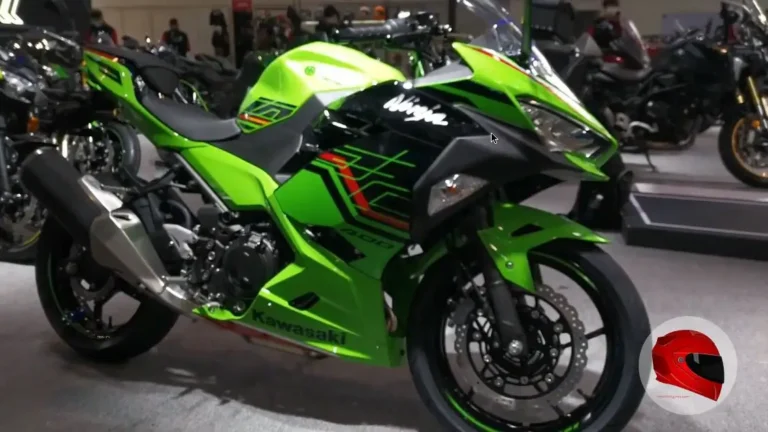
Because the R15 is not broadly sold as a new street-legal model in the United States, buyers often consider other lightweight sport bikes with similarly approachable dimensions and manageable performance. The Kawasaki Ninja 400 and Yamaha R3 have larger engines, stronger acceleration and better highway ability than the R15. Comparing them shows how these U.S. alternatives differ in power, comfort and everyday usability.
Is the R15 a good beginner bike?
The R15 can be a strong learning motorcycle for a beginner who specifically wants sportbike ergonomics, manual shifting and cornering practice. Its 141 kg weight, predictable single-cylinder power, ABS and manageable physical size give new riders a useful platform for building control.
It is less suitable for someone who needs relaxed ergonomics, easy passenger carrying, extensive highway reserve or straightforward U.S. ownership. New riders should complete a recognized safety course, wear full protective gear and choose a legally registered motorcycle with accessible parts and insurance.
FAQs
What cc is a Yamaha R15?
The current Yamaha R15 uses a 155 cc engine. Earlier versions used a 149.8 cc engine, so the model year matters when comparing specifications.
Is the Yamaha R15 a 400cc motorcycle?
No. The current R15 is a lightweight 155 cc sport motorcycle. A 400 cc motorcycle belongs to a substantially larger displacement class with different performance and operating characteristics.
What is the Yamaha R15 top speed?
The typical estimated top speed is approximately 80 to 85 mph. Actual speed depends on rider weight, wind, road gradient, gearing, tire condition and market specification.
Any quoted Yamaha R15 top speed is an estimate, not a guarantee. Gearing, rider weight, wind, elevation, tire condition and road surface can all change the result. The bike’s compact fairing reduces drag, but riding position and weather can still affect the reading. These motorcycle top speed factors also explain why the instrument panel may show a different figure from independent testing.
How much does a Yamaha R15 cost?
India ex-showroom pricing ranges from ₹1,75,692 to ₹2,01,357 across listed variants. A converted global estimate of approximately $2,200 to $2,400 excludes U.S. import, shipping, compliance, tax, insurance and registration costs.
Is a Yamaha R15 legal to ride on U.S. streets?
A current imported R15 is not automatically street legal in the United States. It must satisfy applicable EPA and DOT requirements and pass state registration requirements. A nonconforming motorcycle is restricted to closed-course use.
Conclusion
On paper, the Yamaha R15’s specs make it look like an easy recommendation.
The Yamaha R15 is an impressive lightweight sportbike with strong equipment, efficient performance and sharp handling, but it is not a simple U.S. street-bike purchase. For public-road use in the United States, the Yamaha YZF-R3 is the authorized alternative. Choose an R15 only after establishing its import, certification, insurance and registration path.