Honda Rebel 300 Performance, Specs, Price, and 2026 E-Clutch
Disclaimer: Performance figures may vary depending on factors such as rider, road and weather conditions, vehicle condition, and testing methods. Figures are provided for informational purposes only.
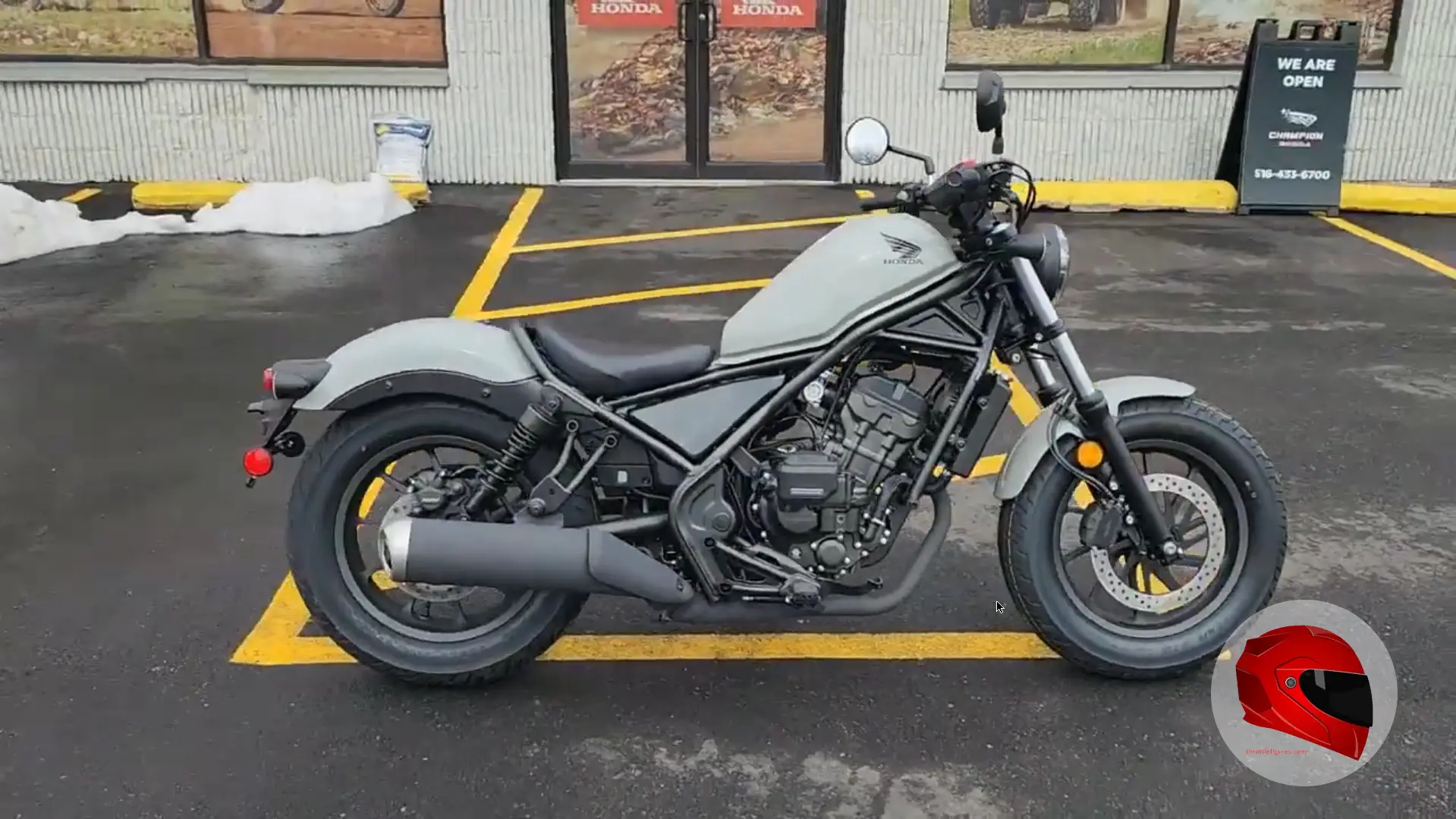
The Honda Rebel 300 is a lightweight cruiser suited to new riders, daily commuting and relaxed back-road riding. Its 27.2-inch seat and 379-pound curb weight make low-speed handling less demanding, while the 2026 model adds standard Honda E-Clutch technology. The main choice is whether you need regular 70-mph highway performance or prefer the Rebel 300’s lower purchase and running costs.
Honda Rebel 300 Specifications and Price
| Attribute | 2026 U.S. specification |
|---|---|
| Model year | 2026 |
| Model | Rebel 300 E-Clutch |
| Base MSRP | $5,349 |
| Destination charge | $600 |
| Total MSRP | $5,949 |
| Factory warranty | 1 year, unlimited mileage |
| Engine type | Liquid-cooled 286cc single-cylinder 4-stroke |
| Valvetrain | DOHC, 4 valves |
| Displacement | 286 cc |
| Bore x stroke | 76.0 x 63.0 mm |
| Compression ratio | 10.7:1 |
| Fuel delivery | 38 mm programmed fuel injection |
| Transmission | 6-speed manual with Honda E-Clutch |
| Final drive | #520 chain |
| Horsepower | 31 hp at 9,000 rpm |
| Torque | 20.3 lb-ft at 8,000 rpm |
| Top speed | 85 mph |
| 0–60 mph | 7.0 seconds |
| 0–100 mph | Not reached; 85 mph top speed |
| Quarter mile | 16.2 seconds |
| Power-to-weight | 0.082 hp/lb |
| Curb weight | 379 lb |
| Seat height | 27.2 in |
| Fuel economy | 70 mpg |
| Fuel capacity | 3.0 gal |
| Overall length | 86.8 in |
| Overall width | 32.4 in |
| Overall height | 43.0 in |
| Wheelbase | 58.7 in |
| Ground clearance | 5.9 in |
| Rake / trail | 28° / 4.3 in |
| Front suspension | 41 mm fork; 5.5 in travel |
| Rear suspension | Dual shocks; 3.7 in travel |
| Front brake | 296 mm hydraulic disc |
| Rear brake | 240 mm hydraulic disc |
| Braking equipment | ABS |
| Front tire | 130/90-16 |
| Rear tire | 150/80-16 |
| Lighting | LED |
| Instrument panel | Digital LCD |
| Passenger equipment | Passenger seat and footpegs |
The $600 destination charge brings the listed price to $5,949 before dealer setup, documentation, taxes, title, registration, plates and other local charges. The acceleration and quarter-mile figures also give buyers a useful basis for comparing the Rebel 300 with other motorcycles.
The Rebel 300’s modest horsepower makes more sense alongside its light curb weight. Power-to-weight ratio often says more about responsiveness than peak output alone. A lighter motorcycle can feel lively in city traffic and easier to manage at low speeds, even if larger engines deliver stronger acceleration. motorcycle power-to-weight ratio helps put the Rebel’s specifications in context.
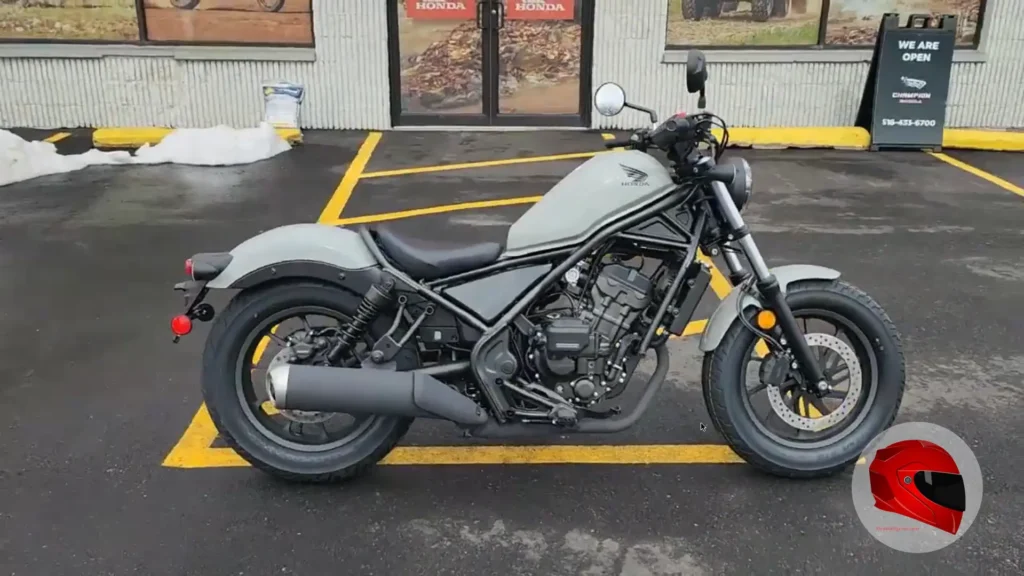
What Honda E-Clutch Does
Honda E-Clutch electronically controls clutch engagement when you start, stop and shift. You still select gears with the foot lever, but you do not need to pull the clutch lever when moving away from a stop or coming to a halt. That reduces the coordination required during early practice and stop-and-go commuting.
The clutch lever remains available when you want direct manual control. You can still learn conventional clutch technique, choose gears yourself and work the gearbox on winding roads. E-Clutch is an assistance system, not an automatic transmission: you remain responsible for gear selection and road speed.
How the Rebel 300 Rides
The 286cc single-cylinder engine delivers modest but useful acceleration around town. Throttle response is easy to control, and the six-speed gearbox covers normal urban speeds. The low seat makes it easier to put both feet down at stops, while the 379-pound curb weight helps with parking-lot turns, backing up and small balance corrections.
Handling is light and predictable. The 58.7-inch wheelbase and cruiser ergonomics suit relaxed riding, while the conventional fork and preload-adjustable rear shocks keep the suspension layout simple. Standard ABS adds support during hard braking and on changing pavement. The 27.2-inch seat suits shorter riders, although taller riders may find the compact cockpit restrictive on longer trips.
At 70 mpg, the Rebel 300 uses little fuel for a full-size street motorcycle. Its 3.0-gallon tank provides a practical range of roughly 200 miles, depending on reserve use and riding conditions. Ownership still includes chain maintenance, tire-pressure checks, oil service and routine brake inspections.
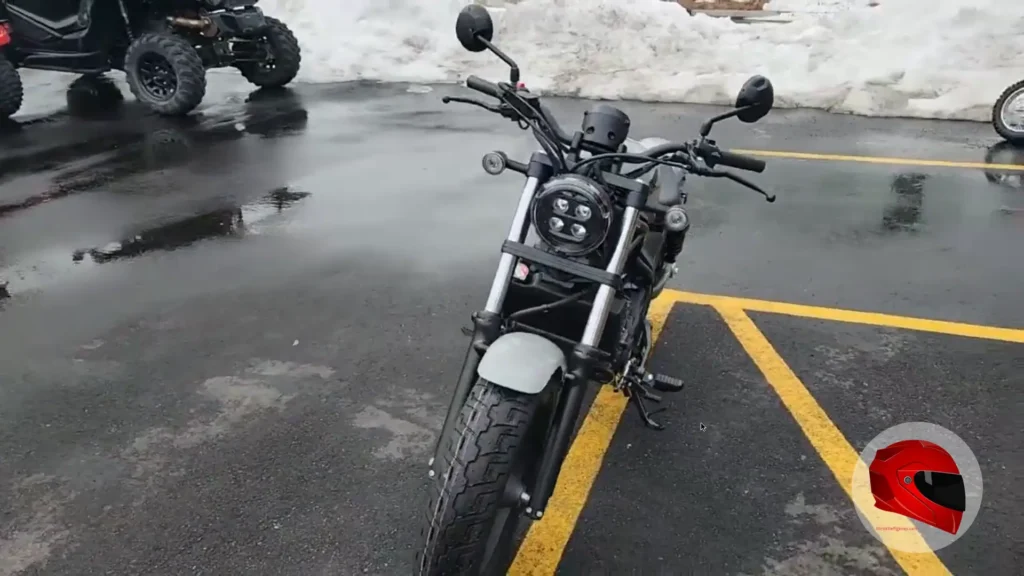
Can the Rebel 300 Handle Highways?
The Rebel 300 can reach 85 mph, so it can travel on highways when traffic and conditions are favorable. Sustained high-speed riding, steep grades, strong headwinds and quick passing expose its limits. At 70 mph, the engine has less reserve than the Rebel 500, and wind exposure can make longer rides tiring.
- 70 mph cruising: Suitable for occasional highway use when traffic is moderate and conditions are calm.
- Passing: Requires more planning because the single-cylinder engine has limited acceleration reserve.
- Wind: The upright cruiser position leaves the rider exposed to crosswinds and trucks.
- Long-distance travel: Possible, but the compact ergonomics, small engine and modest wind protection favor shorter trips.
- Best road environment: City streets, suburban routes, two-lane roads and occasional freeway segments.
If your commute is mostly interstate traffic, the Rebel 500 is the stronger match. The Rebel 300 makes more sense when highway riding is occasional rather than the motorcycle’s main job.
On the highway, the Rebel 300’s published horsepower tells only part of the story. Rider weight, gearing, wind, riding position and aerodynamic drag all affect how quickly it reaches and holds higher speeds. A motorcycle may feel fine at legal highway speeds but still have little reserve for steep grades or passing. Understanding how horsepower determines motorcycle top speed helps distinguish real-world highway comfort from a simple peak-speed claim.
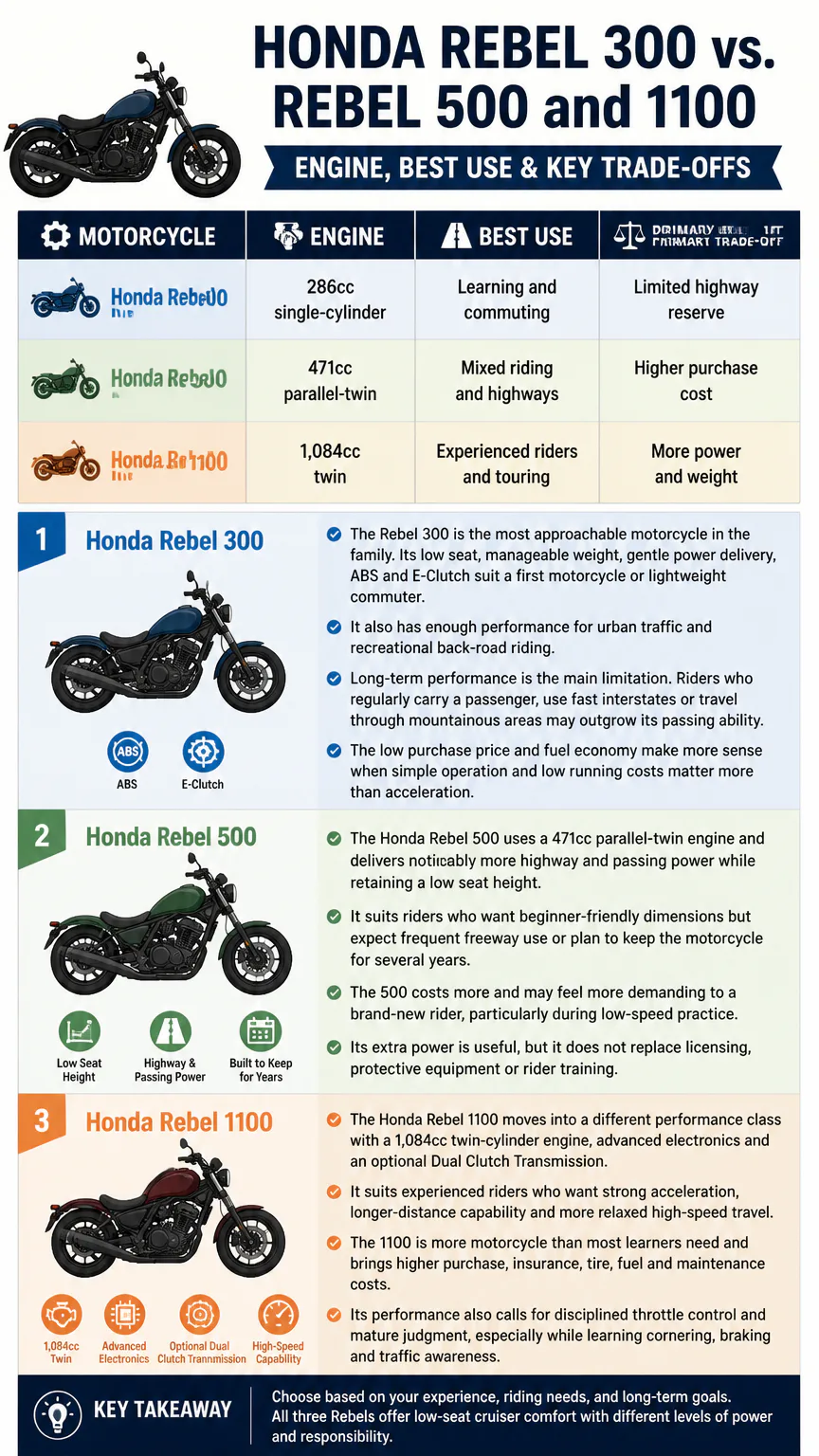
Rebel 300 vs. Rebel 500 and 1100
| Motorcycle | Engine | Best use | Primary trade-off |
|---|---|---|---|
| Honda Rebel 300 | 286cc single-cylinder | Learning and commuting | Limited highway reserve |
| Honda Rebel 500 | 471cc parallel-twin | Mixed riding and highways | Higher purchase cost |
| Honda Rebel 1100 | 1,084cc twin | Experienced riders and touring | More power and weight |
Honda Rebel 300
The Rebel 300 is the most approachable motorcycle in the family. Its low seat, manageable weight, gentle power delivery, ABS and E-Clutch suit a first motorcycle or lightweight commuter. It also has enough performance for urban traffic and recreational back-road riding.
Long-term performance is the main limitation. Riders who regularly carry a passenger, use fast interstates or travel through mountainous areas may outgrow its passing ability. The low purchase price and fuel economy make more sense when simple operation and low running costs matter more than acceleration.
Honda Rebel 500
The Honda Rebel 500 uses a 471cc parallel-twin engine and delivers noticeably more highway and passing power while retaining a low seat height. It suits riders who want beginner-friendly dimensions but expect frequent freeway use or plan to keep the motorcycle for several years.
The 500 costs more and may feel more demanding to a brand-new rider, particularly during low-speed practice. Its extra power is useful, but it does not replace licensing, protective equipment or rider training.
Honda Rebel 1100
The Honda Rebel 1100 moves into a different performance class with a 1,084cc twin-cylinder engine, advanced electronics and an optional Dual Clutch Transmission. It suits experienced riders who want strong acceleration, longer-distance capability and more relaxed high-speed travel.
The 1100 is more motorcycle than most learners need and brings higher purchase, insurance, tire, fuel and maintenance costs. Its performance also calls for disciplined throttle control and mature judgment, especially while learning cornering, braking and traffic awareness.
Honda Rebel 300 Ownership Costs
| Cost item | 2026 U.S. amount or basis |
|---|---|
| Insurance | Rider, location, coverage, ABS |
| Registration | State and local fees |
| Sales tax | State and local rate |
| Dealer setup | Dealer charge |
The purchase price is only the starting cost. Budget for sales tax, title and registration charges, license plates, dealer documentation, setup, motorcycle insurance, riding gear and ongoing chain and tire care. Dealer-arranged financing can also increase the total through interest, even when the monthly payment fits your budget.
Progressive Motorcycle Insurance can quote coverage based on factors such as the 286cc engine, ABS equipment, rider history, location, age, limits, deductible and claims record. Some insurers may adjust pricing after training completion, but the effect depends on the policy and state. Arrange the policy before delivery if the lender or dealer requires proof of coverage.
How to Buy and Register a Rebel 300
A Honda Powersports dealership is the simplest route for a new motorcycle. A private seller may offer a lower price on an older used Rebel 300, but you will need to handle the inspection, payment security, title accuracy and registration paperwork yourself.
- Compare the Rebel 300 with the Rebel 500 based on highway use, passenger needs and expected ownership period.
- Contact a Honda Powersports dealership about available colors, freight and setup charges, financing terms and registration support.
- Use Honda Financial Services for dealer-arranged financing or digital pre-approval when its terms suit your credit profile.
- Inspect a private-seller motorcycle for title status, VIN consistency, service records, chain condition, tires, brakes, leaks and crash damage.
- Arrange motorcycle insurance before riding on public roads.
- Complete the purchase contract, title assignment, bill of sale, lien information and odometer disclosure when required.
- Apply for a motorcycle learner permit or endorsement through your State DMV or BMV.
- Complete the required written and practical evaluations, or take an approved course when state rules allow course completion to replace the riding test.
- Submit title, registration, tax, identification, insurance and payment documents for plates and registration.
The Motorcycle Safety Foundation offers basic and intermediate rider courses nationwide. An approved course can waive the skills test in many states, but licensing rules vary by jurisdiction. Your State DMV or BMV remains responsible for endorsement, title transfer, registration and plates, even when a dealership submits the paperwork electronically.
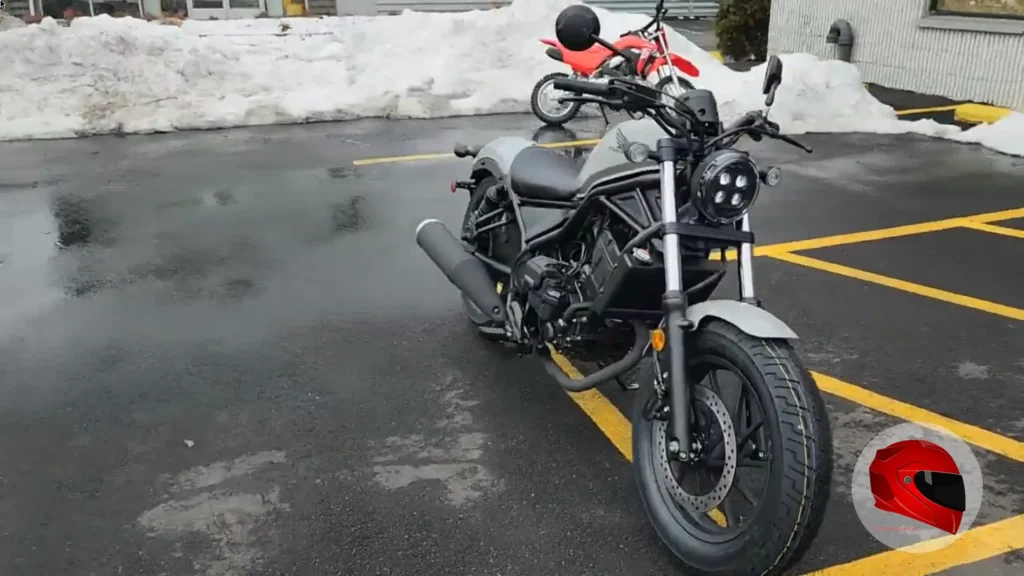
Is the Rebel 300 Right for You?
The Rebel 300 suits first-time riders who want a low seat, light handling, low fuel consumption and a manageable engine. E-Clutch reduces stalling concerns during the early stages of learning while retaining manual gear selection. Standard ABS, LED lighting and passenger equipment add useful everyday features.
It is less suited to riders whose normal routes involve fast freeways, frequent two-up riding, steep hills or long-distance touring. The Rebel 500 provides more usable reserve in those situations without giving up the family’s low-seat layout. Choose the Rebel 1100 when your experience and performance needs justify its larger engine and higher ownership costs.
The Honda Rebel 300 suits riders who want a low seat, relaxed ergonomics and a manageable throttle response. If highway riding, better wind protection or a sportier position matters more, compare those factors alongside engine output, insurance, maintenance and the condition of used bikes. A Kawasaki Ninja 300 buying guide can help riders weigh an easygoing cruiser against a lightweight sportbike.
FAQs
Is the Honda Rebel a women’s bike?
The Honda Rebel 300 is designed for any rider rather than a specific gender. Its low seat, manageable weight and approachable controls suit many body types, but fit depends on reach, riding position, control comfort and confidence.
Does the Rebel 300 have enough power for two riders?
It has a passenger seat and footpegs, but two-up acceleration and highway performance are limited by the 286cc single-cylinder engine. Frequent passenger use is better suited to the Rebel 500 or Rebel 1100.
What license is required for a Honda Rebel 300?
U.S. requirements vary by state, but public-road riding generally requires a motorcycle endorsement or an applicable learner permit. The State DMV or BMV sets the written, practical, age, supervision and equipment requirements.
Is Honda E-Clutch an automatic transmission?
No. Honda E-Clutch controls clutch engagement electronically while the rider shifts through the six-speed gearbox. The clutch lever remains available for manual control.
Conclusion
The 2026 Honda Rebel 300 is a sensible entry-level cruiser for riders who value low-speed confidence, a low seat and affordable operation. It suits city use, training and occasional highway travel. Choose the Rebel 500 when frequent highway passing or stronger long-term performance matters more.