Ducati Panigale V4: Top Speed, 0–60, HP, Torque, Weight & Specs
Disclaimer: Performance figures may vary depending on factors such as rider, road and weather conditions, vehicle condition, and testing methods. Figures are provided for informational purposes only.
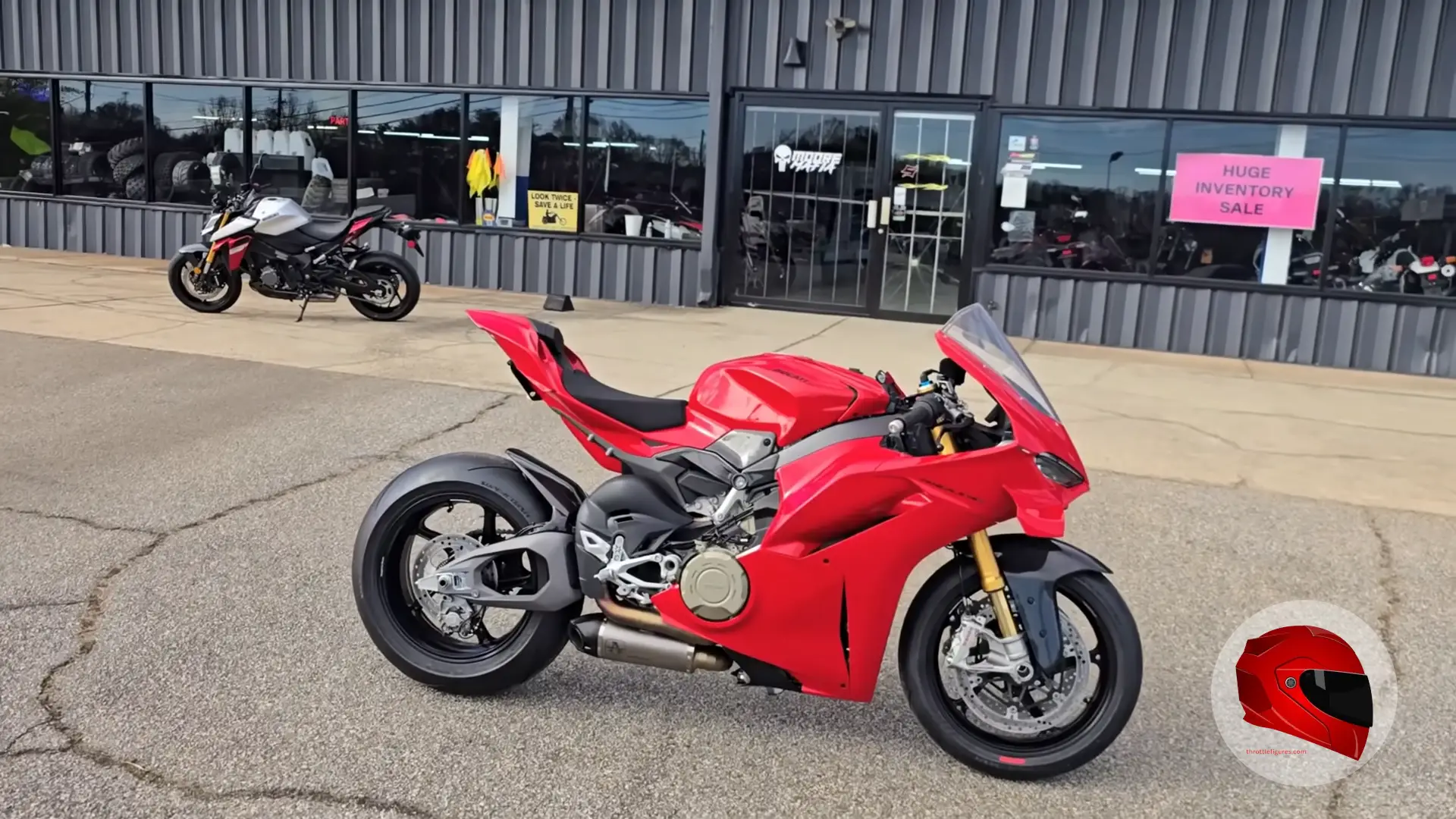
The Ducati Panigale V4 is a 209-horsepower Italian superbike aimed at experienced riders who want road performance with genuine track capability. Its 1,103 cc liquid-cooled 90° desmodromic Desmosedici Stradale V4 works with an advanced electronic package, while the base V4, V4 S, V4 R and limited editions differ significantly in price, equipment and track focus.
Ducati Panigale V4 Specifications and Price
Front brakes | Dual 330 mm semi-floating discs, Brembo Monobloc Hypure 4-piston calipers
Panigale V4 performance and engine
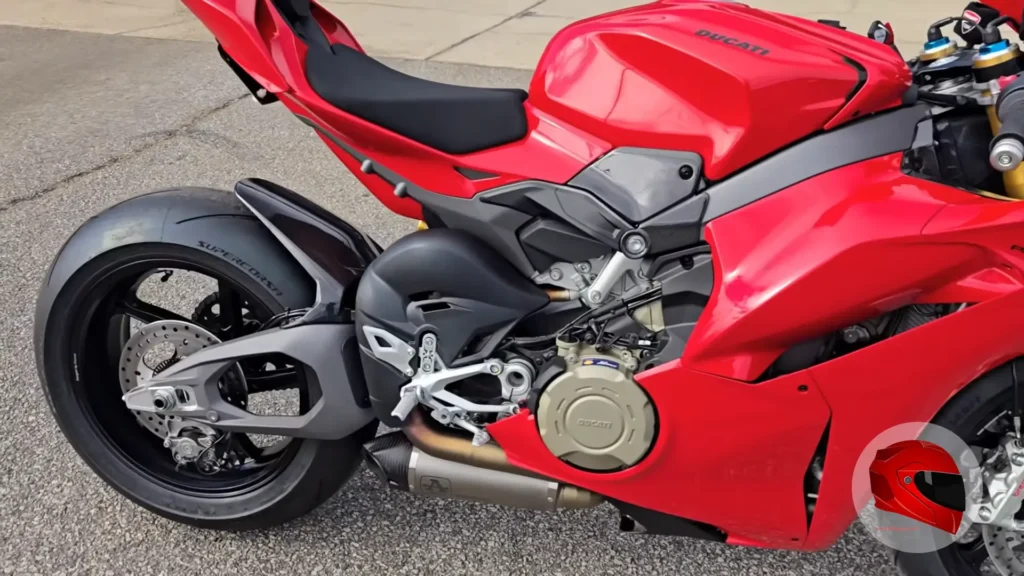
The standard Panigale V4 uses a 1,103 cc liquid-cooled 90° desmodromic Desmosedici Stradale V4. In U.S. street trim, it produces 209 hp at 12,750 rpm and 89.5 lb-ft of peak torque at 11,250 rpm. A 6-speed manual transmission with DQS up/down sends power through a chain final drive.
A counter-rotating crankshaft reduces some of the gyroscopic effect from the spinning engine internals. The result is a motorcycle that responds quickly to steering inputs and builds speed with a distinctly race-derived character. The engine remains usable at moderate road speeds, but its strongest qualities appear during hard corner exits, high-speed track riding and rapid transitions through the upper rev range.
The exhaust note is part of the motorcycle’s identity, but this level of performance demands precise throttle control, gear selection and electronic setup. Riders who are not comfortable with abrupt acceleration, hard braking and rapid direction changes should gain experience on a less powerful motorcycle first.
Chassis, aerodynamics, and electronics
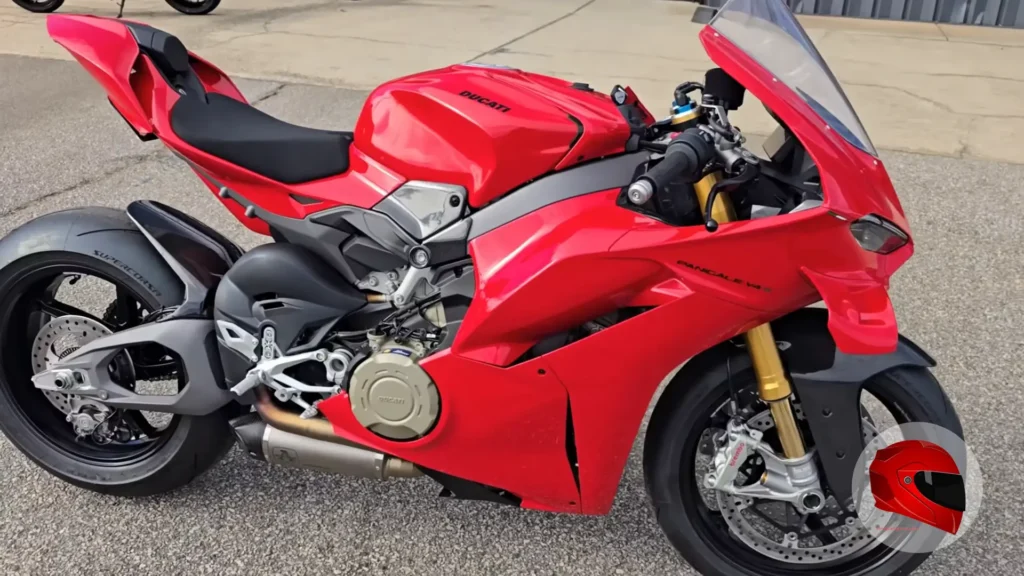
The aluminum alloy Front Frame uses the engine as a stressed structural element, while the hollow symmetrical swingarm supports the rear wheel and suspension movement. This layout keeps the chassis focused around the engine. Dual 330 mm front discs with Brembo four-piston calipers provide the braking hardware expected of a serious superbike.
Front suspension: 43 mm Showa fork on the base V4.
Rear suspension: Sachs shock on the base V4.
Electronic suspension: Öhlins SmartEC 3.0 semi-active equipment on the V4 S.
Braking control: Cornering ABS managed through the motorcycle’s inertial measurement system.
Rider aids: Traction control, slide control, wheelie control and engine-brake control.
Launch function: Power Launch for controlled hard acceleration.
Riding modes: Configurable operating profiles for changing road and track conditions.
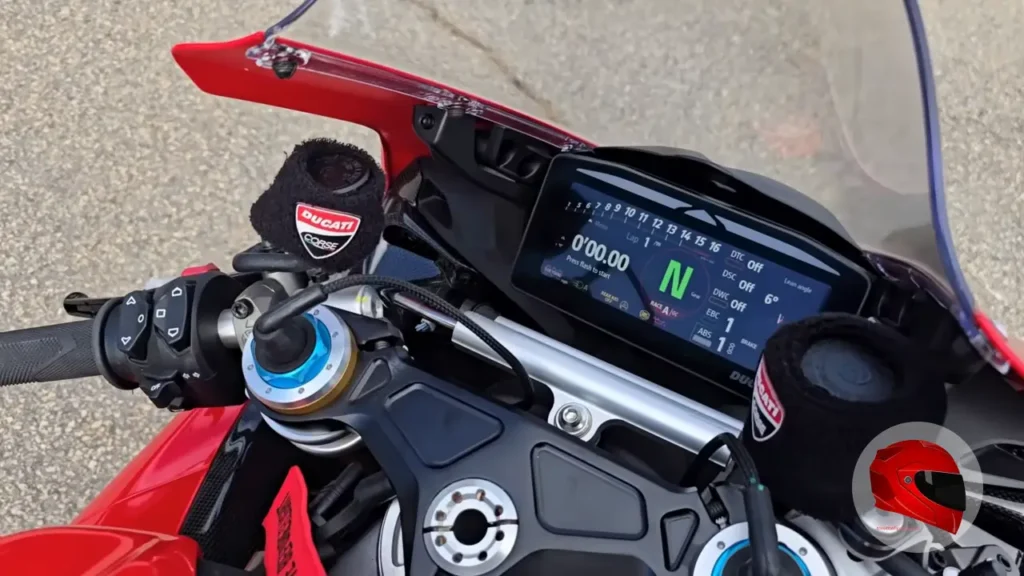
Instrumentation: 6.9-inch full-color TFT display.
Aerodynamic winglets add stability during acceleration and high-speed braking. Their effect is easiest to appreciate on a racetrack, where repeated braking zones and corner entries reveal chassis behavior more clearly than normal road riding. The base motorcycle’s mechanical suspension gives experienced riders a direct relationship with setup, while the V4 S uses electronic control to reduce adjustment work.
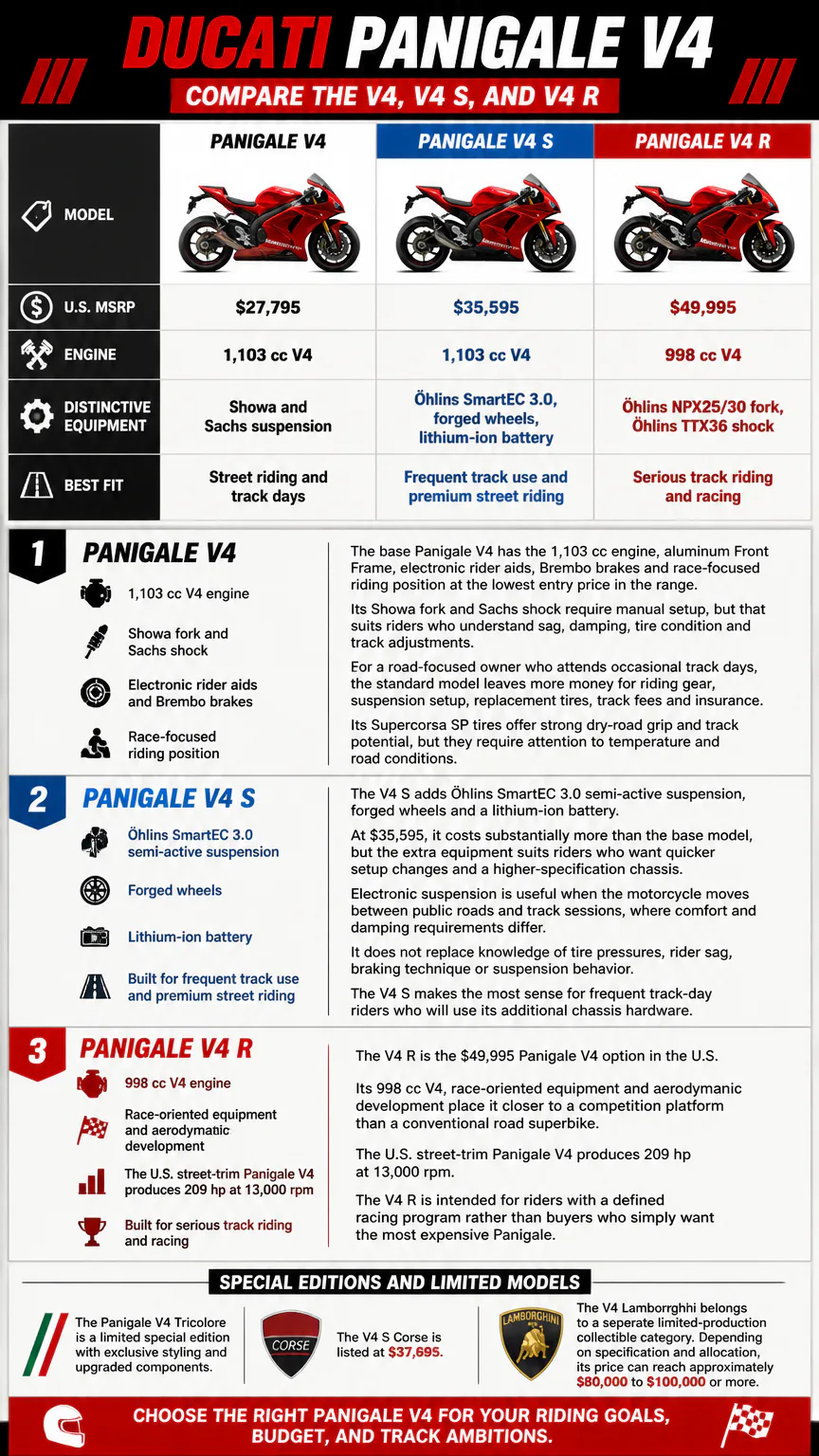
Panigale V4, V4 S, and V4 R compared
|
Model |
U.S. MSRP |
Engine |
Distinctive equipment |
Best fit |
|---|---|---|---|---|
|
Panigale V4 |
$27,795 |
1,103 cc V4 |
Showa and Sachs suspension |
Street riding and track days |
|
Panigale V4 S |
$35,595 |
1,103 cc V4 |
Öhlins SmartEC 3.0, forged wheels, lithium-ion battery |
Frequent track use and premium street riding |
|
Panigale V4 R |
$49,995 |
998 cc V4 |
Öhlins NPX25/30 fork, Öhlins TTX36 shock |
Serious track riding and racing |
Panigale V4
The base Panigale V4 has the 1,103 cc engine, aluminum Front Frame, electronic rider aids, Brembo brakes and race-focused riding position at the lowest entry price in the range. Its Showa fork and Sachs shock require manual setup, but that suits riders who understand sag, damping, tire condition and track adjustments.
For a road-focused owner who attends occasional track days, the standard model leaves more money for riding gear, suspension setup, replacement tires, track fees and insurance. Its Supercorsa SP tires offer strong dry-road grip and track potential, but they require attention to temperature and road conditions.
Panigale V4 S
The V4 S adds Öhlins SmartEC 3.0 semi-active suspension, forged wheels and a lithium-ion battery. At $35,595, it costs substantially more than the base model, but the extra equipment suits riders who want quicker setup changes and a higher-specification chassis.
Electronic suspension is useful when the motorcycle moves between public roads and track sessions, where comfort and damping requirements differ. It does not replace knowledge of tire pressures, rider sag, braking technique or suspension behavior.The V4 S adds electronically controlled Öhlins suspension, forged wheels and a lithium-ion battery, making it the higher-specification chassis version of the V4.
Panigale V4 R
The V4 R is the $49,995 Panigale V4 option in the U.S. Its 998 cc V4, race-oriented equipment and aerodynamic development place it closer to a competition platform than a conventional road superbike.
The U.S. street-trim Panigale V4 produces 209 hp at 12,750 rpm. The V4 R is intended for riders with a defined racing program rather than buyers who simply want the most expensive Panigale.
The Panigale V4 Tricolore is a limited special edition with exclusive styling and upgraded components. The V4 S Corse is listed at $37,695, while the V4 Lamborghini belongs to a separate limited-production collectible category. Depending on specification and allocation, its price can reach approximately $80,000 to $100,000 or more.
Street comfort and track capability
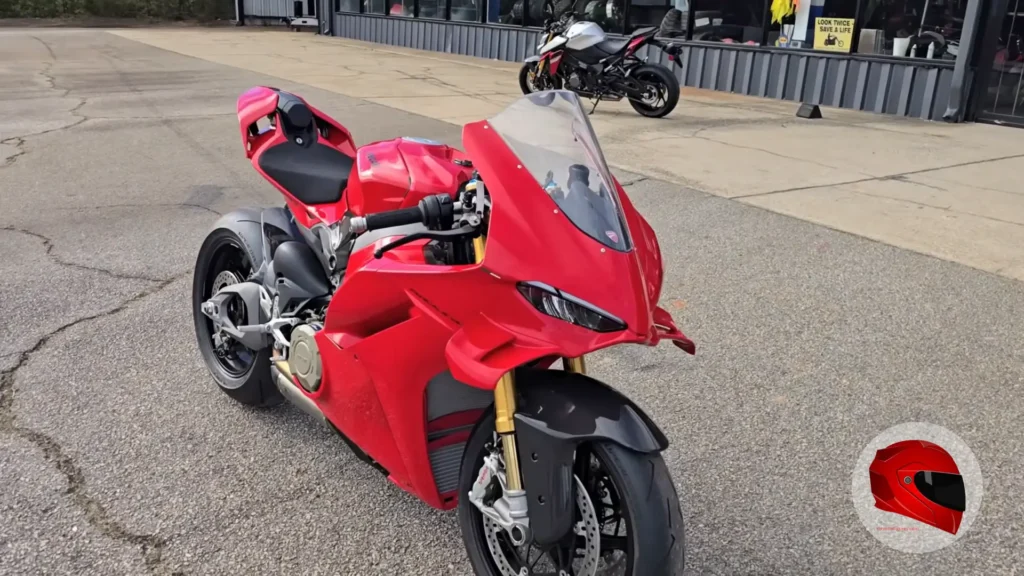
The Panigale V4 is street legal in its U.S. road configuration, but its road manners still reflect its racing purpose. The 33.5-inch seat, forward riding position, firm suspension, wide rear tire and powerful engine put more pressure on the rider’s wrists and lower back than a sport-touring motorcycle. Engine heat can also become noticeable in slow traffic.
The 4.5-gallon fuel tank supports ordinary rides, although range depends heavily on throttle use. Supercorsa SP tires deliver strong dry-road grip and track potential, but they still need proper warm-up and pressure checks. Cold, wet and dirty roads require extra caution. Replacement tires, premium brake components, chain care and scheduled Ducati service add to running costs.
On a racetrack, the motorcycle’s strengths are easier to use. The aerodynamic package, powerful brakes, quick-revving engine, cornering electronics and compact chassis suit repeated braking and acceleration zones. The V4 S is more convenient for riders who change settings often, while the V4 R targets riders who need homologation-focused equipment and race-level performance.
Buying, financing, and ownership costs
The listed MSRP covers only the motorcycle’s starting purchase price. Ducati’s displayed U.S. pricing excludes the $1,295 destination charge, taxes, title, registration, processing and handling fees, dealer charges, options and potential tariffs. Insurance for a 200-plus-horsepower superbike can also be substantial, particularly for newer riders or those with limited motorcycle coverage history.
Authorized Ducati dealer: The main route for a new motorcycle, factory warranty support, financing applications, registration assistance and test rides.
Cycle Trader: An online marketplace for finding dealer-stock and used Panigale V4 motorcycles.
Ducati Financial Services: A participating-dealer financing provider for eligible motorcycle purchases.
Private sale: A purchase route that requires careful checks of the title, lien, service history, mileage, accident history and VIN.
Before signing, separate the advertised motorcycle price from destination, documentation, freight, taxes, registration, accessories and financing charges. A used example should receive a cold-start inspection, diagnostic scan, tire and brake check, chain inspection and confirmation that recalls and scheduled services are complete. A dealer purchase generally simplifies warranty and registration administration, while Cycle Trader expands the search across multiple markets.
Financing approval depends on credit, income, loan term, down payment and the lender’s motorcycle policies. A longer term may lower the monthly payment but increase total interest. Add riding equipment, maintenance, storage, tires, track fees and insurance to the ownership budget rather than judging the motorcycle only by its monthly payment.
Is the Panigale V4 good for beginners?
No. The Panigale V4 is unsuitable as a first motorcycle. Its approximately 209 hp, aggressive ergonomics, rapid acceleration, powerful brakes and high operating speeds leave little room for basic-control mistakes. Electronic aids can reduce risk in some situations, but they cannot replace throttle discipline, braking skill, hazard awareness or sound judgment.
New riders should begin on a manageable motorcycle and complete a recognized motorcycle safety course. Legal operation in the United States generally requires a driver’s license with a Class M motorcycle endorsement or equivalent state authorization. Protective equipment should include a certified helmet, motorcycle jacket, gloves, riding pants and over-the-ankle boots.
The Panigale becomes more reasonable after the rider has developed experience with emergency braking, cornering lines, body position, wet-road judgment and controlled acceleration. Track instruction can help an experienced owner learn the motorcycle in a structured environment, but a racetrack does not make it beginner-friendly.
Ducati Panigale V4 dyno run
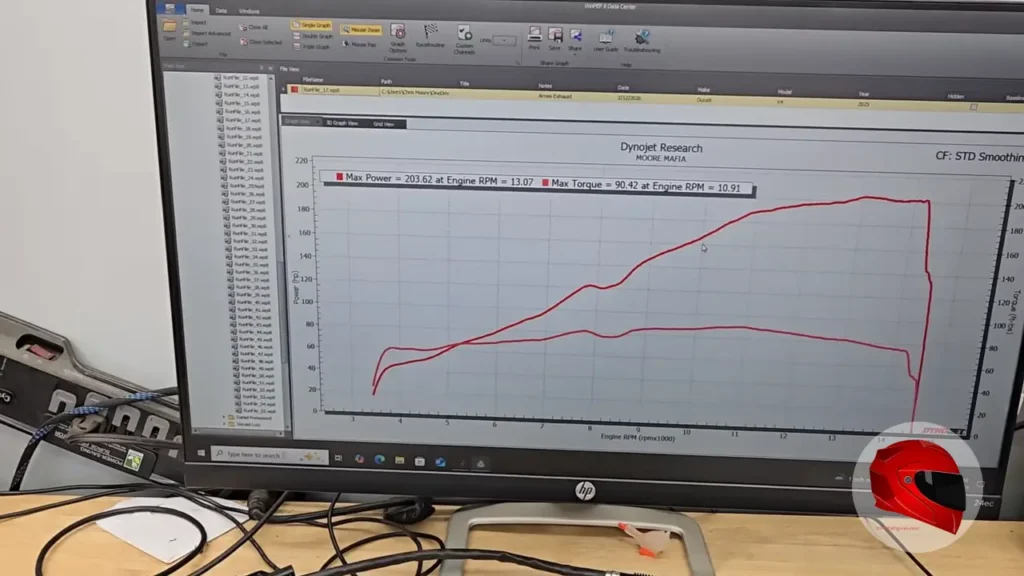
In a February 2026 Moore Mafia dyno test, a 2026 Ducati Panigale V4 S fitted with an Arrow Titanium slip-on produced 203.62 hp and 90.42 lb-ft of torque at the rear wheel. Peak power occurred at 13,070 rpm, while peak torque arrived at 10,910 rpm.
Ducati Panigale V4 FAQs
Is the Panigale V4 street legal?
The standard Panigale V4 and V4 S are sold in U.S. street configurations and can be registered for road use when they meet the requirements of the rider’s state. The V4 R is a homologation-focused model whose street equipment and availability vary by market and model allocation.
What is the Ducati Panigale V4 engine size?
The Panigale V4 uses a 1,103 cc liquid-cooled 90° desmodromic Desmosedici Stradale V4 engine. Its U.S. street-trim output is 209 hp at 12,750 rpm, so describing the motorcycle as a 1,000 cc model is inaccurate.
How fast is the Ducati Panigale V4?
The Panigale V4 is a 200-plus-horsepower superbike built for very high speeds. Actual speed depends on gearing, conditions, rider position and electronic configuration. The V4 R is listed at 197 mph in standard form and up to 205 mph in race configuration.
What does the V4 S add?
The V4 S adds Öhlins SmartEC 3.0 semi-active suspension, forged wheels and a lithium-ion battery. Its higher price is most defensible for riders who regularly use the motorcycle on a track or place a high value on premium suspension adjustment.
Does the Panigale V4 Lamborghini have the same price?
No. The Lamborghini edition is a limited-production special model with collectible positioning. Depending on specification and allocation, its price can reach approximately $80,000 to $100,000 or more, making it separate from the regular Panigale V4, V4 S and V4 R purchase decision.
Conclusion
The base Panigale V4 combines the 1,103 cc V4 engine with Showa/Sachs suspension, while the V4 S adds Öhlins SmartEC 3.0 suspension, forged wheels and a lithium-ion battery. The V4 R moves further toward homologation and competition-focused equipment.
Related on ThrottleFigures
- BMW S1000RR vs Ducati Panigale V4
- Best motorcycle power-to-weight ratios
- Highest torque motorcycles
- All motorcycle model pages
- All comparisons

5 Comments
Comments are closed.