Cornering ABS Explained: How It Works in a Turn
Cornering ABS helps a motorcycle brake more predictably while leaned over by combining wheel-speed data with measurements of the motorcycle’s movement. It matters most during an unexpected hazard, when the rider needs to brake before the motorcycle is upright. Its response depends on lean angle, available tire grip, braking force, road surface, and the motorcycle’s selected ABS mode.
How Cornering ABS Works
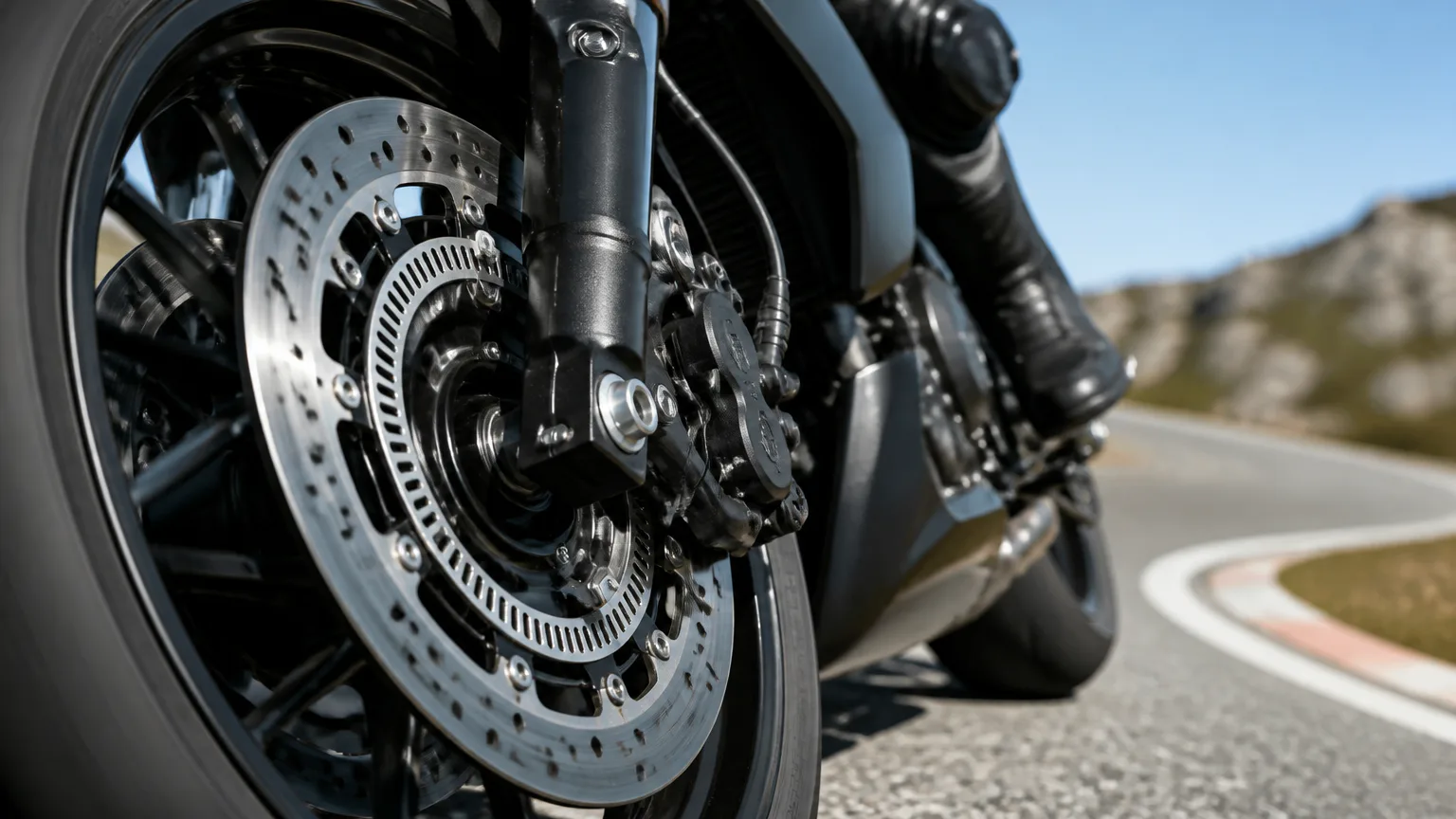
- Monitor wheel rotation. Wheel-speed sensors and tone rings track front and rear wheel speeds. A rapid reduction in wheel speed can signal an impending lockup.
- Measure motorcycle movement. The inertial measurement unit records roll, pitch, yaw, acceleration, and lean angle while the motorcycle is moving.
- Estimate available grip. The electronic control unit combines wheel-speed and IMU data with the friction-circle limit to estimate how much traction remains for braking while the tires are cornering.
- Set brake pressure. The ECU calculates how much hydraulic pressure the front and rear brakes can apply without exceeding the estimated traction available at that moment.
- Regulate braking force. The ABS unit continuously adjusts pressure, sometimes at high frequency, to reduce wheel lockup and preserve stability as speed, lean angle, and tire loading change.
What Cornering ABS Measures
Wheel speed alone cannot describe a motorcycle’s attitude in a turn, so cornering ABS uses several types of information. Magnetic wheel-speed sensors read the rotation of tone rings at the wheels. A five-axis or six-axis IMU measures movement and orientation, including roll, pitch, yaw, and acceleration. The ECU processes those signals and sends commands to the hydraulic ABS modulator.
Lean angle is only one input. Vehicle speed, acceleration, deceleration, wheel-speed difference, braking demand, and the rate at which the motorcycle changes direction also affect the pressure calculation. The exact sensor layout and software response vary by motorcycle and system generation.
Bosch Cornering ABS combines IMU telemetry with hydraulic pressure control for braking during cornering and emergency trail braking. Continental motorcycle ABS also uses IMU hardware and proprietary algorithm tuning to stabilize braking while the motorcycle is leaned. These are supplier technologies; the motorcycle manufacturer determines the final integration, calibration, controls, and available riding modes.
Cornering ABS vs standard ABS
Standard ABS mainly monitors wheel rotation. When it detects that a wheel is slowing faster than the motorcycle’s movement allows, it releases and reapplies brake pressure to prevent a skid. That approach works well for straight-line braking, but it provides less information about how much grip the tires are already using to turn.
Cornering ABS adds motorcycle-dynamics data to the wheel-speed signal. The system can account for lean angle and other movement inputs when deciding how aggressively to intervene. It cannot make a tire behave as if the motorcycle were upright, but it can reduce abrupt pressure changes that increase the risk of a front-wheel lockup, a brake-induced low-side, or the motorcycle standing up and running wide.
Cornering ABS does not make every motorcycle respond the same way. Street, rain, race, and off-road modes may use different intervention thresholds, pressure strategies, and linked-braking behavior. The owner’s manual explains which modes are available and what each one changes.
Why lean-angle braking is difficult
A tire has a finite traction budget. The friction circle describes how lateral cornering force and longitudinal braking force share that available grip. At a 40-degree lean, a substantial portion of the tire’s capacity is already committed to turning, leaving less grip for a sudden increase in brake force.
A large front-brake input can change the motorcycle’s geometry and load the front tire quickly. The motorcycle may stand more upright and steer wide, or the front tire may lose enough grip to tuck. If the rear tire loses grip, the motorcycle can move or yaw. If either tire slides on a low-grip surface, ABS cannot restore traction that the road does not provide.
Gravel, dirt, oil, painted lines, wet metal, and ice reduce the available friction before braking begins. Lean-sensitive control improves pressure management, but it cannot overcome excessive speed, inadequate tire grip, or an abrupt rider input.
How to brake while cornering
The safest braking plan reduces the need for heavy braking at maximum lean. Use smooth inputs, look through the turn, and leave enough room for the motorcycle to slow without demanding more grip than the surface can provide.
- Brake upright when possible. Apply most of the required maximum deceleration before turn-in, using both brakes smoothly and progressively.
- Release pressure before increasing lean. Reduce brake force as the motorcycle turns farther into the corner.
- Use trail braking gradually. Carry light, controlled front-brake pressure into the turn and release it progressively as lean angle increases.
- Keep the motorcycle composed. Avoid a sudden steering correction, throttle chop, or grab of the brake lever while leaned over.
- Brake for an unexpected hazard. Apply firm, controlled pressure and keep the motorcycle pointed toward the safest available path while allowing ABS to manage impending lockup.
Cornering ABS is an emergency safety net, not a substitute for training. Practice emergency braking in a controlled environment with an instructor, using the motorcycle’s approved technique and settings.
Cornering ABS does not remove the need to manage speed, vision and brake pressure before and during a turn. Enter at an appropriate speed and use smooth controls to leave more tire grip available for steering. Abrupt inputs can exceed the available traction before the system has time to help. Practice these basics alongside other motorcycle riding tips to build consistent habits.

What Cornering ABS cannot do
- Create grip: The system cannot increase the friction available from a tire or road surface.
- Guarantee a shorter stop: Stopping distance depends on speed, tires, pavement, slope, rider input, and system calibration.
- Prevent every crash: Excessive entry speed, an obstacle, a contaminated surface, or insufficient space can still cause a collision.
- Replace smooth technique: Progressive braking and appropriate speed remain important even when the motorcycle has lean-sensitive ABS.
- Override every setting: Off-road or race modes can change intervention behavior, and some settings reduce or disable rear-wheel ABS.
- Correct poor maintenance: Incorrect tire pressure, damaged sensors, worn tires, or contaminated brake fluid can affect braking performance.
ABS activation can feel like a pulsing brake lever or pedal, although some interventions are subtle. Do not deliberately trigger the system on public roads to test it.
Cornering ABS maintenance checklist
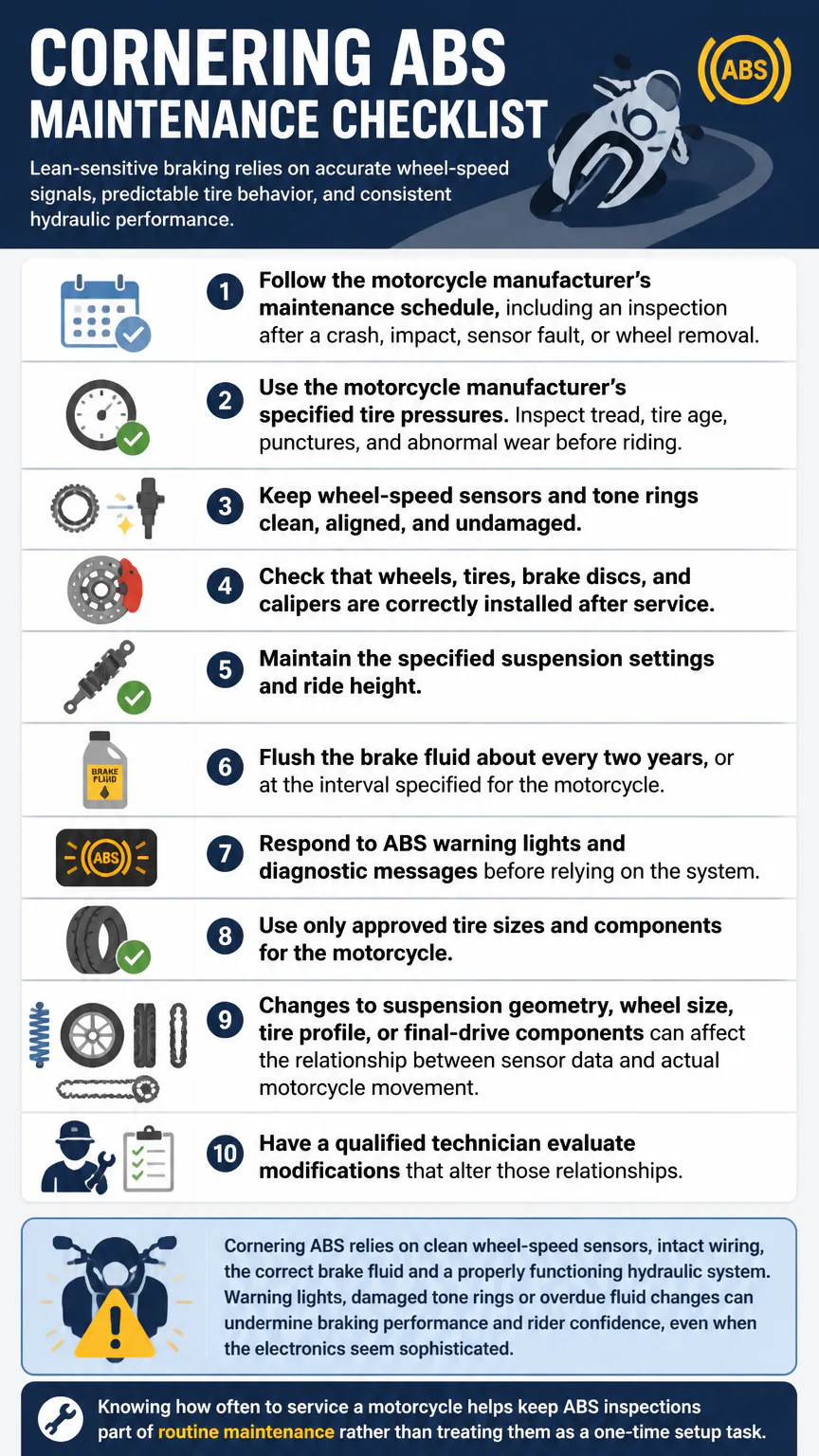
Lean-sensitive braking relies on accurate wheel-speed signals, predictable tire behavior, and consistent hydraulic performance. Follow the motorcycle manufacturer’s maintenance schedule, including an inspection after a crash, impact, sensor fault, or wheel removal.
- Use the motorcycle manufacturer’s specified tire pressures.
- Inspect tread, tire age, punctures, and abnormal wear before riding.
- Keep wheel-speed sensors and tone rings clean, aligned, and undamaged.
- Check that wheels, tires, brake discs, and calipers are correctly installed after service.
- Maintain the specified suspension settings and ride height.
- Flush the brake fluid about every two years, or at the interval specified for the motorcycle.
- Respond to ABS warning lights and diagnostic messages before relying on the system.
- Use only approved tire sizes and components for the motorcycle.
Changes to suspension geometry, wheel size, tire profile, or final-drive components can affect the relationship between sensor data and actual motorcycle movement. Have a qualified technician evaluate modifications that alter those relationships.
Cornering ABS relies on clean wheel-speed sensors, intact wiring, the correct brake fluid and a properly functioning hydraulic system. Warning lights, damaged tone rings or overdue fluid changes can undermine braking performance and rider confidence, even when the electronics seem sophisticated. Knowing how often to service a motorcycle helps keep ABS inspections part of routine maintenance rather than treating them as a one-time setup task.
Common cornering mistakes
Entering a corner too quickly creates a braking problem before the turn begins. Fixating on the outside edge, standing the motorcycle up while braking, or suddenly closing the throttle can cause the motorcycle to run wide even when the tires still have some grip. A late, abrupt brake application also gives the system less time to manage the change in load.
Do not treat an ABS-equipped motorcycle as permission to brake at maximum force throughout every corner. Set an appropriate entry speed, complete most heavy braking while upright, and use only the pressure needed to adjust speed or direction once leaned.
Does ABS allow steering while braking?
Yes. A motorcycle with ABS can continue to steer while braking, and cornering ABS is intended to manage braking during a turn. Steering authority still depends on available traction, lean angle, speed, surface condition, and the rider’s control inputs.
ABS does not guarantee that the motorcycle will hold its line. Keep the motorcycle pointed toward an open escape path, avoid abrupt steering changes, and release brake pressure when traction or stability begins to deteriorate.
What is the 12-second rule on a motorcycle?
The 12-second rule is a visual scanning habit: identify the part of the road the motorcycle will reach in about 12 seconds, then keep updating that view as conditions change. This gives the rider more time to recognize a stopped vehicle, tightening turn, surface hazard, or escape route before emergency braking becomes necessary.
The rule is not a braking-distance calculation. Speed, visibility, traffic, and road conditions determine how far ahead the rider can see and how much time is actually available.
What is the 70/30 brake rule?
The 70/30 rule is a basic training guideline that assigns more braking force to the front brake than the rear because deceleration transfers weight toward the front wheel. It is not a fixed ratio for every motorcycle, speed, surface, or braking event.
Use the manufacturer’s recommended technique and practice progressive use of both brakes. During hard braking, front and rear loading change continuously, so controlled pressure that keeps both tires working is more useful than a rigid 70/30 split.
FAQs
Can cornering ABS prevent a low-side crash?
It can reduce the risk of a brake-induced low-side by managing pressure while the motorcycle is leaned. It cannot prevent a low-side caused by excessive speed, insufficient tire grip, a contaminated surface, or a loss of traction unrelated to braking.
Does cornering ABS stop the motorcycle from standing up?
It reduces the abrupt braking forces that can make a motorcycle stand up and run wide. The motorcycle can still change direction under braking because tire forces, steering input, suspension movement, and road conditions continue to affect its path.
Can cornering ABS be turned off?
Some motorcycles allow riders to change ABS modes, while others keep front-wheel ABS active in every road setting. The available controls and consequences depend on the motorcycle, so use the owner’s manual rather than assuming that a mode switch disables every ABS function.
Is cornering ABS the same as cornering traction control?
No. Cornering ABS manages brake pressure when wheel lockup is imminent. Cornering traction control manages engine torque when rear-wheel slip is detected, although both systems can use information from the same inertial sensor package.
Cornering ABS reduces brake pressure when it senses that a wheel is about to lock, while traction control cuts engine torque when a driven wheel starts to spin. Both systems may use lean-angle and wheel-speed data, so they can feel similar in a turn, but they intervene for opposite reasons. Understanding motorcycle traction control makes the difference clear: traction control supports acceleration, while cornering ABS supports braking.
How does ABS feel when it activates?
Activation can produce a pulsing sensation at the brake lever or pedal and a rapid change in braking force. Some interventions are difficult to feel, especially when the system makes small, high-frequency adjustments.
Does a motorcycle need cornering ABS for safe riding?
No. Safe riding still depends on speed control, observation, tire condition, braking technique, and training. Cornering ABS adds a valuable layer of control during an emergency, but it does not replace those fundamentals.
Conclusion
Cornering ABS reads motorcycle movement and wheel behavior, estimates the grip available while leaned, and regulates brake pressure before a wheel locks. Treat it as a safety margin: maintain the motorcycle carefully, brake heavily while upright when possible, and use progressive trail braking rather than relying on electronics to overcome limited traction.