Motorcycle 0–60 Rankings: Fastest Street-legal Bikes Compared
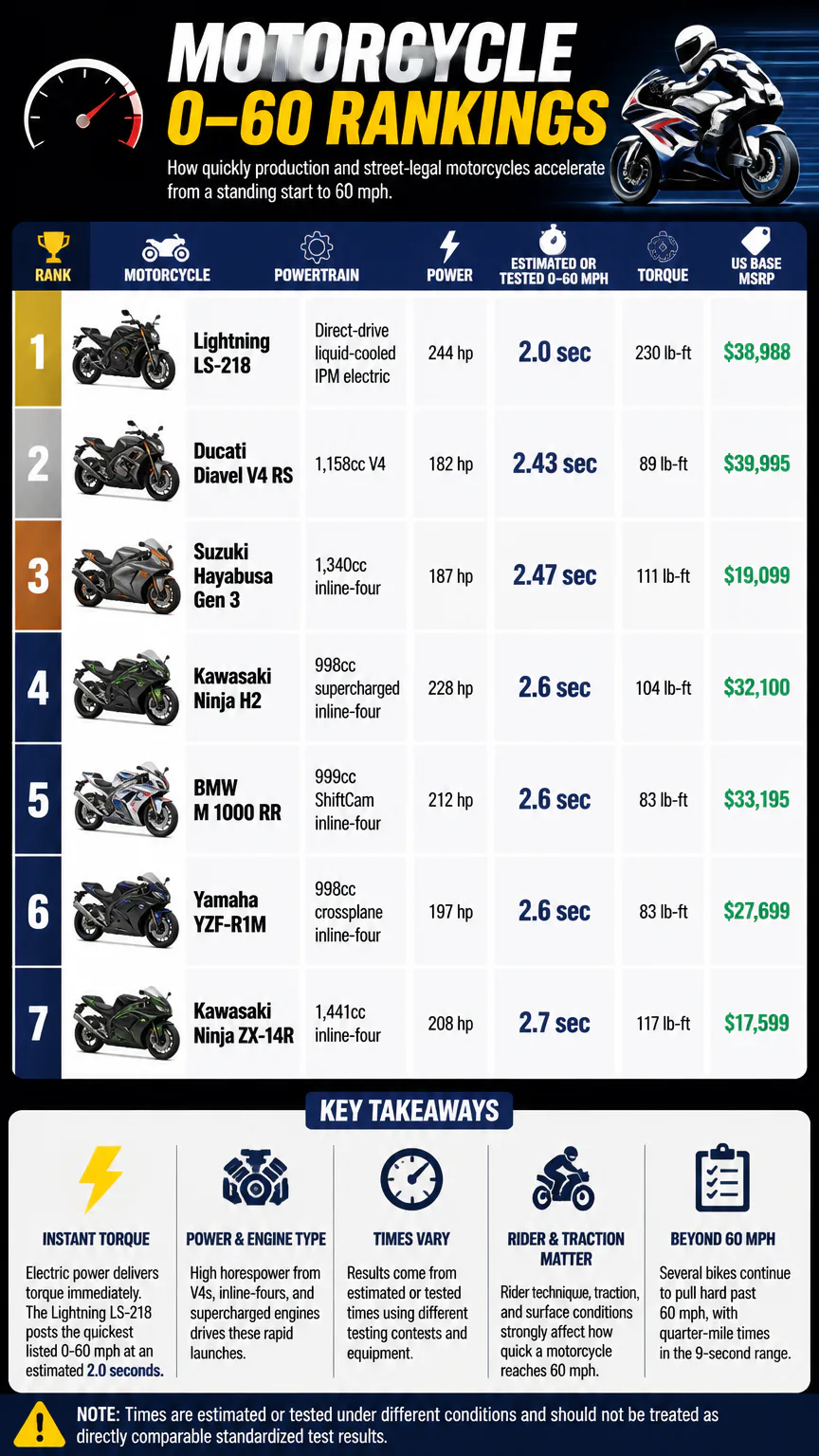
Motorcycle 0-60 rankings show how quickly production bikes launch, rather than how fast they are at maximum speed. The quickest machines can reach 60 mph in about two seconds, but horsepower is only part of the result. Rider technique, tire grip, launch electronics, timing equipment, temperature and altitude all matter. Estimated figures and independently tested times are therefore not directly identical measurements.
Top Motorcycle 0-60 Rankings
| Rank | Motorcycle | Powertrain | Power | Estimated or tested 0–60 mph | Torque | US base MSRP |
|---|---|---|---|---|---|---|
| 1 | Lightning LS-218 | Direct-drive liquid-cooled IPM electric | 244 hp | 2.0 sec | 230 lb-ft | $38,988 |
| 2 | Ducati Diavel V4 RS | 1,158cc V4 | 182 hp | 2.43 sec | 89 lb-ft | $39,995 |
| 3 | Suzuki Hayabusa Gen 3 | 1,340cc inline-four | 187 hp | 2.47 sec | 111 lb-ft | $19,099 |
| 4 | Kawasaki Ninja H2 | 998cc supercharged inline-four | 228 hp | 2.6 sec | 104 lb-ft | $32,100 |
| 5 | BMW M 1000 RR | 999cc ShiftCam inline-four | 212 hp | 2.6 sec | 83 lb-ft | $33,195 |
| 6 | Yamaha YZF-R1M | 998cc crossplane inline-four | 197 hp | 2.6 sec | 83 lb-ft | $27,699 |
| 7 | Kawasaki Ninja ZX-14R | 1,441cc inline-four | 208 hp | 2.7 sec | 117 lb-ft | $17,599 |
Lightning LS-218
The Lightning LS-218 has the quickest listed 0-60 mph result at an estimated 2.0 seconds. Its direct-drive, liquid-cooled IPM electric powertrain delivers torque immediately, without the shift interruption of a conventional motorcycle. With 244 horsepower, it has the output for exceptional standing-start acceleration when the tires and surface can put that torque to the ground.
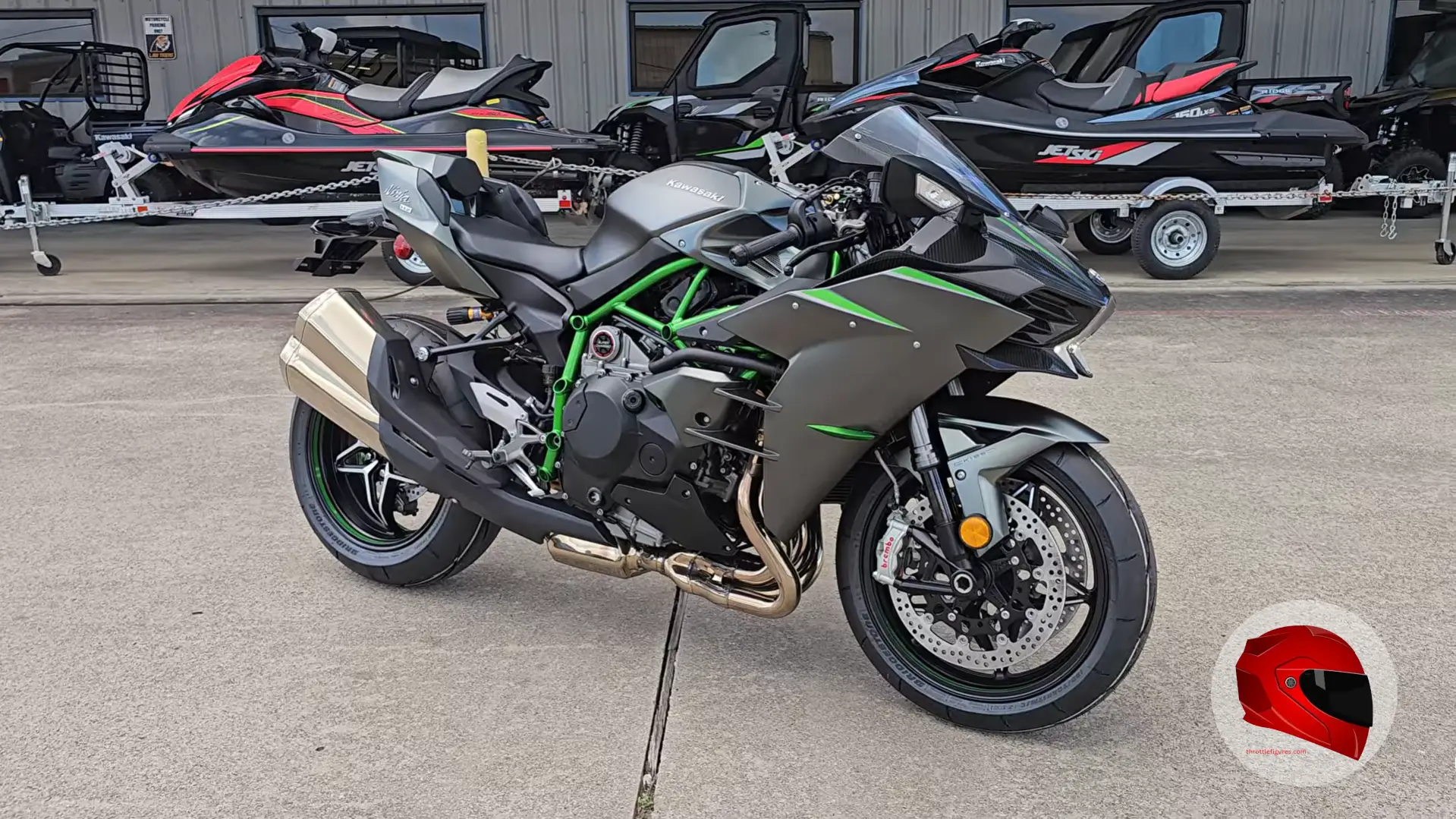
The LS-218 is aimed at riders who want electric performance and instant response. Its battery weight, charging access, riding range and limited availability affect everyday use, however. The 2.0-second figure is an estimate, so it should not be treated as a directly comparable standardized test result.
Ducati Diavel V4 RS
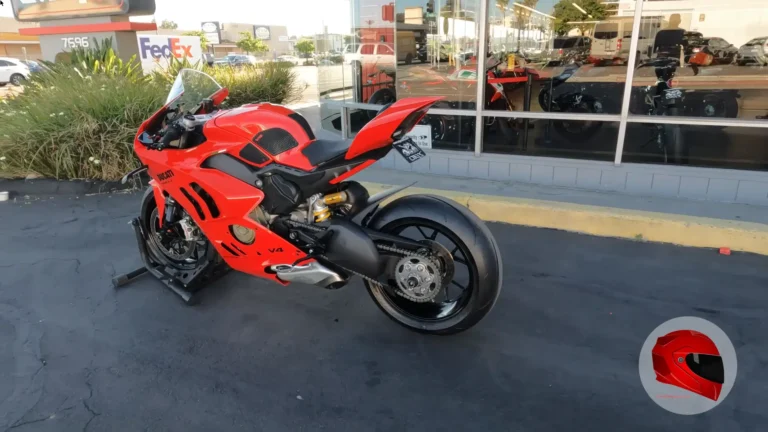
The Ducati Diavel V4 RS pairs power-cruiser ergonomics with a 1,158cc V4 producing 182 horsepower. Its reported 2.43-second 0-60 mph time puts it ahead of most conventional superbikes in this ranking. The broad torque delivery and upright riding position give it a different acceleration character from a fully faired race-replica motorcycle.
It suits riders who want dramatic launches without the crouched ergonomics of a pure sportbike. A powerful upright motorcycle still requires careful throttle control during a launch, and the reported time comes from a different testing context than the estimated figures assigned to several other motorcycles.
Suzuki Hayabusa Gen 3
The third-generation Suzuki Hayabusa uses a 1,340cc inline-four engine with 187 horsepower and an estimated 0-60 mph time of 2.47 seconds. Its large-displacement engine delivers strong acceleration across a broad speed range, while the aerodynamic bodywork supports high-speed stability and long-distance riding.
The Hayabusa gives riders hyperbike acceleration along with substantial road manners. Its size and mass require more commitment at low speed than a lightweight superbike. Launch performance also depends on controlling the front wheel while maintaining rear-tire traction. Its 9.47-second quarter-mile time shows that the acceleration continues well beyond 60 mph.
Kawasaki Ninja H2
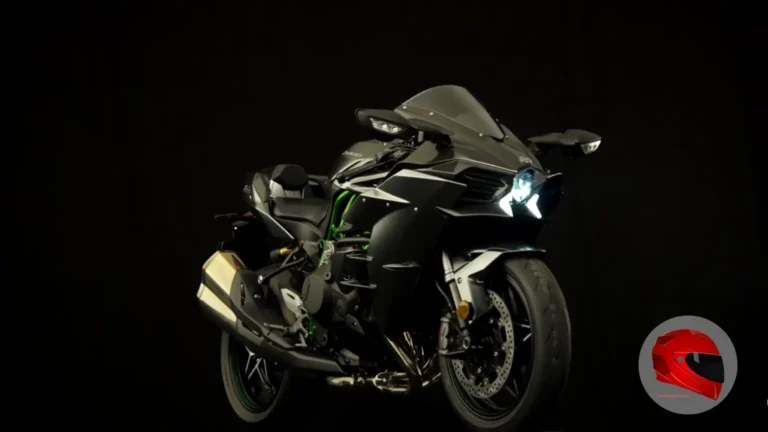
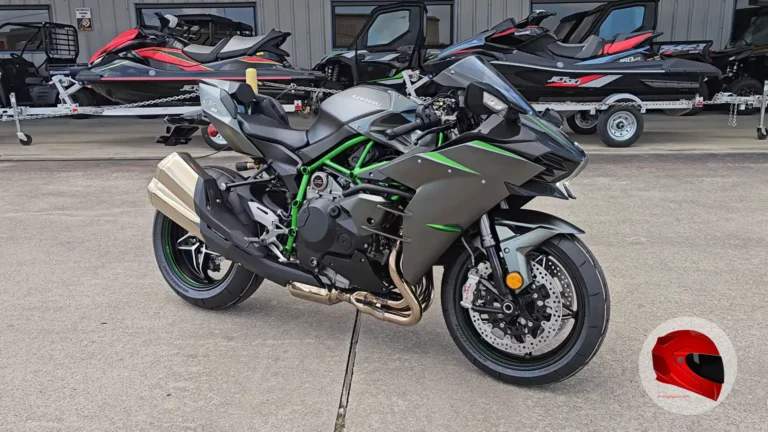
The Kawasaki Ninja H2 uses a 998cc supercharged inline-four rated at 228 horsepower. Its estimated 2.6-second 0-60 mph time places it among the fastest street-legal production motorcycles. The supercharger continues to build strong power as speed rises.
The H2 suits riders who value engine intensity and high-speed acceleration as much as the initial launch. Its 228-horsepower output makes traction management especially important, and reproducing its performance consistently on ordinary public roads is difficult. Its estimated 9.62-second quarter-mile time confirms that the engine remains effective after the first 60 mph.
BMW M 1000 RR
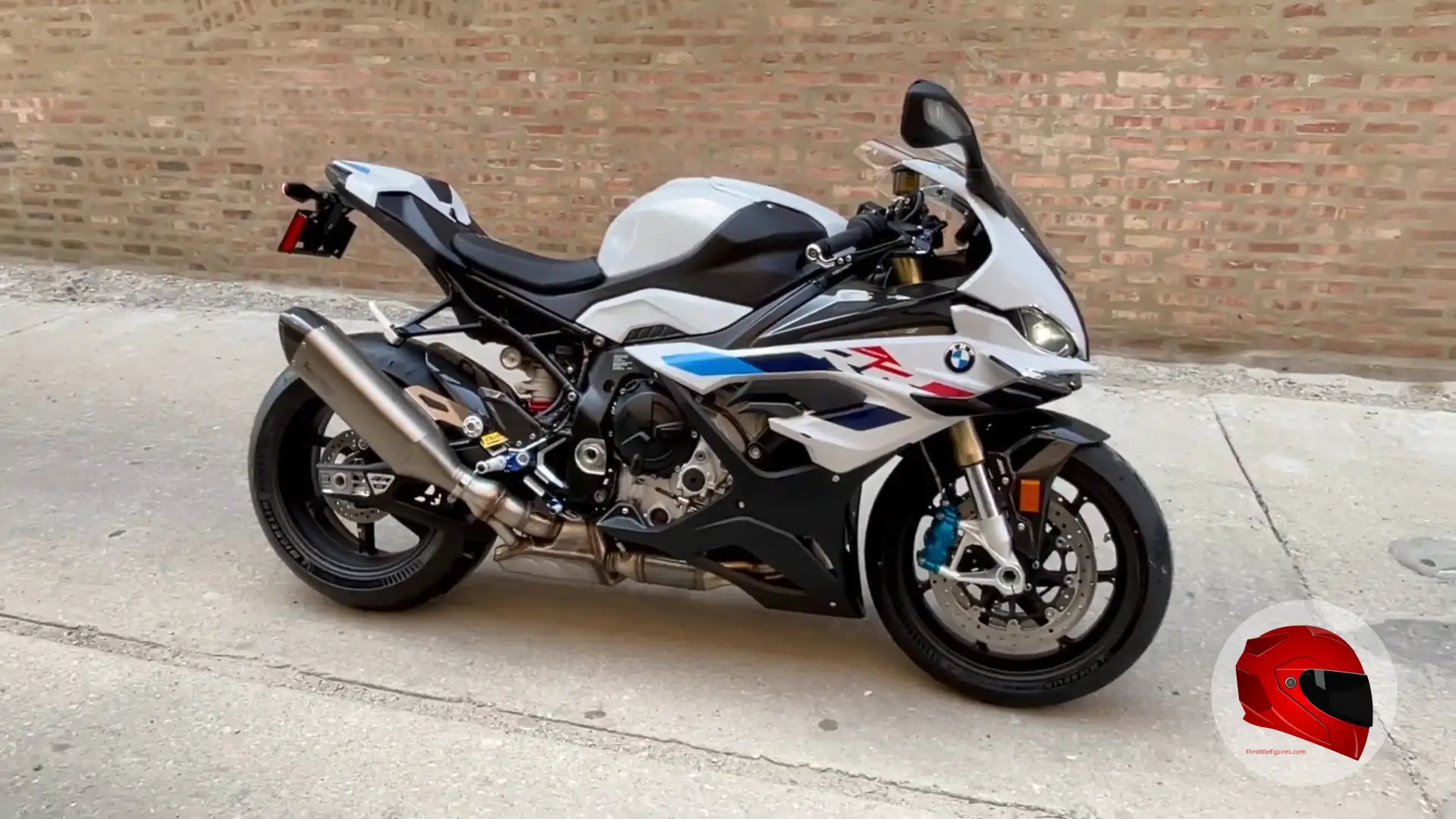
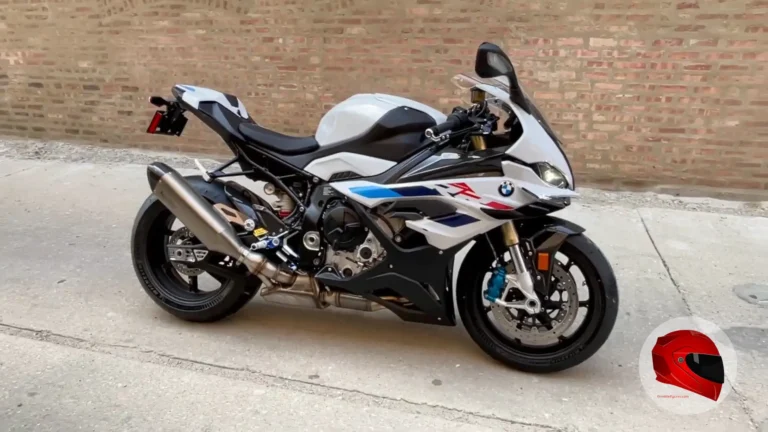
The BMW M 1000 RR reaches an estimated 0-60 mph in 2.6 seconds from a 999cc ShiftCam inline-four producing 212 horsepower. Variable valve timing supports its high output, while the chassis and aerodynamic design focus on precise control at speed.
This motorcycle is built around superbike acceleration and track-focused handling. Its relatively compact engine does not limit performance; power-to-weight ratio, gearing, electronics and riding position matter just as much as displacement. The estimated time ties it with several other motorcycles, so launch quality and test equipment can determine the order in a direct comparison.
Yamaha YZF-R1M
The Yamaha YZF-R1M uses a 998cc crossplane inline-four engine producing 197 horsepower and an estimated 2.6-second 0-60 mph time. The crossplane crankshaft gives the engine its distinctive firing character and supports controlled power delivery during hard acceleration.
The R1M is intended for riders who value superbike handling, feedback and track capability alongside straight-line speed. Its riding position and focused chassis are less suited to relaxed commuting or touring. The 2.6-second figure is an estimate, so the R1M belongs in the same acceleration tier as the H2 and M 1000 RR rather than in a guaranteed finishing order.
Kawasaki Ninja ZX-14R
The Kawasaki Ninja ZX-14R has the largest engine in this primary ranking: a 1,441cc inline-four producing 208 horsepower. Its estimated 2.7-second 0-60 mph time is only slightly behind the 2.6-second group. The 9.47-second quarter-mile time shows how effectively its displacement supports continued acceleration.
The ZX-14R gives riders strong straight-line performance from a substantial high-speed platform. Its size and weight make it less nimble than a dedicated liter-class superbike, but they can also contribute to stability during fast road riding. Launch technique remains important because the engine can overwhelm rear-tire grip when the throttle is opened too aggressively.
Requirements and context
A genuine 0-60 mph run belongs on a closed-course drag strip or another controlled private facility. Public-road testing creates legal and safety problems. A prepared surface also gives the motorcycle a repeatable chance to use its power without traffic, intersections or unpredictable hazards.
- Use a closed course with adequate runoff and emergency access.
- Wear a certified helmet, protective riding gear, gloves and motorcycle boots.
- Check tire condition, pressure, chain adjustment, brakes and fuel or battery charge.
- Use GPS-based timing equipment or a calibrated performance logger.
- Record rider weight, weather, temperature, altitude, surface condition and wind.
- Repeat the run in both directions when the facility allows it.
Launch control, wheelie control, traction control, clutch technique and rider weight can change the result by several tenths of a second. A manufacturer estimate, an independent test and a rider’s personal run are separate data points, even when they involve the same motorcycle.
The fastest gasoline motorcycles
The Ducati Diavel V4 RS and Suzuki Hayabusa Gen 3 sit at the top of the gasoline-powered motorcycles in this ranking. The Diavel uses a 1,158cc V4 with 182 horsepower, while the Hayabusa uses a 1,340cc inline-four with 187 horsepower. Their near-identical times show that engine layout and displacement do not determine launch performance by themselves.
The Kawasaki Ninja H2 adds forced induction to a 998cc inline-four and produces 228 horsepower. The BMW M 1000 RR and Yamaha YZF-R1M use 999cc and 998cc engines, yet their 2.6-second estimates put them beside the supercharged Kawasaki. Aerodynamics, gearing, electronics, chassis setup and rider technique narrow much of the apparent displacement gap.
Other fast gasoline motorcycles include the KTM 1290 Super Duke R at a tested 2.6 seconds, the Honda CBR1000RR-R Fireblade at an estimated 2.7 seconds and the Aprilia RSV4 1100 Factory at an estimated 2.7 seconds. The KTM uses a 1,301cc V-twin with 180 horsepower, while the Honda and Aprilia produce 214 and 220 horsepower respectively. All three sit in the same broad performance tier as the motorcycles in the primary ranking.
Many of the fastest gasoline motorcycles in 0-60 rankings are liter-class bikes, combining high-revving engines, advanced electronics and lightweight chassis for strong launches. Engine size alone does not guarantee the quickest time, but comparing the fastest 1000cc motorcycles shows how closely modern superbikes compete in this performance class.
How to compare 0-60 times fairly
Separate tested figures from estimates first. A tested time has a defined rider, surface, timing system, weather condition and launch method. An estimate can still show a motorcycle’s general performance level, but it does not prove that one model will beat another in every run.
- Confirm that each figure measures 0-60 mph rather than 0-100 km/h.
- Check whether the number was tested, reported or estimated.
- Confirm that the motorcycle was stock and street-legal in the stated configuration.
- Compare rider weight, launch electronics, tire condition and surface preparation.
- Use repeated runs instead of relying on one best pass.
For a buying decision, the smallest numerical difference deserves the least emphasis. A 2.6-second motorcycle can be faster or slower than a 2.47-second motorcycle in a real launch if the rider, tires, temperature and traction differ. Quarter-mile performance, braking, chassis control, comfort and ownership requirements also matter once the bikes are already below three seconds.
A bike with huge horsepower can still lose a 0-60 sprint if it weighs more or struggles to put its power down. Comparing motorcycle power-to-weight ratios adds context when two motorcycles record similar times despite having different engines and chassis designs.
Top 10 fastest motorcycles
The primary table contains seven comparable entries. Three additional street-legal production motorcycles bring the group to ten: the KTM 1290 Super Duke R at a tested 2.6 seconds, the Honda CBR1000RR-R Fireblade at an estimated 2.7 seconds and the Aprilia RSV4 1100 Factory at an estimated 2.7 seconds. These entries should be read with care because tested and estimated figures do not carry the same evidentiary weight.
Top 20 fastest motorcycles
A defensible top-20 list requires consistent 0-60 mph measurements for twenty named production motorcycles. The available comparison supports ten entries, so this article uses a defined top-10 cutoff instead of presenting an unsupported top 20. Racing-only, modified, custom and streamliner motorcycles also belong in separate categories when their testing conditions differ from those of street-legal production bikes.
0-60 versus 0-100 mph
0-60 mph focuses on the launch, where traction, wheel lift, clutch work and launch electronics have an outsized effect. A 0-100 mph result includes the acceleration from 60 to 100 mph, making gearing, aerodynamic drag, power delivery and high-speed stability more important. Motorcycles that are close at 0-60 can change order at 0-100, even when both figures are measured correctly.
Comparable verified 0-100 mph results are not available for the motorcycles in this ranking, so no defensible 0-100 mph order is assigned. The listed 0-60 figures should not be converted into 0-100 estimates or treated as evidence of a specific high-speed ranking.
A quick 0-60 time mostly comes down to the launch. Reaching 100 mph also shows how well the engine keeps pulling beyond it, while quarter-mile results bring traction, gearing, aerodynamics and sustained acceleration together. That makes the fastest quarter-mile motorcycles useful for comparison.
Production-bike records versus speed records
A production-bike 0-60 record concerns acceleration by a road-legal motorcycle built for customer sale. An outright motorcycle speed record concerns maximum speed and usually involves a land-speed vehicle, racing machine, streamliner or heavily modified motorcycle. These categories use different vehicles and test conditions, so an outright speed record cannot rank production-bike acceleration.
How comparable is each time?
| Result type | What it indicates | How to compare it |
|---|---|---|
| Tested | A measured run with a stated rider, timing method, surface and conditions | Most useful when the other results use similar conditions |
| Reported | A published performance figure whose full test setup may differ | Use as a performance reference, not an exact finish order |
| Estimated | A calculated or projected acceleration figure | Use to identify a performance tier rather than a standardized ranking |
| Any result | Acceleration affected by rider technique, traction, weather, equipment and surface | Give close times a range of uncertainty instead of treating hundredths as decisive |
How to verify a motorcycle 0-60 time
Compare performance figures by test method, not just by the number beside them. Start with the manufacturer’s specification or performance claim, then look for an independent instrumented test and a performance database that identifies its measurement method.
- Record the manufacturer’s claimed or published 0-60 mph figure and label it as a claim.
- Find an independent test with a named timing system, rider, surface, launch method and vehicle configuration.
- Use a performance database to compare additional runs, checking whether it distinguishes tested, reported and estimated figures.
- Write down tire condition, rider weight, weather, altitude, rollout and electronic settings before comparing times.
- Give priority to repeated instrumented runs conducted under similar conditions. Keep manufacturer claims and unlike test results as separate reference points.
FAQs
What is the fastest motorcycle from 0 to 60 mph?
The Lightning LS-218 has the fastest listed result in this ranking, with an estimated 0-60 mph time of 2.0 seconds. Its direct-drive electric powertrain provides immediate torque, but the figure is not a standardized test comparison with every gasoline motorcycle.
Why do motorcycle 0-60 times vary?
Rider skill, launch technique, rider weight, tire grip, surface preparation, weather, temperature, altitude and timing equipment all affect the result. Electronic settings and wheelie control can also change how much power reaches the ground.
Are these motorcycles safe to test on public roads?
Hard-launch testing should be performed only on a closed course with proper protective equipment and sufficient runoff. Public roads add traffic, legal restrictions, pedestrians and unpredictable surfaces that make acceleration testing unsafe.
Is a 1,000cc motorcycle always faster than a larger motorcycle?
No. The Kawasaki Ninja H2, BMW M 1000 RR and Yamaha YZF-R1M use engines near 1,000cc but occupy the same acceleration tier as larger motorcycles. Power-to-weight ratio, gearing, traction, aerodynamics and launch electronics are also important.
What is Jay Leno’s motorcycle collection worth?
There is no single fixed value for Jay Leno’s motorcycle collection. Estimates vary with the valuation date, the rarity and provenance of individual motorcycles, and whether an estimate includes his cars as well as his motorcycles.
Conclusion
The Lightning LS-218 leads this ranking with an estimated 2.0-second 0-60 mph run, while the fastest gasoline motorcycles cluster between 2.43 and 2.7 seconds. Use those figures as performance benchmarks, then consider power delivery, chassis, riding position and the controlled conditions required to reproduce them safely.

One Comment
Comments are closed.