Kawasaki Ninja H2 vs H2R: Power, Speed, Legality, and Real-world Use
The Kawasaki Ninja H2 and Kawasaki Ninja H2R share a 998cc supercharged inline-four engine, but they are built for different jobs. The H2 is street legal and suited to road riding with occasional track use. The H2R gives up road equipment and regulatory compliance for more power, less weight and closed-course performance. The choice depends on legality, transport, running costs, track access and whether the extra $27,700 MSRP has a place on a closed circuit.
Ninja H2 vs H2R Specs and Price
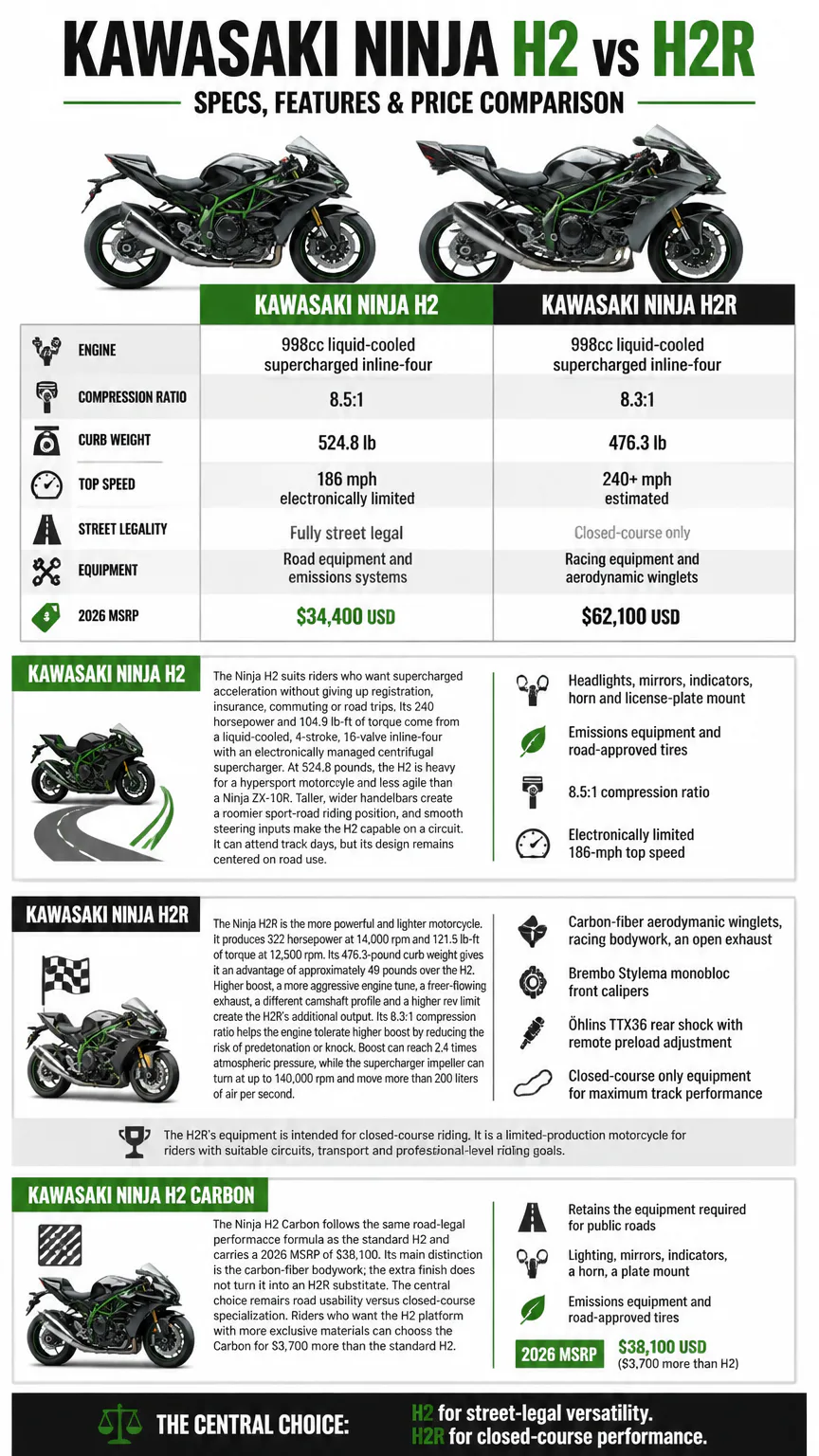
| Specification | Kawasaki Ninja H2 | Kawasaki Ninja H2R |
|---|---|---|
| Engine | 998cc liquid-cooled supercharged inline-four | 998cc liquid-cooled supercharged inline-four |
| Compression ratio | 8.5:1 | 8.3:1 |
| Curb weight | 524.8 lb | 476.3 lb |
| Top speed | 186 mph electronically limited | 240+ mph estimated |
| Street legality | Fully street legal | Closed-course only |
| Equipment | Road equipment and emissions systems | Racing equipment and aerodynamic winglets |
| 2026 MSRP | $34,400 USD | $62,100 USD |
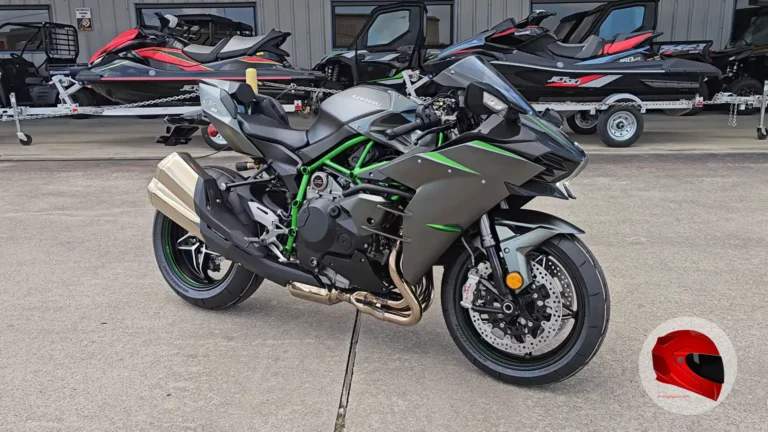
Kawasaki Ninja H2
The Ninja H2 suits riders who want supercharged acceleration without giving up registration, insurance, commuting or road trips. Its 240 horsepower and 104.9 lb-ft of torque come from a liquid-cooled, 4-stroke, 16-valve inline-four with an electronically managed centrifugal supercharger.
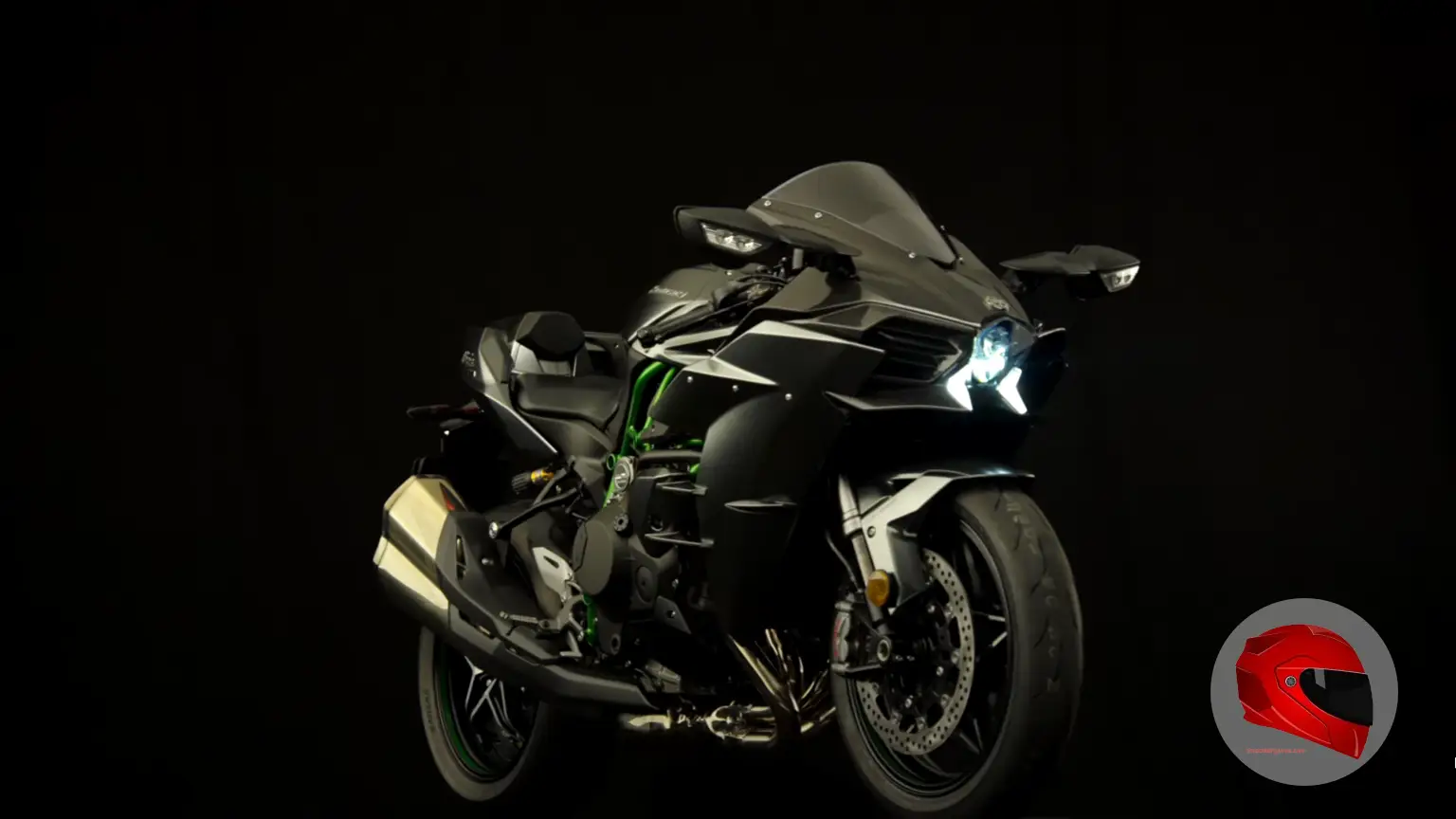
At 524.8 pounds, the H2 is heavy for a hypersport motorcycle and less agile than a Ninja ZX-10R. Taller, wider handlebars create a roomier sport-road riding position, and smooth steering inputs make the H2 capable on a circuit. It can attend track days, but its design remains centered on road use.
- Headlights, mirrors, indicators, horn and license-plate mount
- Emissions equipment and road-approved tires
- 8.5:1 compression ratio
- Electronically limited 186-mph top speed
Kawasaki Ninja H2R
The Ninja H2R is the more powerful and lighter motorcycle. It produces 322 horsepower at 14,000 rpm and 121.5 lb-ft of torque at 12,500 rpm. Its 476.3-pound curb weight gives it an advantage of approximately 49 pounds over the H2.
Higher boost, a more aggressive engine tune, a freer-flowing exhaust, a different camshaft profile and a higher rev limit create the H2R’s additional output. Its 8.3:1 compression ratio helps the engine tolerate higher boost by reducing the risk of predetonation or knock. Boost can reach 2.4 times atmospheric pressure, while the supercharger impeller can turn at up to 140,000 rpm and move more than 200 liters of air per second.
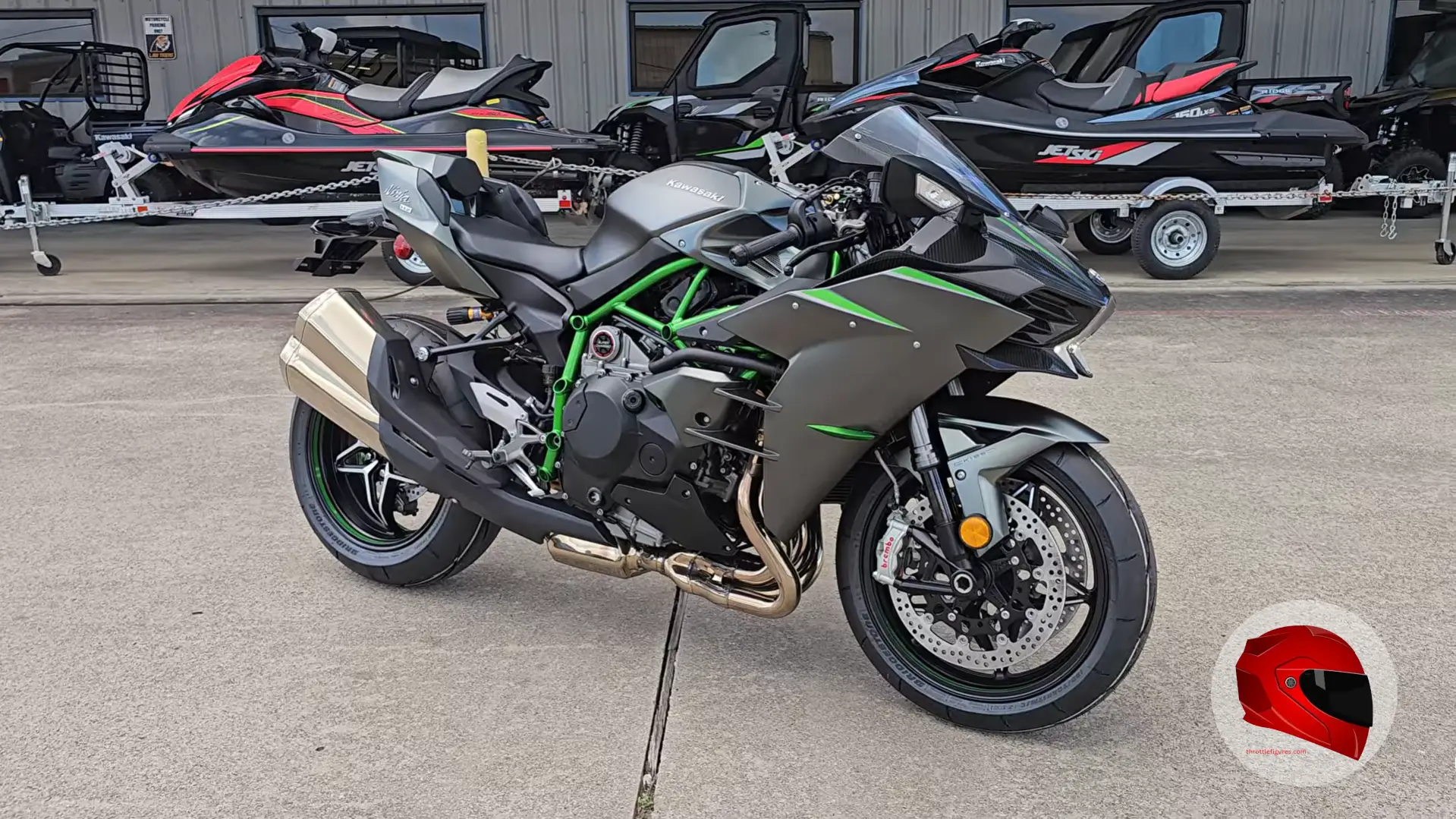
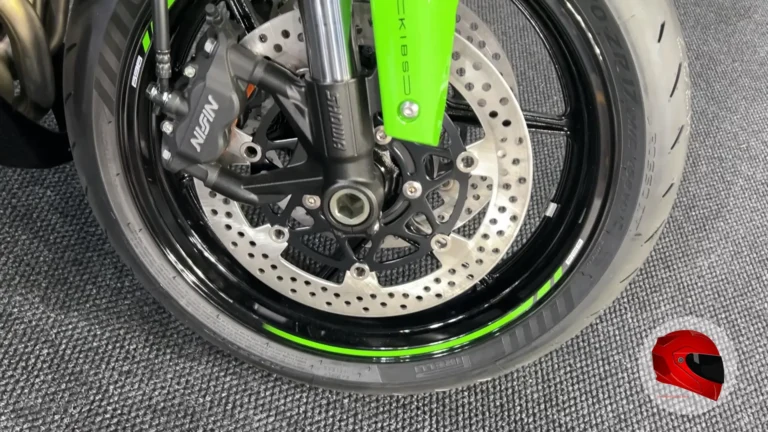
The H2R’s equipment is intended for closed-course riding. Carbon-fiber aerodynamic winglets, racing bodywork, an open exhaust, Brembo Stylema monobloc front calipers and an Öhlins TTX36 rear shock with remote preload adjustment support track performance. It is a limited-production motorcycle for riders with suitable circuits, transport and professional-level riding goals.
Kawasaki Ninja H2 Carbon
The Ninja H2 Carbon follows the same road-legal performance formula as the standard H2 and carries a 2026 MSRP of $38,100. Its main distinction is the carbon-fiber bodywork; the extra finish does not turn it into an H2R substitute. The central choice remains road usability versus closed-course specialization.
Riders who want the H2 platform with more exclusive materials can choose the Carbon for $3,700 more than the standard H2. It retains the equipment required for public roads, including lighting, mirrors, indicators, a horn, a plate mount, emissions equipment and road-approved tires.
Requirements and context
The H2 can be titled, registered, insured and ridden on public roads in the United States when it meets the requirements of the owner’s state. Registration still involves the state Department of Motor Vehicles, proof of ownership, taxes and fees, and the motorcycle insurance required by local law.
The H2R cannot be registered for public-road use because it lacks required road equipment and is not configured for street emissions and noise rules. It must be transported to a suitable closed course, such as Losail International Circuit, in a properly secured trailer or professional freight vehicle. A track-only insurance policy may be relevant because ordinary motorcycle policies do not automatically cover circuit riding.
- Use the H2 for public roads, commuting, touring and occasional track days.
- Use the H2R only at a closed course with an appropriate transport plan.
- Title, registration, insurance and tax requirements vary by state, and the H2 must satisfy the owner’s state requirements before it is ridden on public roads.
- Budget for destination charges, dealer fees, taxes, freight, tires, fuel, maintenance and protective equipment beyond MSRP.
Performance and engineering
Both motorcycles use a centrifugal supercharger for strong acceleration. Electronic systems manage traction, engine braking, launch behavior and chassis inputs. The supercharger technology also draws on Kawasaki’s broader aerospace and industrial engineering expertise.
The H2R’s extra output does not come from a simple software change. It uses higher boost and more aggressive calibration, along with hardware and exhaust changes that would not suit a street-legal motorcycle. The lower compression ratio supports that boost level, while the H2R’s lighter chassis package reduces the mass the engine must accelerate.
The power-to-weight difference affects both acceleration and handling. Compared with the heavier H2, the H2R offers greater agility, stability and feedback, with less fore-and-aft weight transfer. Both motorcycles sit between the more traditional naturally aspirated Ninja ZX-14R and the lighter, sharper Ninja ZX-10R in overall character, although neither matches the ZX-10R’s focused agility.
Horsepower alone does not determine how fast the H2 or H2R will go. Aerodynamics, gearing, tire limits, rider position and the length of the run all affect the result. The H2R’s track-focused bodywork and setup can therefore matter nearly as much as its engine output when comparing published figures. These motorcycle top speed factors help explain the gap between theoretical performance, test results and real-world runs.
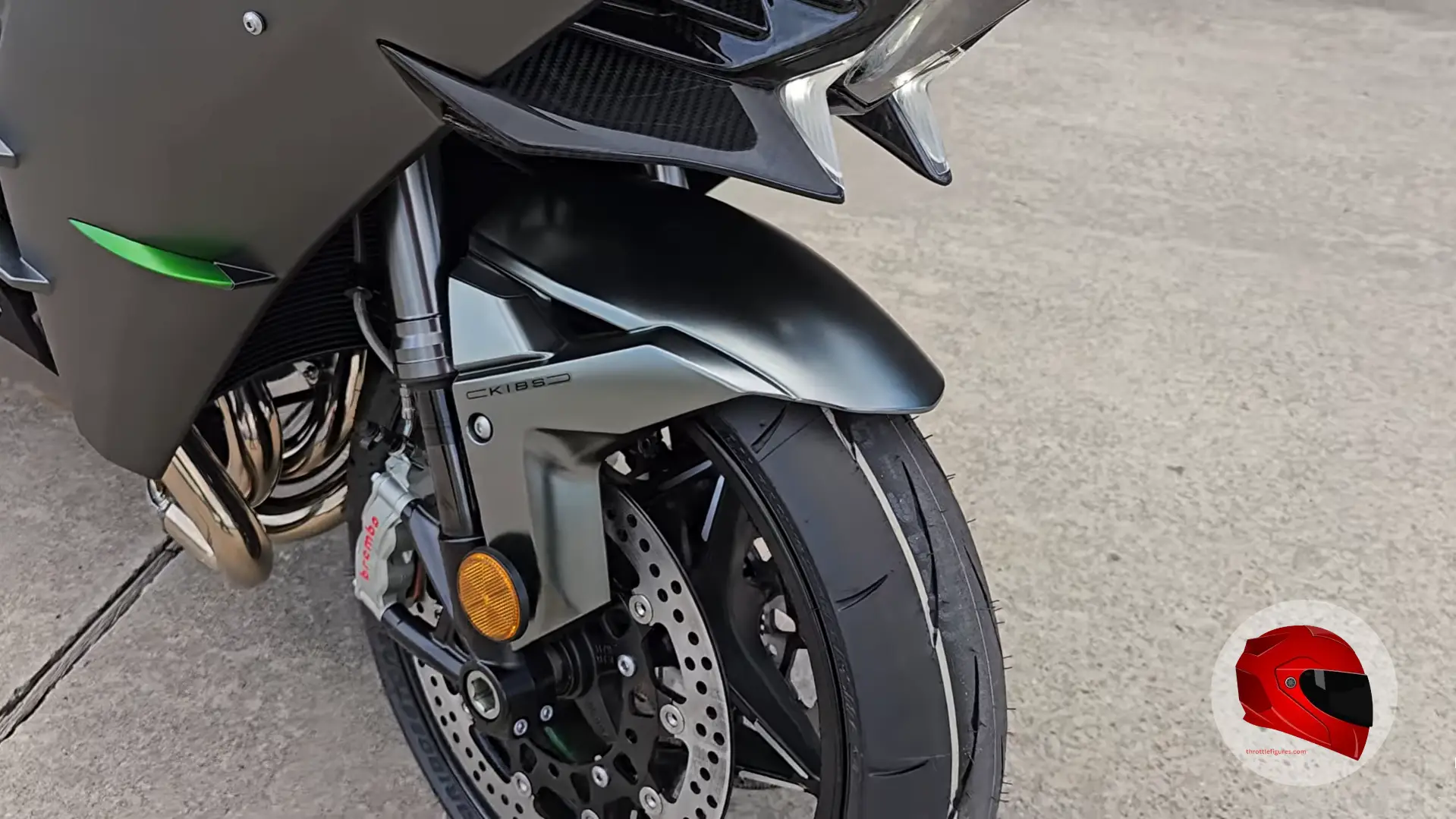
Kawasaki Ninja h2: Road-ready performance
The H2’s road equipment adds weight, but it also simplifies ownership. Headlights, mirrors, turn indicators, a horn, a license-plate mount, emissions hardware and road tires let the motorcycle leave the garage under its own power for a public-road ride. Its taller and wider handlebars give it a roomier riding position than the ZX-10R, which suits longer road use.
The 186-mph electronic limit is already beyond legal public-road speeds, so it does not restrict normal riding. The H2 delivers strong highway acceleration and enough performance for track days, while its road compliance avoids the transport and venue requirements associated with H2R ownership.
The compromises are weight, cost, heat, tire wear and the skill needed to manage supercharged power. The H2 is not an inexpensive commuter, even though it is the more usable motorcycle for most owners. Its 2026 MSRP is $34,400 before taxes, freight, dealer charges and registration costs.
Kawasaki Ninja h2r: Maximum track performance
The H2R’s commonly cited top-speed range is approximately 220-240-plus mph. That performance belongs only on a controlled circuit with sufficient runoff, suitable surface conditions, safety procedures and a properly prepared rider.
Its Bosch inertial measurement unit works with Kawasaki dynamic modeling software and rider aids such as Kawasaki Launch Control Mode, Kawasaki Traction Control, Kawasaki Engine Brake Control and Kawasaki Intelligent anti-lock Brake System. Brembo Stylema front calipers and the Öhlins TTX36 rear shock add track-focused hardware, while the winglets help manage aerodynamic load at high speed.
The H2R’s $62,100 2026 MSRP is $27,700 higher than the standard H2 and $24,000 higher than the H2 Carbon. That premium buys substantially more power, lower weight and racing equipment, but it does not provide road access. The H2R makes sense for a rider with regular access to suitable closed-course facilities and the budget for transport, setup, tires, maintenance and coaching.
The H2R’s advantage is clearest from a standing start, where supercharged torque, launch control and traction determine how quickly it puts its power down. A quarter-mile run often says more than a single top-speed figure because it measures acceleration over a fixed distance. It also shows why a track-only bike should not be judged by street usability alone, placing the H2R alongside the fastest quarter-mile motorcycles.
How to buy and register
New H2 and H2R purchases often involve limited allocation and special-order timing. An authorized Kawasaki dealer is the right starting point for availability, pricing beyond MSRP, financing, documentation and delivery arrangements.
- Decide whether the motorcycle will be registered for road use or transported exclusively to a closed course.
- Contact an authorized Kawasaki dealer about current allocation, model availability, dealer charges and delivery timing.
- Compare the complete out-the-door cost, including destination, taxes, title, registration, freight and setup.
- Arrange financing and insurance that match the motorcycle’s intended use.
- Inspect the vehicle identification number, purchase documents and title status before accepting delivery.
- Register the H2 through the state Department of Motor Vehicles before riding it on public roads.
Cycle Trader can help locate used H2, H2 Carbon and H2R listings across the United States, although condition, mileage, modifications, title status and asking price vary by seller. The Kawasaki Dealer Locator helps identify nearby authorized dealers for new-bike inquiries, service, parts and warranty support. A used H2R remains closed-course only regardless of its age or ownership history.
FAQs
Is the Ninja H2 or H2R faster?
The Ninja H2R is faster. It produces 322 hp at 14,000 rpm and has an estimated top speed of 240+ mph, while the Ninja H2 produces 240 hp at 11,500 rpm and is electronically limited to 186 mph.
The H2R’s higher power gives it more speed potential, but power alone does not decide which bike is faster in every test. At high speeds, air resistance increases sharply, while gearing, aerodynamics, track conditions and the rider’s tuck also matter. That is why comparing horsepower determine top speed requires more than looking at dyno figures.
Are the Ninja H2 and H2R the same motorcycle?
They share a 998cc supercharged inline-four layout, but the specifications are different. The H2 is a street-legal road motorcycle; the H2R has higher boost, racing bodywork, an open exhaust, lower weight and closed-course-only status.
Is a H2 or Hayabusa faster?
The Ninja H2 has the higher performance ceiling than a Hayabusa, with 240 hp at 11,500 rpm and a 186-mph electronic limit. A Hayabusa remains a powerful road motorcycle, but it does not match the H2’s supercharged output.
Does the H2R cost more to operate than the H2?
Yes. In addition to its higher purchase price, the H2R requires closed-course transport and track-focused consumables, and it cannot replace a street motorcycle for ordinary travel. Track tires, fuel, maintenance, storage, freight and venue costs can materially increase ownership expenses.
Conclusion
Choose the Ninja H2 if you need one motorcycle that can be registered, insured, ridden on public roads and taken to occasional track days. Choose the H2R when closed-course performance is the main purpose and the $62,100 price, transport requirements and running costs fit your plans. The H2 Carbon sits between those choices as a premium road-focused version without changing the H2’s basic legal and ownership advantages.

3 Comments
Comments are closed.