Suzuki Hayabusa vs Kawasaki Ninja H2: Guide & Key Facts
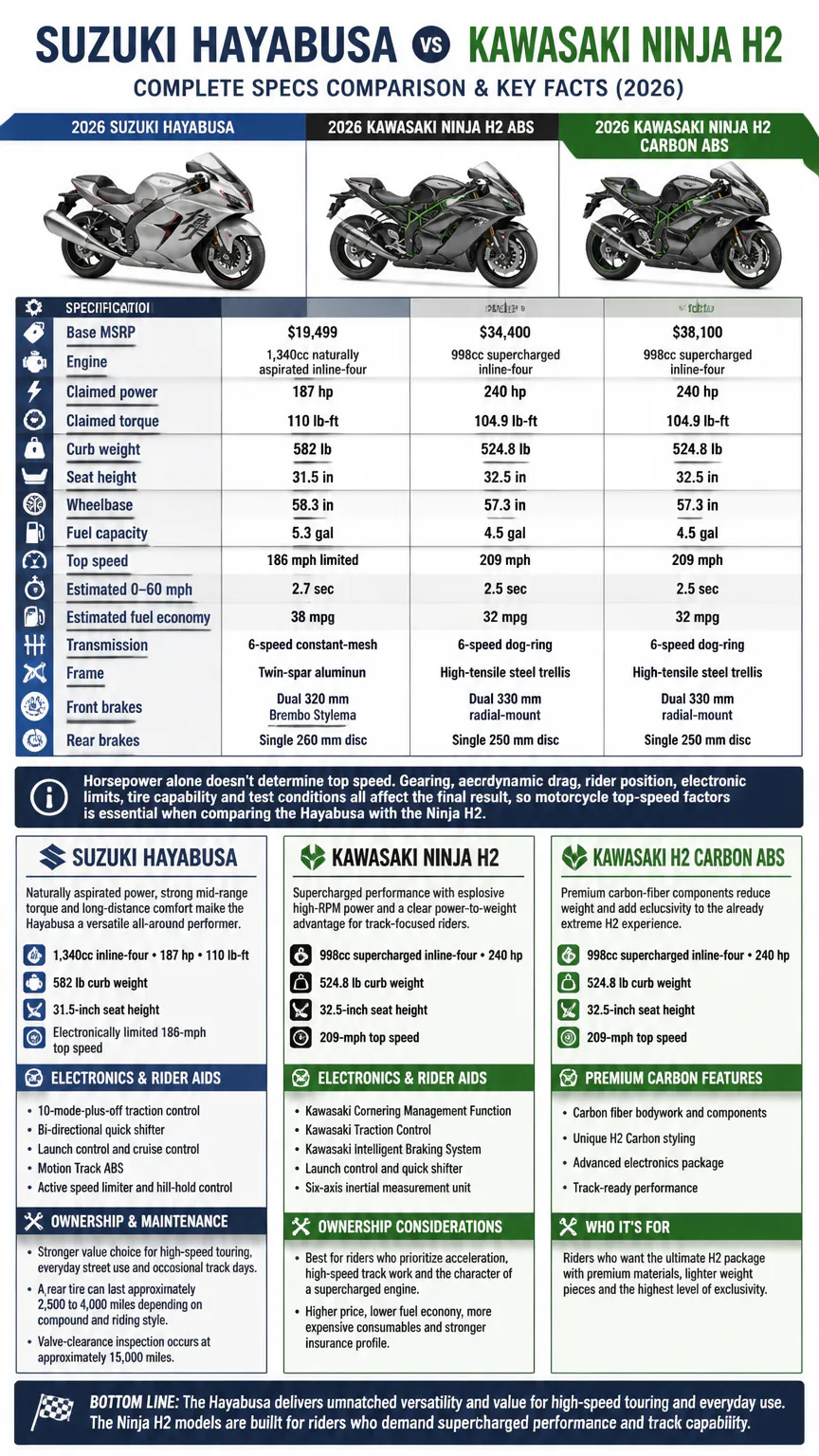
Choosing between the 2026 Suzuki Hayabusa and 2026 Kawasaki Ninja H2 depends on whether you value long-distance comfort and lower ownership costs or want the strongest acceleration and supercharged engine character. The Hayabusa starts at $19,499 in the United States, while the street-legal Ninja H2 starts at $34,400. Both are exceptionally fast, but they serve different purposes.
Suzuki Hayabusa vs Kawasaki Ninja H2 Specs
| Specification | 2026 Suzuki Hayabusa | 2026 Kawasaki Ninja H2 ABS | 2026 Kawasaki Ninja H2 Carbon ABS |
|---|---|---|---|
| Base MSRP | $19,499 | $34,400 | $38,100 |
| Engine | 1,340cc naturally aspirated inline-four | 998cc supercharged inline-four | 998cc supercharged inline-four |
| Claimed power | 187 hp | 240 hp | 240 hp |
| Claimed torque | 110 lb-ft | 104.9 lb-ft | 104.9 lb-ft |
| Curb weight | 582 lb | 524.8 lb | 524.8 lb |
| Seat height | 31.5 in | 32.5 in | 32.5 in |
| Wheelbase | 58.3 in | 57.3 in | 57.3 in |
| Fuel capacity | 5.3 gal | 4.5 gal | 4.5 gal |
| Top speed | 186 mph limited | 209 mph | 209 mph |
| Estimated 0–60 mph | 2.7 sec | 2.5 sec | 2.5 sec |
| Estimated fuel economy | 38 mpg | 32 mpg | 32 mpg |
| Transmission | 6-speed constant-mesh | 6-speed dog-ring | 6-speed dog-ring |
| Frame | Twin-spar aluminum | High-tensile steel trellis | High-tensile steel trellis |
| Front brakes | Dual 320 mm Brembo Stylema | Dual 330 mm radial-mount | Dual 330 mm radial-mount |
| Rear brakes | Single 260 mm disc | Single 250 mm disc | Single 250 mm disc |
Horsepower alone doesn’t determine top speed. Gearing, aerodynamic drag, rider position, electronic limits, tire capability and test conditions all affect the final result, so motorcycle top-speed factors is essential when comparing the Hayabusa with the Ninja H2.
Suzuki Hayabusa
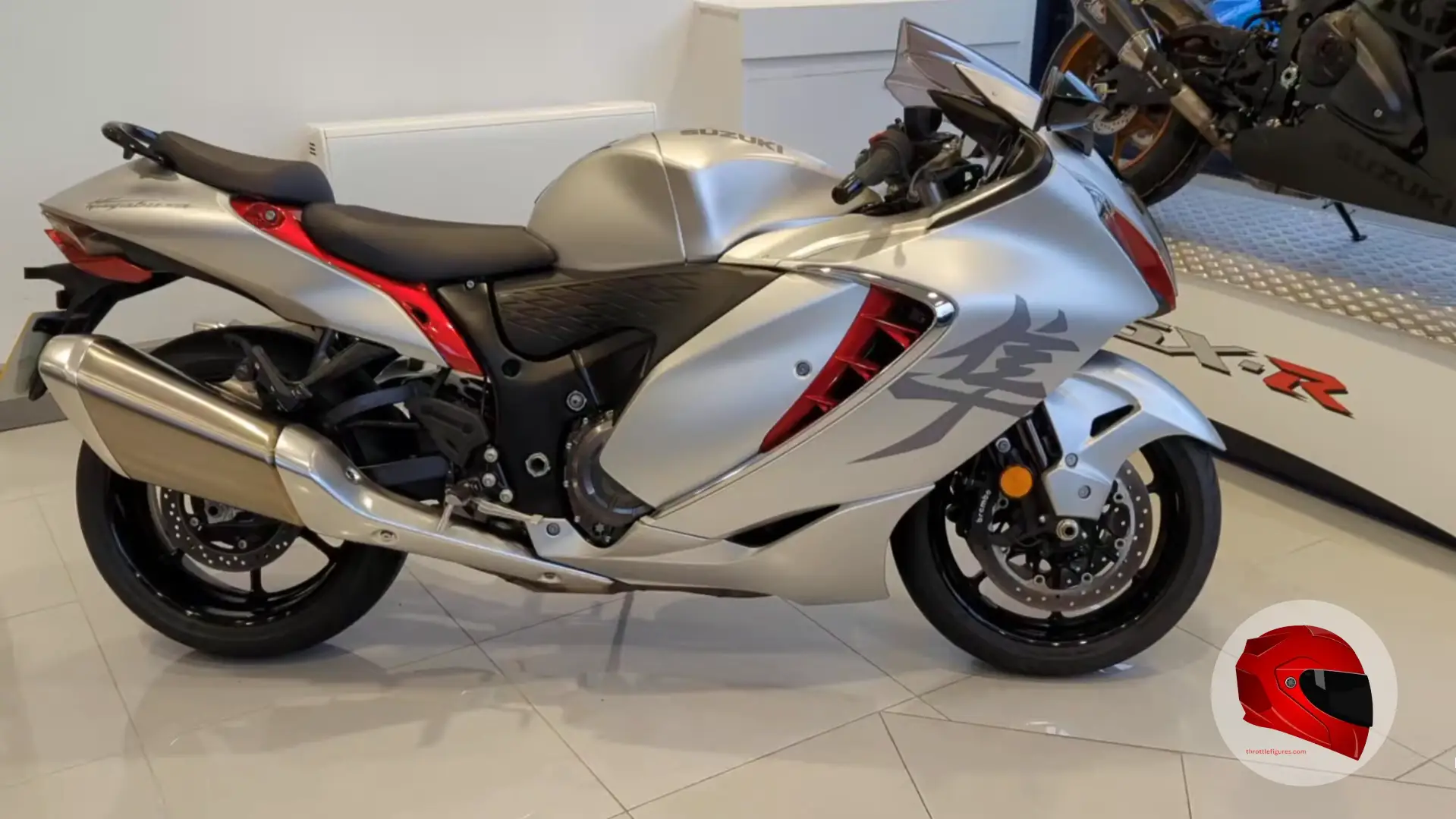
The Hayabusa uses a 1,340cc naturally aspirated inline-four that produces 187 hp and 110 lb-ft of torque. Its strong low- and mid-range torque suits highway riding, overtaking and smooth corner exits without requiring the engine speeds associated with the H2.
At 582 pounds ready to ride, the Hayabusa is heavier than the Kawasaki. That extra mass gives it a planted feel on fast roads, although it is more noticeable during parking-lot maneuvers and low-speed turns. The 31.5-inch seat is easier to reach, and the riding position is better suited to extended trips. Its electronically limited 186-mph top speed is sufficient for closed-course use but falls short of the H2’s potential.
- 10-mode-plus-off traction control
- Bi-directional quick shifter
- Launch control and cruise control
- Motion Track ABS
- Active speed limiter and hill-hold control
The Hayabusa is the stronger value choice for a rider who wants one motorcycle for high-speed touring, everyday street use and occasional track days. A rear tire can last approximately 2,500 to 4,000 miles depending on compound and riding style. Valve-clearance inspection occurs at approximately 15,000 miles.
Kawasaki Ninja H2
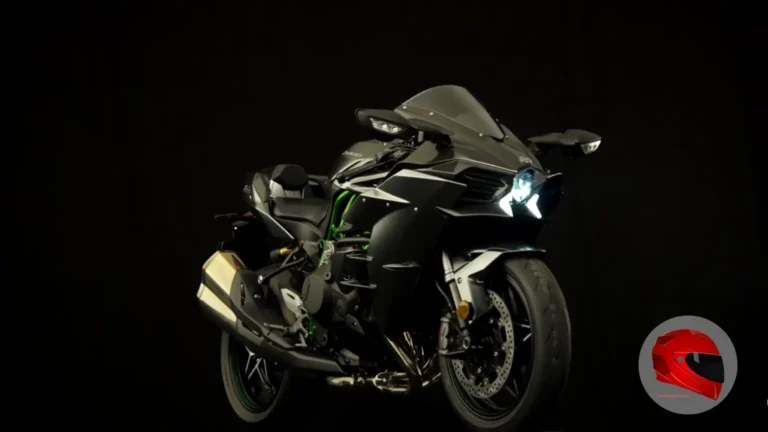
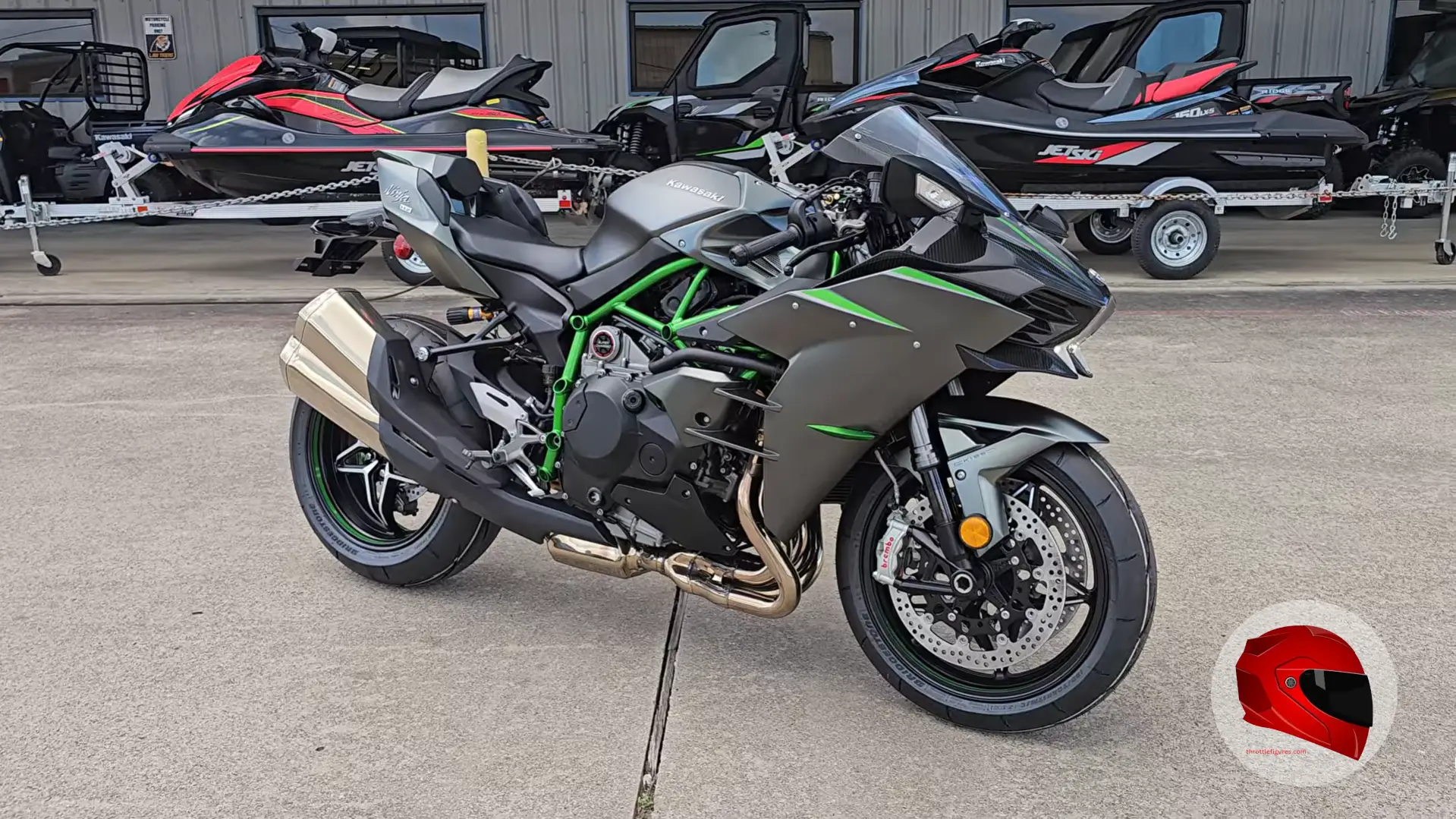
The Ninja H2’s 998cc liquid-cooled supercharged inline-four produces 240 horsepower at 11,500 rpm with ram air. Its peak torque figure is lower than the Hayabusa’s at 104.9 lb-ft, but the supercharger builds exceptional thrust as engine speed rises. The 524.8-pound curb weight gives the Kawasaki a clear power-to-weight advantage.
The H2 uses a high-tensile steel trellis frame, dual 330 mm semi-floating front discs, radial-mount calipers and a six-speed dog-ring transmission. Its 32.5-inch seat is manageable for many riders, but the taller height and more aggressive ergonomics feel less relaxed during long touring days.
- Kawasaki Cornering Management Function
- Kawasaki Traction Control
- Kawasaki Intelligent Braking System
- Launch control and quick shifter
- Six-axis inertial measurement unit
The H2 suits riders who prioritize acceleration, high-speed track work and the character of a supercharged engine. Its higher price, lower fuel economy, more expensive consumables and stronger insurance profile make it harder to justify as an all-purpose motorcycle.
Kawasaki Ninja H2 Carbon
The Ninja H2 Carbon shares the standard H2’s supercharged 998cc engine, 240-horsepower output, chassis, brakes and electronic package. Its $38,100 MSRP covers premium carbon-fiber bodywork and added visual distinction rather than a separate performance level.
The Carbon is therefore a styling and exclusivity purchase. It suits an owner who wants the H2 platform and places a high value on its special bodywork, but it does not provide a meaningful acceleration advantage over the standard H2. The $3,700 premium is substantial before destination, dealer preparation, taxes, registration and insurance.
For track riding, the Carbon has the same basic performance potential as the standard H2. On public roads, both versions exceed the performance that can be used legally, so the Carbon’s appeal comes mainly from its appearance and exclusivity.
Requirements and context
Both the Suzuki Hayabusa and road-legal Kawasaki Ninja H2 models can be used on public roads when properly titled, registered, equipped and insured. A buyer needs a valid Class M motorcycle license or motorcycle endorsement under the rules of the state where the motorcycle will be registered. A standard automobile license is not sufficient.
- Valid motorcycle license or endorsement
- State title and registration documents
- Required motorcycle liability coverage
- Purchase agreement and proof of ownership
- Applicable sales tax, registration fees and dealer charges
The Kawasaki Ninja H2R is a separate closed-course motorcycle. It is not street legal, cannot be registered for normal public-road use and should not be treated as a faster trim of the road-legal H2. The H2R has a base MSRP of $62,100 and produces approximately 310 to 326 horsepower with ram air. Its track-only status changes the licensing, transport, insurance and operating requirements.
The track-only Ninja H2R is faster than the Hayabusa in closed-course acceleration and speed testing, although results vary with setup, rider, surface and conditions. It is not a street-legal alternative to the Hayabusa or the road-legal Ninja H2.
Hayabusa performance and comfort
The Hayabusa’s naturally aspirated engine delivers its output progressively, with substantial torque available at lower engine speeds. Highway passing is easy, and the engine does not require constant gear changes. Aerodynamic bodywork, the lower seat, cruise control and a stable chassis make it better suited to long-distance riding than the H2’s sharper road-and-track bias.
Fuel use depends heavily on speed. The Hayabusa is estimated at 38 mpg, although sustained high-speed riding can reduce that figure. Its 5.3-gallon fuel capacity provides useful touring range.
The motorcycle’s weight is noticeable during low-speed turns and parking maneuvers. Once moving, the twin-spar aluminum chassis and long aerodynamic profile keep it composed. Brembo Stylema four-piston calipers on dual 320 mm discs provide strong braking performance, while the electronic rider aids help manage the motorcycle’s size and output.
Ninja H2 performance and technology
The Ninja H2 feels faster because its supercharged engine continues building force as the revs climb. Its 240-horsepower output and 524.8-pound curb weight give it a clear advantage in acceleration and high-speed running. The motorcycle reaches 209 mph, although public roads provide no legal setting for using that capability.
Kawasaki Cornering Management Function monitors engine and chassis behavior through corner entry, the apex and corner exit. It works with traction control, intelligent braking and the quick shifter to coordinate braking force, engine power and gear changes. These systems do not replace smooth inputs, correct tire pressures or proper track technique.
The tradeoff is cost and consumption. Estimated fuel economy is 32 mpg. The supercharger, premium brake hardware, specialized tires and higher purchase price create a larger ownership budget. The taller seat and aggressive riding position are also less accommodating for riders who regularly cover long distances.
The Ninja H2’s supercharged engine and electronics deliver serious speed, but its road equipment determines how much of that performance you can use outside a track. The track-only H2R takes the same basic concept further with fewer compromises for public roads, making the H2 versus H2R comparison useful for weighing outright performance against everyday usability.
Which bike accelerates faster?
The Kawasaki Ninja H2 accelerates faster. Its estimated 0-to-60-mph time is 2.5 seconds, compared with 2.7 seconds for the Hayabusa. The advantage comes from the H2’s supercharged power, lower weight and launch-control calibration.
The difference becomes more apparent during high-speed roll-ons, where the H2 continues building power toward its higher rev range. The Hayabusa remains extremely quick and delivers more peak torque at lower engine speed, so it can feel effortless during ordinary passing even though it is not the faster motorcycle.
Top-speed comparisons require some context. The Hayabusa is electronically limited to 186 mph, while the H2 reaches 209 mph. Those figures apply to closed-course testing only. On public roads, the more useful distinction is the Hayabusa’s smoother touring behavior compared with the H2’s sharper response and stronger acceleration reserve.
Peak horsepower is only part of the acceleration story. Each bike also has to move its own weight, fuel, rider and luggage, so the Hayabusa and Ninja H2 can feel different off the line and during overtakes even when their headline figures are similar. Comparing motorcycle power-to-weight ratios puts those figures in better context.
Handling, braking, and everyday riding
The Hayabusa’s greater weight and longer wheelbase make low-speed maneuvering more deliberate, but its lower 31.5-inch seat helps when stopping in traffic or paddling the bike. Once moving, its stable chassis and progressive power delivery make corner entries and exits predictable. The H2 is 57.3 inches between the axles and weighs 524.8 pounds, so it changes direction with less effort. Its taller seat and aggressive ergonomics require more care at low speeds.
| Riding area | Hayabusa | Ninja H2 and H2 Carbon |
|---|---|---|
| Low-speed usability | Heavier, but easier seat height and calmer power delivery | Lighter, with a taller seat and sharper response |
| Cornering response | Stable and composed through fast corners | More immediate direction changes and stronger track bias |
| Suspension behavior | Balanced for stability, street riding and touring | Set up for premium control and aggressive riding |
| Braking feel | Dual 320 mm Brembo Stylema brakes with Motion Track ABS | Dual 330 mm radial-mount brakes with intelligent braking electronics |
| High-speed stability | Strong aerodynamic stability and planted tracking | Stable at speed, with greater acceleration reserve |
For daily riding, the Hayabusa is easier to live with because its ergonomics, seat height and smoother response suit commuting and long trips. The H2 rewards a rider who wants a more aggressive position, quicker cornering reactions and stronger braking hardware, but it feels less relaxed in traffic and during extended touring.
Where to buy and finance
US motorcycle dealerships are the purchase channel for a Hayabusa, Ninja H2 or H2 Carbon. A dealer can arrange financing, appraise a trade-in, prepare the purchase agreement and handle title and registration paperwork. Freight, setup, documentation and other dealer services are separate from the manufacturer’s base MSRP.
Before paying a deposit, ask for a written out-the-door quote that includes the motorcycle, destination, setup, documentation, taxes, registration and any dealer-added charges. H2 and H2 Carbon availability may require a dealer order. Financing normally requires proof of income, identification and insurance. A financed motorcycle generally requires comprehensive and collision coverage until the loan is paid.
Pricing and ownership costs
The Hayabusa’s $19,499 base MSRP leaves a large gap between the two motorcycles. The Ninja H2 ABS starts at $34,400, while the H2 Carbon ABS starts at $38,100. Freight, dealer preparation, taxes, registration and other charges can raise the final purchase price.
An out-the-door price can be 15% to 20% above base MSRP after freight, setup, documentation, taxes, registration and other charges. H2 and H2 Carbon purchases may also require a special order. US motorcycle dealerships handle the purchase, financing, trade-in appraisal, title paperwork and registration process.
Progressive, Foremost and State Farm offer motorcycle coverage. Premiums vary with location, age, riding history, coverage limits, deductible, storage and insured value. The Ninja H2 usually costs more to insure than the Hayabusa because of its higher replacement value and performance profile. A financed motorcycle generally requires comprehensive and collision coverage.
Cash payment avoids loan interest and can simplify title handling. A lender may still make sense when preserving savings matters more than minimizing the total cost. Financing requires proof of income, identification, insurance and a signed purchase agreement.
Which bike fits your riding?
- For touring and frequent street use: choose the Hayabusa for its lower price, lower seat, smoother torque delivery, cruise control and larger fuel capacity.
- For maximum acceleration: choose the Ninja H2 if its 240-hp supercharged engine, lighter curb weight and 2.5-second estimated 0-60 time justify the higher budget.
- For premium appearance: choose the H2 Carbon if its carbon-fiber bodywork and exclusivity matter more than gaining performance over the standard H2.
- For closed-course riding: consider the H2’s track-oriented performance, but keep the separate, track-only H2R out of any street-bike comparison.
Which motorcycle should you buy?
- Choose the Hayabusa for high-speed touring, lower purchase cost, easier everyday use and smoother naturally aspirated power delivery.
- Choose the Ninja H2 for the quickest acceleration, supercharged engine character, lighter curb weight and more aggressive track-oriented performance.
- Choose the H2 Carbon when premium carbon bodywork and exclusivity justify its additional cost over the standard H2.
For most US riders who want a street motorcycle rather than a collector-grade performance purchase, the Hayabusa covers more types of riding. The Kawasaki Ninja H2 is the better choice when its supercharger, acceleration and premium hardware are the main reasons for buying.
Maintenance and consumable costs
The Hayabusa is generally less expensive to maintain because its naturally aspirated engine, conventional chassis and lower-priced consumables place less strain on the ownership budget. Its rear tire can last approximately 2,500 to 4,000 miles depending on compound and riding style. Valve-clearance inspection occurs at approximately 15,000 miles.
The Ninja H2 and H2 Carbon use more expensive performance tires and premium brake components, so tire replacement, brake pads and brake service estimates are higher than for the Hayabusa. Their supercharged engines also require model-specific servicing, including inspection of the supercharger system during scheduled maintenance. Follow the manufacturer’s service schedule for oil, filters, valve clearance, drive components, tires and brakes rather than treating the H2 like a standard naturally aspirated motorcycle.
For a realistic ownership estimate, price scheduled dealer service, a complete set of tires, front and rear brake pads, chain and sprocket work and H2-specific supercharger-related inspection separately. Exact totals vary by dealer labor rates, tire choice, riding pace and annual mileage, but the H2’s consumables and specialized service create the higher ongoing maintenance budget.
FAQs
Is the Hayabusa cheaper than the Ninja H2?
The 2026 Hayabusa starts at $19,499, while the Ninja H2 ABS starts at $34,400 before other dealer charges. The H2 Carbon starts at $38,100.
Which motorcycle is better for touring?
The Hayabusa is better suited to touring because of its lower seat, smoother naturally aspirated torque, cruise control, aerodynamic stability and stronger fuel economy. The H2 can cover distance quickly, but its riding position and operating costs are less touring-focused.
Can the Ninja H2 be ridden on public roads?
Yes. The Ninja H2 ABS and H2 Carbon are street-legal when registered, insured and operated with the required equipment. The separate Ninja H2R is track-only and cannot be used as a normal street motorcycle.
Which motorcycle costs less to insure?
The Hayabusa generally has a lower insurance-cost starting point because its purchase price and replacement value are lower. Actual premiums depend on the rider, location, coverage, deductible and insurer.
Conclusion
The Suzuki Hayabusa is the more balanced choice for touring, street riding and budget-conscious ownership. The Kawasaki Ninja H2 wins on acceleration and supercharged character, but that performance comes with a much higher entry price and running cost. Choose the H2 when those specific advantages justify the premium.