Harley-Davidson Street Glide: Guide & Key Facts
Disclaimer: Performance figures may vary depending on factors such as rider, road and weather conditions, vehicle condition, and testing methods. Figures are provided for informational purposes only.
The 2026 Harley-Davidson Street Glide is a full-size Grand American Touring motorcycle built for long-distance travel. It combines V-Twin torque, integrated luggage, wind protection and modern touchscreen controls. The right choice depends on more than MSRP: fairing design, running-order weight, passenger equipment, engine specification, insurance and service costs all affect how well it fits your plans.
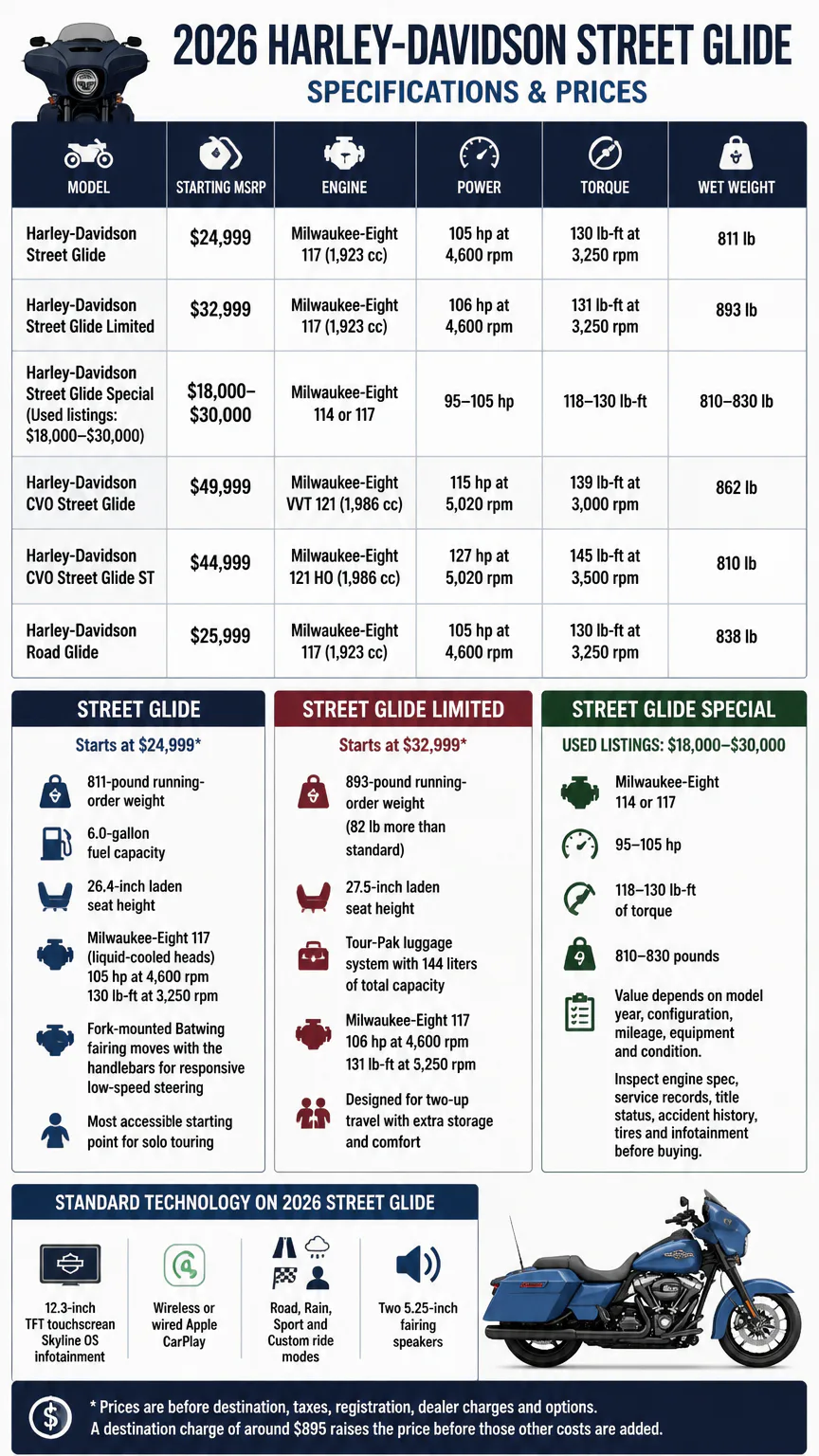
2026 Street Glide Specifications and Prices
| Model | Starting MSRP | Engine | Power | Torque | Wet Weight |
|---|---|---|---|---|---|
| Harley-Davidson Street Glide | $24,999 | Milwaukee-Eight 117 (1,923 cc) | 105 hp at 4,600 rpm | 130 lb-ft at 3,250 rpm | 811 lb |
| Harley-Davidson Street Glide Limited | $32,999 | Milwaukee-Eight 117 (1,923 cc) | 106 hp at 4,600 rpm | 131 lb-ft at 3,250 rpm | 893 lb |
| Harley-Davidson Street Glide Special | Used listings: $18,000–$30,000 | Milwaukee-Eight 114 or 117 | 95–105 hp | 118–130 lb-ft | 810–830 lb |
| Harley-Davidson CVO Street Glide | $49,999 | Milwaukee-Eight VVT 121 (1,986 cc) | 115 hp at 5,020 rpm | 139 lb-ft at 3,000 rpm | 862 lb |
| Harley-Davidson CVO Street Glide ST | $44,999 | Milwaukee-Eight 121 HO (1,986 cc) | 127 hp at 5,020 rpm | 145 lb-ft at 3,500 rpm | 810 lb |
| Harley-Davidson Road Glide | $25,999 | Milwaukee-Eight 117 (1,923 cc) | 105 hp at 4,600 rpm | 130 lb-ft at 3,250 rpm | 838 lb |
Harley-Davidson Street Glide
The standard Street Glide starts at $24,999 before destination, taxes, registration, dealer charges and options. A destination charge of around $895 raises the price before those other costs are added. With an 811-pound running-order weight, 6.0-gallon fuel capacity and 26.4-inch laden seat height, it is the most accessible starting point in this group for solo touring.
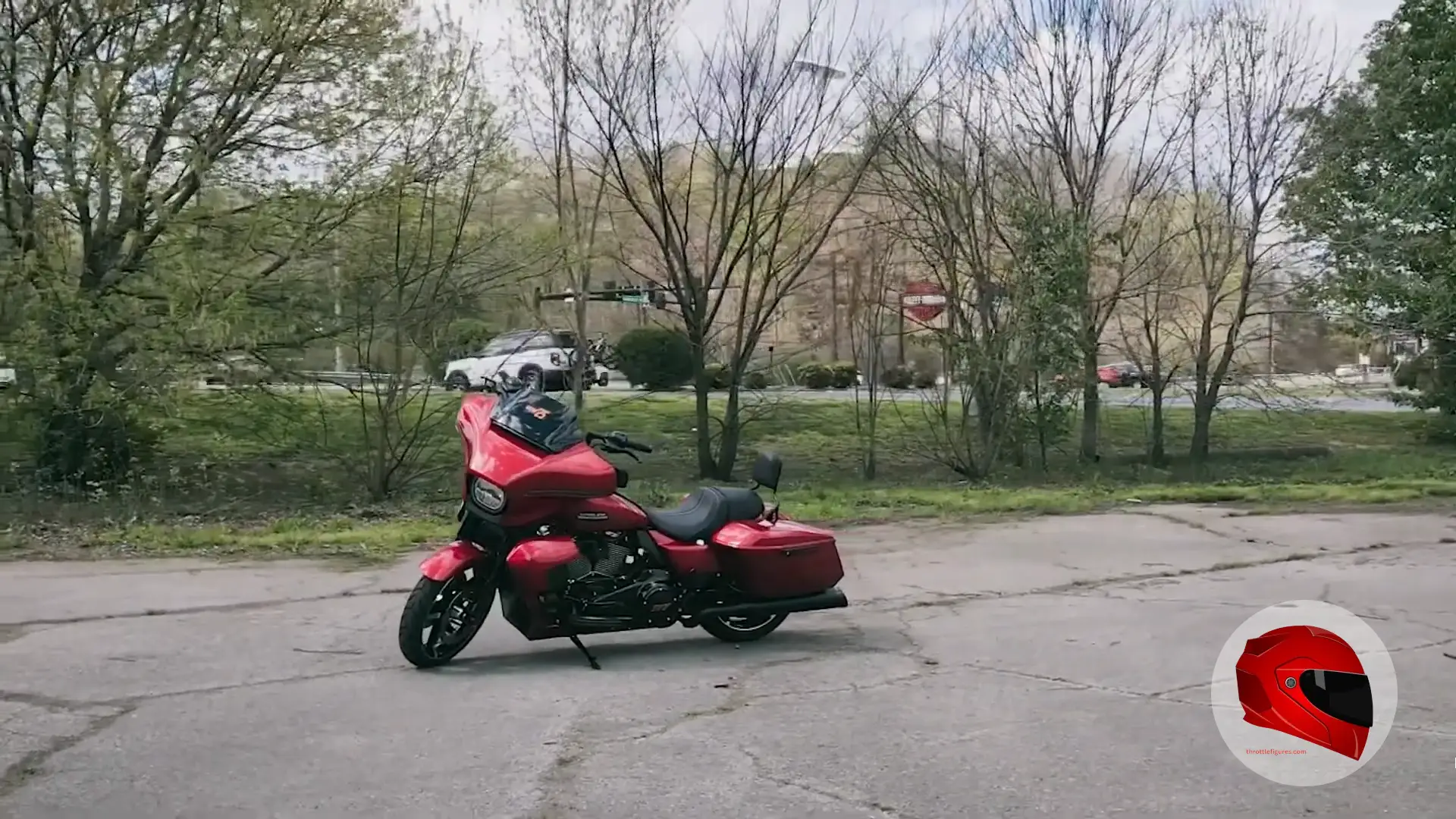
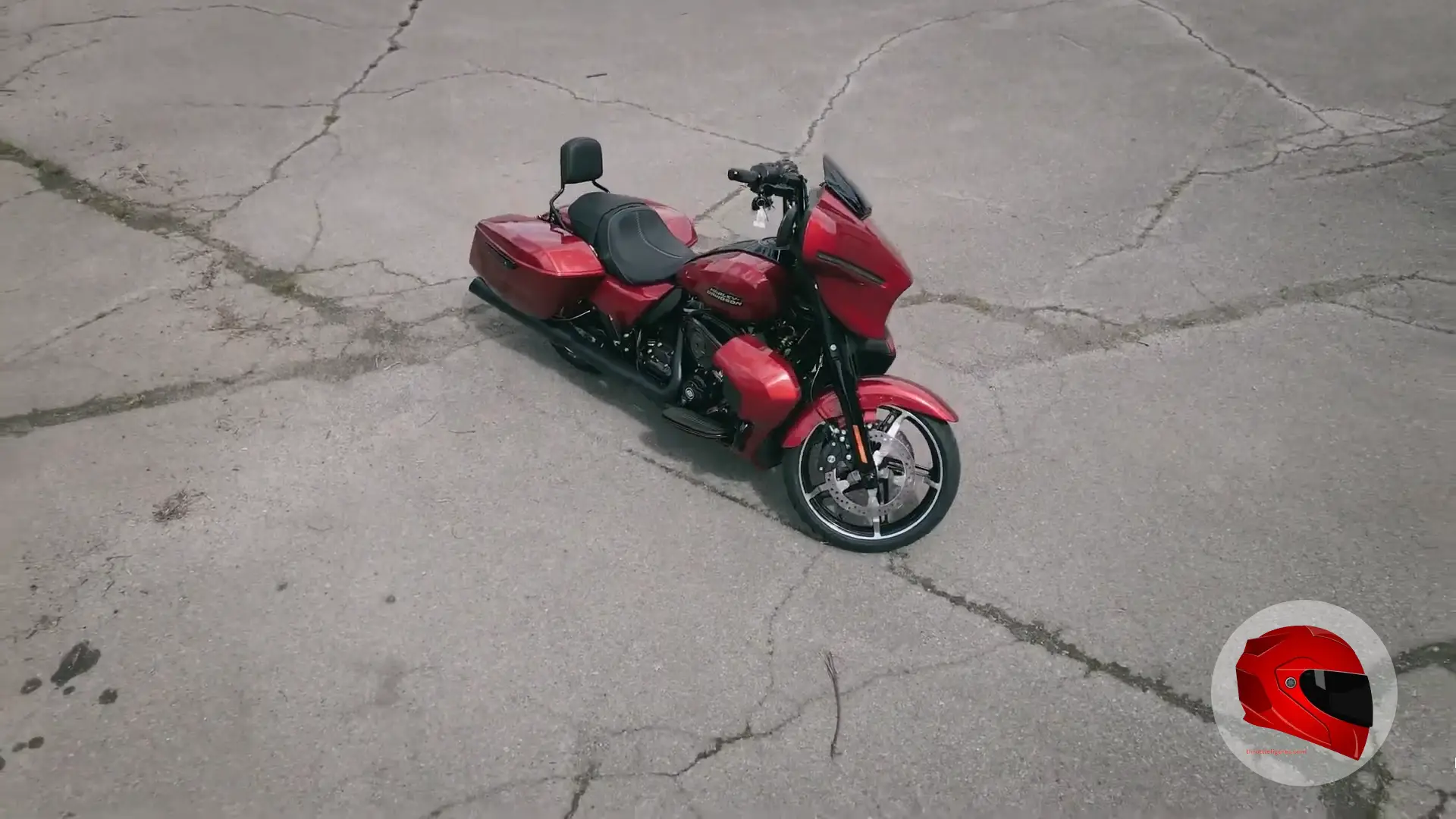
Its Milwaukee-Eight 117 has liquid-cooled cylinder heads and produces 105 hp at 4,600 rpm and 130 lb-ft of torque at 3,250 rpm. The fork-mounted Batwing fairing moves with the handlebars, giving the motorcycle its traditional Street Glide profile and a responsive low-speed steering feel. The standard model suits riders who want a full touring platform without paying for the Limited’s extra passenger and luggage equipment.
- 12.3-inch TFT touchscreen
- Skyline OS infotainment
- Wireless or wired Apple CarPlay
- Road, Rain, Sport and Custom ride modes
- Two 5.25-inch fairing speakers
Harley-Davidson Street Glide Limited
The Street Glide Limited starts at $32,999 and adds equipment for two-up travel. Its 893-pound running-order weight is 82 pounds greater than the standard model, and its laden seat height is 27.5 inches. Shorter riders should consider the extra mass and taller seat when maneuvering on uneven ground or backing out of parking spaces.
Output rises slightly to 106 hp and 131 lb-ft of torque. The main practical difference is storage: the Tour-Pak luggage system brings total capacity to 144 liters. That space suits extended trips, passenger gear and weather layers, although the added luggage and touring equipment increase both the purchase price and the demands of low-speed handling.
Choose the Limited when passenger comfort and carrying capacity are central to the purchase. The standard Street Glide costs less and is easier to manage for solo riders who do not need the extra luggage volume.
Harley-Davidson Street Glide Special
The Street Glide Special is most relevant to buyers comparing certified pre-owned and marketplace inventory. Used listings range from $18,000 to $30,000. Available examples use the Milwaukee-Eight 114 or 117 and produce 95-105 hp and 118-130 lb-ft of torque, with weights ranging from 810 to 830 pounds. Model year, configuration, mileage, equipment and condition have a greater effect on value than the name alone.
Before comparing a Special with a new 2026 Street Glide, inspect the engine specification, service records, title status, accident history, tire condition and infotainment operation. A lower purchase price can be offset by deferred maintenance, worn tires, aftermarket parts or less favorable financing terms.
This model suits buyers who want the Street Glide shape and touring equipment while shopping across used inventory. It is less suitable if you want one fixed factory specification, a new-bike warranty or a predictable equipment list.
Harley-Davidson CVO Street Glide
The CVO Street Glide sits at the premium end of the lineup, with a starting MSRP of $49,999. It uses the Milwaukee-Eight VVT 121 (1,986 cc), producing 115 hp at 5,020 rpm and 139 lb-ft of torque at 3,000 rpm. Its price reflects upgraded trim, finish, equipment and exclusivity. Separate the motorcycle price from freight, setup, taxes, registration and accessories in the purchase agreement.
The CVO suits buyers who place a high value on premium presentation and factory personalization. It is harder to justify on basic transportation grounds because the standard Street Glide already includes the 117 engine, Skyline OS, Apple CarPlay, ride modes and touring fairing. Insurance and financing costs also rise with the purchase price.
Before buying, compare the CVO’s included equipment with the cost of adding similar parts to a standard motorcycle. Factory integration, warranty coverage and finish quality may justify the premium, while an accessory-equipped standard model may suit riders who care more about function.
Harley-Davidson Road Glide
The Road Glide starts at $25,999 and uses the same 117-cubic-inch displacement as the standard Street Glide. It produces 105 hp and 130 lb-ft of torque, while its 838-pound running-order weight is 27 pounds greater than the standard Street Glide. Its key design difference is the frame-mounted Sharknose fairing.
A frame-mounted fairing keeps its mass attached to the motorcycle as the handlebars turn. That layout gives the Road Glide a different steering response and a planted feel at highway speed. The Street Glide’s fork-mounted Batwing fairing moves with the bars, making low-speed steering feel and fairing design the main points of comparison.
Choose the Road Glide if you prefer its fairing behavior and riding position. Choose the Street Glide if you prefer the Batwing design, lighter listed weight and handlebar-mounted fairing. Both provide the same stated 105-hp, 130-lb-ft engine output.
The Street Glide’s horsepower is useful for comparing engine output, but it does not determine how quickly this large touring motorcycle accelerates or how fast it can travel. Curb weight, aerodynamic drag from the fairing and luggage, gearing, traction and electronic limits all affect real-world performance. That makes the question of whether horsepower determines motorcycle top speed the faster motorcycle more complicated than the specification sheet suggests.
Requirements and context
Every US state requires a motorcycle endorsement or motorcycle license classification, although the process varies. New buyers should also budget for registration, sales tax, insurance, protective equipment and secure storage. The purchase is not complete until the title, lien information, odometer disclosure, bill of sale and registration paperwork are correct.
- Valid motorcycle license or endorsement
- Proof of insurance meeting state requirements
- Government-issued identification
- Signed purchase agreement or bill of sale
- Title and lien documents for used motorcycles
- Registration and sales-tax funds
Harley-Davidson HD-1 Marketplace is a manufacturer-affiliated way to locate motorcycle inventory, including used motorcycles and available Street Glide models. Cycle Trader includes dealer and private-party listings, so you can compare mileage, location, model year and asking price. Listing details still need independent inspection and document review.
Harley-Davidson Financial Services handles motorcycle financing for qualified applicants. Compare the annual percentage rate, loan term, down payment, total finance charge and prepayment conditions rather than focusing only on the monthly payment. Used and premium CVO models can have very different total payment amounts even when their monthly figures look similar.
- Set a total purchase budget that includes taxes, fees, insurance, equipment and initial service.
- Compare new dealer inventory with HD-1 Marketplace and Cycle Trader listings.
- Obtain a written out-the-door price and separate each fee.
- Arrange insurance and financing before signing the purchase documents.
- Inspect used motorcycles and verify the title, VIN, service history and lien release.
- Complete registration and confirm warranty documents before taking delivery.
Private sales, trade-ins, and transport
For a private-party purchase, inspect the motorcycle and verify the VIN, titleholder, lien status, odometer disclosure and service records before paying. Use a bill of sale that identifies the buyer, seller, motorcycle, sale price, date and condition. Complete the title transfer with the seller and keep copies of the signed documents. Do not release payment until the ownership paperwork is properly assigned.
Ask the dealer for a written trade-in valuation that separates the motorcycle’s allowance from the purchase price. Compare that allowance with private-sale offers, account for any outstanding loan payoff and confirm whether the dealer will send the payoff directly to the lender. A motorcycle with a lien cannot be transferred cleanly until the payoff and title release are documented.
For delivery, get transport quotes based on distance, pickup timing, motorcycle size and whether the carrier uses open or enclosed service. Confirm cargo insurance limits, damage documentation, pickup and delivery addresses, and responsibility for loading, unloading and inspection. Photograph the motorcycle before collection and check for new damage before signing the delivery receipt.
How the Milwaukee-Eight 117 performs
The Milwaukee-Eight 117 displaces 117 cubic inches, or 1,923 cc, and reaches peak torque at 3,250 rpm. That torque curve supports relaxed highway acceleration, passing with luggage and two-up riding without requiring high engine speed. Peak horsepower arrives at 4,600 rpm, giving the motorcycle useful upper-range performance for open-road travel.
An 811-pound running-order weight affects every low-speed task. U-turns, sloped parking spaces, gravel shoulders and backing maneuvers require deliberate body position and throttle control. The Limited’s 893 pounds increase that demand, while the Road Glide’s 838 pounds place it between the two Street Glide versions listed here.
Top speed and 0-60 mph times tell less of the touring story than passing response, wind protection, braking control, rider confidence and low-speed manageability. Acceleration results vary with the rider, fuel load, surface, temperature and traction.
The Milwaukee-Eight 117 pulls strongly from low revs, so the Street Glide can accelerate smoothly with luggage or a passenger without frequent downshifts. For touring, that everyday torque matters more than a high peak-power figure. The wider highest torque motorcycles helps put the Street Glide’s relaxed, muscular delivery in perspective.
Technology, safety, and comfort features
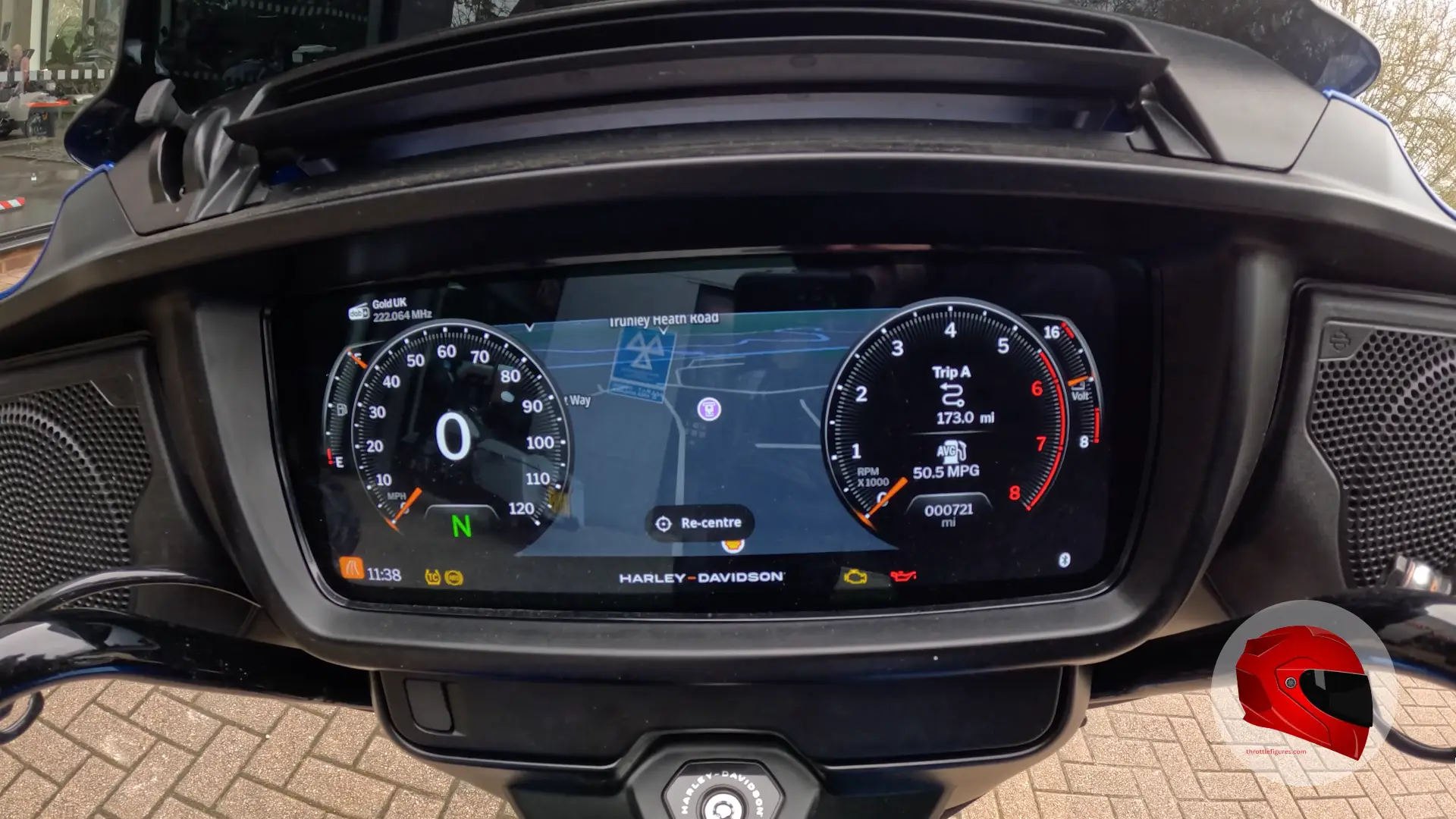
The 12.3-inch TFT touchscreen runs Skyline OS and displays navigation, audio, vehicle information and connected functions in one place. Wireless or wired Apple CarPlay supports navigation, calls and music through a compatible smartphone. The standard audio system uses two 5.25-inch fairing speakers. Rockford Fosgate equipment is available in touring audio configurations and Stage II multi-speaker kits.
- Road mode: General riding and touring conditions.
- Rain mode: Softer response for wet or lower-grip surfaces.
- Sport mode: Sharper engine response for active riding.
- Custom mode: Rider-selected power and response settings.
Rider Safety Enhancements include cornering ABS, electronic linked braking, traction control, Drag-Torque Slip Control, Vehicle Hold Control and tire-pressure monitoring. These systems assist with braking, acceleration, hill starts and changing grip, but they do not replace proper speed selection or rider training.
The fork-mounted Batwing fairing provides wind protection while retaining the Street Glide’s characteristic silhouette. The Limited adds Tour-Pak luggage and greater carrying capacity. Sit on both models and check the seat position, reach to the controls, screen visibility, passenger accommodation and balance while parked before making a choice.
Street Glide ownership costs and problems
Annual insurance for a Street Glide ranges from $750 to $1,800 for many riders, while high-risk policies can exceed $2,000. Age, riding history, location, coverage limits, storage, annual mileage and motorcycle value all affect the premium. A CVO or heavily financed motorcycle may also require higher comprehensive and collision coverage.
- Initial service: 1,000 miles
- Later routine service: approximately every 5,000 miles
- Independent-shop service: $200, $400
- Dealership service: $400, $900 or more
- Rear tire life: approximately 7,000-12,000 miles
- Installed rear tire replacement: $350, $500
- Factory warranty: 2 years with unlimited mileage
Heat management matters during slow traffic, hot weather and extended idling. During inspection and routine service, check infotainment software behavior, air-cleaner seepage and suspension response. These checks do not mean every motorcycle has a defect; they identify areas that can affect comfort, cleanliness and repair costs.
Large touring motorcycles put heavy loads on tires, brakes, driveline components and suspension parts. Check tire age and tread, inspect for leaks, verify that the touchscreen and audio system work correctly, and make sure the motorcycle tracks straight under braking. A complete service history is especially valuable on higher-mileage or modified motorcycles.
Routine maintenance is one of the best ways to control Street Glide ownership costs. Oil and filter changes, brake inspections, tire checks and drivetrain service should be part of the budget, along with fuel and insurance, rather than treated as surprise repairs. A regular maintenance schedule covers how often to service a motorcycle and helps owners separate normal upkeep from warning signs that need prompt attention.
Estimate the Out-the-Door Cost
- Start with the motorcycle price: A new 2026 Street Glide starts at $24,999. Used Street Glide Special listings range from $18,000 to $30,000.
- Add destination and dealer charges: The advertised MSRP does not include destination charges, setup, documentation or other dealer fees.
- Budget for government costs: Sales tax, title and registration increase the amount due at purchase and vary by state.
- Include selected equipment: Accessories, protective riding gear and initial service can raise the cash needed beyond the motorcycle price.
- Price the ongoing costs: Get an insurance quote and compare the total finance charge, not just the monthly payment, before signing.
- Request one written total: Ask the dealer to list the motorcycle, freight, setup, taxes, registration, documentation fee, accessories, trade-in credit, down payment and amount financed separately.
Street Glide customization options
Common Street Glide customization areas include luggage, suspension, exhaust, audio, ergonomics and protection. Riders add luggage for carrying capacity, suspension parts for ride-height or handling preferences, exhaust components for sound and appearance, audio upgrades for stronger output, ergonomic parts for fit and protection equipment for vulnerable bodywork.
Before installing aftermarket parts, check warranty coverage, tuning requirements, local exhaust and emissions rules and the effect on resale value. Factory accessories preserve integration and documentation, while aftermarket parts provide more choice but require careful attention to compatibility and installation quality.
FAQs
Is a Street Glide a women’s motorcycle?
Yes. The Street Glide is suitable for any rider who can meet the licensing, control, reach and physical demands of an 811-pound touring motorcycle. Seat height, handlebar reach, parking technique and riding instruction matter more than gender.
What is the best year Street Glide to buy?
For a new purchase, the 2026 Street Glide has the current 117 engine, Skyline OS, 12.3-inch display, Apple CarPlay, ride modes and Rider Safety Enhancements. For a used purchase, service history, mileage, condition, equipment and price matter more than model year alone.
Does the Street Glide require premium fuel?
Fuel requirements depend on the engine specification and the motorcycle’s owner documentation. Use the octane rating and fuel guidance specified for that particular motorcycle, especially when comparing a Milwaukee-Eight 114, 117 or another configuration.
What is better, Road Glide or Street Glide?
The Road Glide uses a frame-mounted Sharknose fairing, while the Street Glide uses a fork-mounted Batwing fairing. Choose the Road Glide if you prefer a fairing that stays fixed as the handlebars turn, or choose the Street Glide if you prefer the Batwing design and a fairing that moves with the bars.
Conclusion
The standard 2026 Street Glide offers the strongest value for riders who want a modern full-size touring motorcycle with the 117 engine and Batwing fairing. Choose the Limited for passenger luggage capacity, the Road Glide for its frame-mounted fairing, the Special for carefully inspected used inventory, or the CVO for premium factory equipment and finish.